Showing posts with label Australia. Show all posts

Sunday, May 22, 2011

Tobacco Giants Threaten to Slash Cigarette Price over Australia's Plain Packaging Plans

THE DAILY TELEGRAPH: One of Australia's major tobacco companies has warned that the price of cigarettes could halve if a plan to bring in plain packets is carried out.

At the launch of a multi-million dollar campaign against the government's proposals, British and American Tobacco Australia (BATA) said more people would end up smoking if plain packaging was introduced.

BATA warned that uniform packets would make illegal imported cigarettes made in China and Indonesia and known as "chop chop" easier to disguise and would eventually force prices down sharply as tobacco companies tried to compete.

Last month, Australia unveiled the world's toughest laws on tobacco promotion that would see cigarettes sold in ugly olive-green packets plastered with graphic health warnings. Under the plan, due to take effect next year, all logos would be removed and replaced with the brand name in a small, specific font.

But BATA has vowed to fight the move, warning that it will backfire and spark a boom in black market tobacco.

"When all cigarette packs look the same and lose their trademarks and distinguishing features, counterfeiters will have a field day mass producing packets to smuggle into Australia," David Crow, BATA's chief executive said. Continue reading and comment » | Bonnie Malkin, In Sydney | Tuesday, May 17, 2011

Friday, May 20, 2011

Bali 9 duo Myuran Sukumaran and Andrew Chan await final fate

Andrew Chan and Myuran Sukumaran
1 week after having been spared the death penalty, Scott Rush was all smiles in a Bali jail yesterday.

But 2 Bali 9 colleagues still on death row were nervous.

"It's like bad luck to say anything," Myuran Sukumaran said yesterday, adding he was hopeful of a good outcome and happy Rush had been spared.

But as for planning big events, like a wedding, he said: "It is very difficult to think about the future, with something like this hanging over your head."

Last month, fellow Bali 9 member Martin Stephens married his Indonesian girlfriend in jail and the pair was allowed a conjugal night behind bars.

Sukumaran also has an Indonesian girlfriend, as does fellow death-row prisoner Andrew Chan. But both are coy about any plans to follow in Stephens' footsteps.

The results of their final appeal to the Supreme Court are pending and could be handed down within weeks.

Sukumaran was speaking at the launch in Bali's Kerobokan Prison yesterday of a new series of English and computer courses for prisoners.

The courses were inspired and partly run by Sukumaran, Chan and fellow Bali 9 member Matthew Norman, as part of their bid to provide rehabilitation behind bars and to give something back to Indonesia.

Fellow Australian prisoner Schapelle Corby is also awaiting a response to her final plea - for clemency from Indonesia's President, on humanitarian grounds. The plea is currently before President Susilo Bambang Yudhoyono; however, there is no timeframe for a decision.

Source: Adelaide Now, May 19, 2011


I still have nightmares: Rush breaks silence on escaping death penalty

Scott Rush
"A mixture of guilt, a sense of release and the realisation that I have a 2nd chance" ... Scott Rush. It was, Scott Rush says, his ''dreadful burden'', a vision that came at night as he drifted off to sleep in the Tower, the notorious maximum security facility at Bali's Kerobokan prison.

There he was, tied to a post in a forest, a dozen policemen in front of him, their rifles pointed, trigger fingers ready to let loose a volley of bullets. In his first comments since news last week that his death sentence had been repealed, the young Australian heroin trafficker says: ''I still have the nightmares''.

But he is found new purpose, too, and he can now glimpse a life outside of the high walls of Kerobokan.

''I was in my cell when I received the news,'' he said, in handwritten remarks sent to the Herald. ''I sat there in silence for a while. I don't know how long but it was quite surreal …

''So many emotions welled up in me. It is a hard feeling to describe, a mixture of guilt, a sense of release and the realisation that I have a 2nd chance.''

The reality, Rush said, is ''still sinking in'' but ''my early determination to reform myself has been strengthened''.

''One dreadful burden has been lifted; a new responsibility has begun.''

While his death sentence was commuted to life in prison, 25-year-old Rush and his legal team believe there is still the possibility of freedom.

Like other prisoners in Indonesia serving life terms, Rush can make an application to the Ministry of Justice and Human Rights to have the sentence changed to 20 years.

Such applications are often successful and 4 other Australian members of Rush's drug-smuggling syndicate serving life terms have already sent applications for consideration.

There is also the less likely option of a direct appeal to clemency to the Indonesian President, Susilo Bambang Yudhoyono.

If he ever gets out, Rush wants to be an ''ambassador against drugs''.

''I have met so many people inside Kerobokan prison whose lives have been destroyed by drugs, and [seen] the pain it has caused their families and young ones. So I would like to give back to my community and help others say NO to drugs,'' he wrote.

In his six years in prison Rush has battled deep depression and behaved erratically, including a flirtation with Islam that included his circumcision in a clandestine ceremony organised by some Muslim prisoners.

His guilt about the distress he caused his family has weighed heavily and Rush said he still could not forgive himself for joining eight other Australians to smuggle heroin from Bali to Australia.

Even so, his lawyer, Colin McDonald, said yesterday that Rush had been transformed.

''He looks changed,'' he said. ''The gaunt eyes are no longer there … I've never seen him look healthier.

''It's been hard to keep hope alive but, in this instance, fortunately hope has triumphed.''

Source: Sydney Morning Herald, May 19, 2011
_________________________
Use the tags below or the search engine at the top of this page to find updates, older or related articles on this Website.

Wednesday, May 11, 2011

Australia's High Currency May Bust Sectors

Australia appears to have defied the global financial crisis, enjoying several consecutive years of growth. There is another side to this rosy picture though, as the country's strong currency is hurting a number of industries. Andrew Thomas reports

Tuesday, May 10, 2011

Australian drug smuggler Scott Rush Spared Death Penalty in Indonesia: Lawyer

'Bali 9' Scott Rush
Australian drug smuggler Scott Rush, one of a gang known as the Bali Nine, has won an appeal against his death sentence in Indonesia, his lawyer said on Tuesday.

“His judicial review has been accepted by the Supreme Court. His death penalty has been annulled and the sentence has been changed to life,” Frans Hendra Winata said.

“The reason is because he is still young, he expressed remorse and he has never been convicted of any other crime. And most especially, he was just a courier and not the mastermind.”

The 24-year-old was convicted and ultimately sentenced to death for his role in an attempt to smuggle some eight kilograms of heroin into Australia from the Indonesian resort island of Bali in 2005.

The two alleged ringleaders of the Bali Nine gang, Andrew Chan and Myuran Sukumaran, are also seeking to have their death sentences reduced to life.

A spokesman for the Indonesian Supreme Court was unable to confirm that Rush’s appeal had been successful.

“I don’t know yet about that,” spokesman Djoko Sarwoko said.

Source: Agence France-Presse, May 10, 2011


Bali Nine member Scott Rush 'spared execution' in Indonesia

Scott Rush (center)
Rush, 24, had been facing execution for his part in a 2005 plot to smuggle more than eight kilograms of heroin from Bali to Australia.

But the Indonesian Supreme Court, which published the decision today, instead commuted his sentence to life, citing the fact that Rush had shown remorse for his actions while also taking into account his age.

His father Lee Rush said the family would continue fighting to free their son.

"It's a great relief, it's been a long time coming," he told reporters in Bali.

"The sentence was far too harsh from the beginning for the crime that he committed.

"We had hoped we could get a lighter sentence.

"We must continue to get Scott and the other Australians back home where they belong."

The court also cited the fact that he was only a courier, and not considered a ringleader of the group.

Rush, from Brisbane, was only 19 and on his first trip to Bali when he was arrested at Ngurah Rai Airport with 1.3kg of heroin strapped to his legs underneath his clothing.

The so-called ringleaders of the Bali Nine - Andrew Chan and Myuran Sukumaran - are also waiting for the outcome of judicial reviews in the hope they will escape the firing squad.

If their appeals fail, they must also rely on President Yudhoyono granting them clemency.

Rush now joins a number of other members of the drug smuggling plot who are also serving life sentences in Bali's Kerobokan Prison, including Martin Stephens, Matthew Norman, Si Yi Chen, Tan Duc Than Nguyen and Michael Czugaj.

Stephens had his final appeal against a life sentence rejected in January.

The final member of the drug ring, Renae Lawrence, is serving a 20-year sentence, which has already been reduced by almost two years.

Foreign Minister Kevin Rudd said Australians would greet the decision with relief.

"The Australian Government welcomes this decision by the Supreme Court," he told Parliament.

The Federal Government remains in close touch with Rush's parents, who had been informed of the decision.

Mr Rudd said Rush's parents had shouldered a heavy burden, with years of waiting for the decision.

Opposition foreign affairs spokeswoman Julie Bishop said Rush was a young man, aged 19, when he was caught trafficking drugs and had a somewhat troubled past.

If there was ever a lesson for people to understand they must abide by the laws of other countries, Rush's was one, she said.

"This young man has learned a very, very harsh lesson," Ms Bishop told Parliament.

Source: Herald Sun, May 10, 2011


Scott Rush told life sentence is final

Bali Nine drug mule Scott Rush has been told the decision to commute his death sentence to life in prison is final.

Rush's Bali-based lawyer, Robert Khuana, said he had asked prison authorities to pass on the news to Rush that Indonesia's Supreme Court had granted his final appeal, sparing him from execution.

"I have asked the prison officers to tell Scott of the decision," Mr Khuana told AAP on Wednesday.

However, Mr Khuana wanted Rush to know the decision was final.

Mr Khuana will visit Rush in person at Kerobokan Prison on Thursday to discuss the decision in more detail.

Rush, 25, from Brisbane, had been facing the death penalty for his part in a 2005 plot to smuggle more than eight kilograms of heroin from Bali into Australia.

However, the Supreme Court on Tuesday revealed it had granted his final appeal, known as judicial review, and had commuted his sentence to life in prison.

While the result was not as good as the 15 years sought by Rush's lawyers, the decision did bring relief to his family, with his father Lee Rush saying it had been: "A long time coming."

It also comes after an earlier appeal delivered a much more shocking result.

Rush, the youngest of nine Australians convicted over the drug-smuggling conspiracy, was given life in prison when initially convicted, but had his sentence increased to death at his first appeal.

The panel of judges that presided over that decision were the same three that reversed it on Tuesday, sparing Rush's life.

While the written decision is not yet available in full, it is understood the decision was 2-1 in favour of reducing his sentence, with the judges citing the fact that Rush had shown remorse for his actions, and was only a minor player in the drug-smuggling plot.

His age was also taken into account.

Rush was only 19, and on his first overseas trip, when he was arrested at Ngurah Rai Airport with 1.3kg of heroin strapped to his legs and body underneath his clothing.

Rush's supporters expressed relief on Wednesday, however like Lee Rush they had been hoping for a lighter sentence.

Father Tim Harris, the family's former parish priest, said the decision to spare Rush's life was wonderful but also heartbreaking.

"It's sort of bittersweet, isn't it, where there's great news about Scott's situation on the one hand but ongoing pain continues by virtue of the fact that Scott continues to serve a life sentence." he told the ABC.

But the reaction from the man who tipped off the Australian Federal Police (AFP) about the Bali Nine plot showed there remains anger towards the role Australian authorities played in the saga.

Family friend and barrister Bob Myers tipped off the AFP weeks before the Bali Nine were arrested in Indonesia, in a bid to stop the smugglers before they committed the crimes.

He said the government was doing all it could to "right the wrong" of the past but he could not forgive the federal police for their role in the incident.

"These nine young Australians all faced the death penalty because of the actions of the federal police," Mr Myers told ABC radio on Wednesday.

"It was the federal police that really had these nine people incarcerated in the first place, so I'll never forgive them for that."

It is believed the Supreme Court carefully considered the testimony of former AFP commissioner Mick Keelty in deciding to grant Rush's judicial appeal.

Mr Keelty, who was also a lead player in the AFP investigation that led to the Bali Nine arrests, told the Supreme Court at Rush's final appeal that he was the lowest ranking among the members of the syndicate.

Source: AAP, May 11, 2011
_________________________
Use the tags below or the search engine at the top of this page to find updates, older or related articles on this Website.

Thursday, April 28, 2011

Asia-Australia Banana Farms Battling Bacteria


By ONE Liners Agency

AUSTRALIA NEWS - Banana plantations in Australia are facing a major threat due to bacteria traveled from Indonesia, Philippines and Africa. Discussions recently in the Northern Territory's capital Darwin at a scientific conference revealed that three very similar types of bacterias from the three region have spread quickly.

The bacterias are Indonesia's blood disease bacterium, Philippines' bugtok bacterium and Africa's xanthomonas bacterium, said Australian plant pathologist at the conference hosted jointly by Australian and Asian Plant Pathology Societies.

The bacterias are one of the biggest threats to the bananas there and for the first time scientists from Asia and Australia have come together to gain some research findings from the discussions.

Richard Davis, Australian Quarantine and Inspection Service plant pathologist, said the bacteria have been very devastating in these countries and have spread too quickly, crossing hundreds of kilometres in a year.

About 400 scientists attended the event from Australia, Indonesia, Solomon Islands, Philippines, Fiji, East Timor, Africa and Papua New Guinea.

Meanwhile, the prices of bananas in Australia have soared after the devastation caused by Cyclone Yasi in February this year.

Wednesday, April 27, 2011

Australian prisoners kept in 'inhumane' conditions in Indonesia, says jail chief

Kerobokan Jail
BALI'S Kerobokan Jail is now so over-crowded that is "inhumane' and in some cell blocks the prisoners barely have enough room to sleep, the jail's Governor said today.

Governor Siswanto said that the 323-inmate capacity of Kerobokan jail, where the Bali Nine - Andrew Chan, Si Yi Chen, Michael Czugaj, Renae Lawrence, Tach Duc Thanh Nguyen, Matthew Norman, Scott Rush, Martin Stephens and Myuran Sukumaranwas - are kept, now stands at 1034 prisoners.

"It is 300 % overcapacity. There are a lot of inmates and detainees, they have to push each other to sleep and it is inhumane," Mr Siswanto said during Indonesia's Corrections Day celebration at the jail.

He said that based on national standards the ideal capacity would be about 357 prisoners.

"Now it is very, very overcrowded and it could impact both the rehabilitation and security system."

Mr Siswanto said on each shift only 11 guards was responsible for the 1034 prisoners.

But so far authorities have failed to buy land to build a new prison.

Kerobokan jail is currently home to 12 Australians – Schapelle Corby, the Bali 9, Angus McCaskill and Michael Sacatides - serving sentences ranging from seven years to the death penalty and all on drugs charges.

Mr Siswanto’s comments come as prisoners got a day away from the monotony of normal prison life yesterday as a band played and guards and prisoners sang karaoke and danced together.

The festivities were part of the national Corrections Day celebrations.

One day after his 18-year sentence for methamphetamine trafficking was handed down, former Sydney man Michael Sacatides chatted amicably with members of the Bali 9. But he would not comment on the sentence.

Members of the Bali 9, who are on death row and with their final appeal decisions pending, along with others serving life sentences, also attended and appeared in good spirits but none of the Australians graced the stage or dance floor to show off their prowess.

And Schapelle Corby, who is serving a 20-year sentence, did not attend the celebrations at all. Corby is waiting on the outcome of her plea for clemency to the Indonesian President. The plea, on humanitarian grounds, seeks clemency on the basis of her mental illness.

Lodged one year ago there is no time frame on when a decision will be made and prison authorities at yesterday’s celebration said they had heard nothing.

Taswem Tarib, the Justice and Human Rights Ministry chief in Bali, said that if Corby was granted clemency and a sentence cut then the ministry would conform with regulations regarding remissions and parole.

"Based on our correctional regulation, inmates who have served a long term and behaved well will get their rights for remission and parole," Mr Tarib said.

Other Australian prisoners – Bali Nine members serving life sentences - are also hoping that this year brings them some good news. Many have recently lodged applications to have their life terms reduced to a determinant sentence of 15 or 20 years.

Under Indonesian law, life term prisoners have the right to apply for reduced determined sentences of not less than 15 years, after they have served six years of their sentence and been of good behaviour.

If granted, this would then allow them to qualify for yearly remissions which can be up to eight months off for each year served. Those on life sentences are not allowed to have remissions.

A decision on the Bali Nine applications is not expected until later this year but authorities say it is most likely they will all receive the reduction.

Source: Daily Telegraph, April 27, 2011
_________________________
Use the tags below or the search engine at the top of this page to find updates, older or related articles on this Website.

Tuesday, April 26, 2011

Australian man Michael Sacatides jailed for 18 years in Indonesia

Australian man Michael Sacatides has been sentenced to 18 years in prison after being found guilty of smuggling 1.7kg of methamphetamine into Bali.

The panel of judges presiding over the case in the Denpasar District Court today found the 43-year-old guilty, while also increasing the sentence by 2 years compared to a request entered by prosecutors 2 weeks ago.

He had initially been facing the possibility of a death sentence for smuggling $A390,000 worth of methamphetamine, also known as ice, into Bali from Thailand.

Sacatides was arrested at Bali's international airport on October 1 last year when customs officers noticed the drugs concealed in a hidden compartment in the suitcase he was carrying when he arrived on a flight from Bangkok.

The kickboxing trainer from Sydney's west has always maintained his innocence, telling investigators at the time of his arrest that he had borrowed the luggage from a man known as Akaleshi Tripathi, whom he knew from Bangkok, where he had been living and working for almost 2 years.

Tripathi, alias Peter, has never been found.

Source: Sydney Morning Herald, April 25, 2011
_________________________
Use the tags below or the search engine at the top of this page to find updates, older or related articles on this Website.

Wednesday, April 13, 2011

Alleged smuggler Michael Sacatides from Sydney is facing a maximum 16 years behind bars in Bali

Prosecutors asked yesterday that an accused Australian drug smuggler be sentenced to 16 years in prison, a sign that Indonesian authorities are softening their attitudes to the death penalty. Michael Sacatides (pictured), who was caught with 1.7 kilograms of methamphetamine in his luggage at Bali airport in October, was eligible to receive the death sentence if convicted. But following an instruction from the Attorney-General's office in Jakarta, prosecutors opted for a sentence request that was lighter than the prison terms given to the Australians who formed the so-called Bali nine heroin syndicate, or to the cannabis smuggler Schapelle Corby.

There was clearly deliberation in Jakarta before the request was made. The hearing yesterday was delayed twice as government lawyers pondered the decision.

The outcome is a positive development for Scott Rush, Andrew Chan and Myuran Sukumaran, who are on death row in Bali and have their final appeals before the Supreme Court.

''It's encouraging,'' said Todung Mulya Lubis, a campaigner against the death penalty and the lawyer for Chan and Sukumaran. ''It means that the government may think that the death penalty is not the solution … that it won't deter people from drug trafficking.''

The decision will provide little comfort for Mr Sacatides, a martial arts instructor from western Sydney who maintains his innocence and was expressionless during proceedings yesterday.

His defence is that the drugs were planted in his luggage by an associate who owed him money and knew he was travelling from Bangkok to Bali.

Methamphetamine, which is also known as ice or shabu shabu, is considered a category one drug in Indonesia and the death penalty can apply for the importation of as little as 5 grams.

The prosecutor, Gusti Putu Atmaja, said the government had taken into account Mr Sacatides's lack of criminal record when making the request. ''This request is per Jakarta's guidance,'' he said.

After a flurry of executions, Indonesia has not put anyone before a firing squad since the Bali bombers Amrozi, Mukhlas and Imam Samudra 2½ years ago. A Constitutional Court decision in 2008 upholding the legality of the death penalty also ruled it should be used sparingly and that those sentenced to death should be given the opportunity to repent and have their sentences commuted to prison terms.

In the past year, Indonesia has also begun a campaign for clemency for more than 100 of its citizens on death row in Malaysia.

Source: Sydney Morning Herald, April 13, 2011
_________________________
Use the tags below or the search engine at the top of this page to find updates, older or related articles on this Website.

Saturday, April 9, 2011

Aussie Dollar Boosted by Its Own 'Gold Standard'

THE DAILY TELEGRAPH: The Australian dollar is one of the strongest currencies in the world because it is a commodity -backed currency. That’s why it hit a 29-year high against the US dollar today – and it’s all related to the gold price.

The gold price is hitting new all-time highs on a daily basis because many investors have lost faith in paper money. They believe that central bank printing presses are devaluing currencies on a daily basis.

It is the same lack of belief in paper money that has been boosting the Aussie dollar. Paper money used to be backed by gold held in a central bank, but this was abandoned all over the world, allowing central banks to print money via processes such as quantitative easing.

Today, no currency in the world is on the gold standard – all money is “fiat” money.

However, Australia has significant resources of gold, uranium, iron ore, coal and many other important and valuable commodities. They are in the ground, not in a central bank, but this is the nearest thing the world has to the old gold standard. That’s why the Australian currency is so strong.

The same is also true of currencies in Canada, South Africa and Russia. They are effectively backed by commodities in the ground. » | Garry White | Friday, April 08, 2011
Australians Up In Arms Over Carbon Tax

On a per-capita basis, Australians are among the world's worst polluters, and the government is trying to put a price on carbon.


But the plan to change that -- by taxing polluting industries -- is running into stiff opposition, with thousands turning out to protest the move.


Al Jazeera's Andrew Thomas reports from Sydney. (08 April 2011)


Tuesday, April 5, 2011

Australia Experiences Huge Trade Deficits


By ETHAN Markoff

AUSTRALIA NEWS - Twin natural disasters have paralyzed Australian export and subsequently for the first time in 11 months the country has seen an alarming trade deficit. A recent report shows the trade deficit posted in February at A$205m ($212m; £131m). It is far less expected figure than analysts who were contemplating gain a surplus of close to A$950m.

Meanwhile the Reserve Bank of Australia (RBA) still to change in interest rates and kept it at 4.75%.

Glenn Stevens, governor of the central bank blamed the natural calamity for this slowness. He said the natural disasters over the summer affected the production of coal in flooded mines and took longer than expected.

Earlier in January and February, two main business cities of Australia Queensland and Victoria were badly affected by floods and cyclone. These states are main production places of many rich resources. As a result the production process experienced a quick fall, with export fell by 8%.

However, the Reserve Bank of Australia is hopeful to recover the loss over the next few months. Australia’s exports slid 2% in February to A$22.8bn.

On the other hand imports rose by 5% to A$23bn due to sharp rise in the price of fuels and lubricants. In the last 2 months the country has witnessed a stupendous 26% price rise in fuel and lubricant.

The economy of Australia in the last few years grew robustly and as a result lots of employment and more disposable income were created.

The recent natural disasters have caused a rise in inflation.

Despite trade deficit, the overall economy of Australia is still the best in Asia Pacific region. Increasing demand from other emerging economic countries and global price rise of essential commodity have been helping hands for Australia’s biggest commodity exporters.

"The outlook for trade remains very strong, with high commodity prices underpinning miners' plans for huge investment spending," said Brian Redican of Macquarie.

Seeing the enthusiasm of companies like BHP Billiton who are planning to invest $9.5bn to expand its iron ore and coal operations in Australia, analysts expect Australian companies to invest as much as A$160bn and eventually will give a good impetus to the country’s economy.

Monday, April 4, 2011

Malaysian Drug Trafficker Loses Bid to Escape Death Sentence in Singapore

Yong Vui Kong, a 23-year-old Malaysian who faces execution for smuggling 47 grams (1.7 ounces) of heroin to Singapore, lost a bid at the city state’s highest court for a presidential review of his sentence.

Yong’s lawyer M. Ravi asked a 3-judge appeal panel to re-examine Singapore’s clemency process, in the 1st case of its kind. Ravi had argued the president had the power to grant a pardon, rather than Prime Minister Lee Hsien Loong’s cabinet, which had earlier advised President SR Nathan not to commute the sentence.

Yong’s appeal was “devoid of merit,” Chief Justice Chan Sek Keong said in delivering the verdict today on behalf of a three-judge panel.

Singapore, which has one of the world’s lowest crime rates, according to the United Nations Office on Drugs and Crimes, has a mandatory death sentence for drug smuggling. Yong had lost an earlier appeal in which he argued the mandatory provision was unconstitutional.

Ravi said he plans to appeal again to the city state’s cabinet seeking clemency.

“He was hoping for the best,” Ravi said after the ruling. “He’s deeply disappointed and aggrieved by the judgment.”

Yong, who appeared in court today in a purple prison jumpsuit with his head shaved, was a former kitchen helper who sold DVDs in a night market. He claimed he tried to provide money for his mother by smuggling drugs into Singapore. An online petition appealing for clemency for Yong had at least 42,039 signatures.

Mandatory Death Sentence

Singapore also imposes a mandatory death sentence for murder and some firearms offenses. The city’s overall crime rate slipped 0.6 percent to 32,986 cases last year, according to data from the police.

“We take a very serious view of drug trafficking,” Lee said in December 2005, when he dismissed Australia’s calls to commute Australian drug smuggler Nguyen Tuong Van’s death sentence. “The penalty is death.”

Nguyen’s death sentence for smuggling 396 grams of heroin into Singapore in 2002 caused an uproar in Australia. Consumers, politicians and newspapers editorials there called for boycotts of companies including Singapore Telecommunications Ltd.’s Optus unit and Singapore Airlines Ltd.

The case is Yong Vui Kong v Attorney-General CA144/2010 in the Singapore Court of Appeal.

Click here to sign an online petition urging Singapore's president to commute Yong Vui Kong's death sentence to a prison sentence.

Source: Bloomberg News, April 4, 2011


Court upholds death sentence against Vui Kong in drug case

SINGAPORE: The Court of Appeal here has dismissed the appeal by Sabah-born Yong Vui Kong, 23, who was sentenced to death by the High Court for possession of 47.27gm of heroin.

The appeal was dismissed in a joint judgment by Chief Justice Chan Sek Keong and Judges of Appeal Justice Andrew Phang Boon Leong and Justice V.K. Rajah yesterday.

Vui Kong’s lawyer M. Ravi had brought up several points in the appeal, including a statement by the republic’s Law Minister K. Shanmugam who commented last May that he should not be pardoned as it could lead to an increase in drug-related activities in the country.

The statement was made before Yong could submit his clemency application to Singapore president S.R. Nathan.

Before announcing their judgment, Chan explained that the three judges had unanimously agreed that the appeal had no merit and should be dismissed.

Vui Kong, who kept looking down during the whole process, seemed distraught when the decision was finally made.

Outside the court, his elder brother Vun Leong, 26, said he was saddened by the court’s decision.

“I feel that they are being unfair to my brother as he was young, uneducated and easily influenced at the time of the incident.

“I hope the Malaysian Government will help him as he has changed for the better,” he said.

Vun Leong said he had yet to break the news to his mother.

Ravi said he would continue with his clemency petition to the Singapore president.

“Although the decision is very disappointing, we will not give up and will submit the clemency petition to the president within the next three months,” he said, adding that the president then had three months to reply.

“We will also be appealing to the Malaysian Government to intercede on Vui Kong’s behalf. Hopefully, it will make a difference,” he said.

Ravi said he would also be filing an official complaint on the Appeal Court’s decision to the International Court of Justice.

“We hope the Malaysian Govern­ment will strongly back us on this,” he said.

Vui Kong was caught in June 2007 when he was 18 and was sentenced to death in January 2009.

Source: The Star, April 5, 2011
_________________________
Use the tags below or the search engine at the top of this page to find updates, older or related articles on this Website.

Sunday, March 27, 2011

Australia Launches Investigation Into Racist Videos


By MALILA Harris

AUSTRALIA NEWS – In a recent brawl over the racist videos and comments allegedly posted in Facebook by troops serving in Afghanistan, Australian Defense Minister Stephen Smith has apologized to his Afghan counterpart, Abdul Rahim Wardak. He also assured an investigation into the matter and would take steps against the guilty.

The videos show Australian troops using unwarranted racist comments against Afghans such as smelly locals.

Australia's Seven Network News broadcast the material on Thursday.

It is reported that more than 1,550 troops have been serving in Afghanistan’s southern Uruzgan province.

Mr. Smith said the soldiers who were found guilty of racism would be recalled from Afghanistan.

In one video soldiers were making fun of an Afghan man who fled from the site of an explosion and mocked him as a “scared….mufti”.

Mr. Smith described the incidents as appalling and condemned it absolutely. He strongly said that soldiers were not there for cultural and racial abuse. He ordered senior members of the Australian military to do the proper investigation.

The Afghan ambassador Amanullah Jayhoon expressed his satisfaction over the Australian Defense Minister initiatives and said it would be satisfied to carry out an investigation over the distressing, shocking and appalling incidents.

Wednesday, January 19, 2011

Bali Nine drug smuggler Andrew Chan out of hospital

Andrew Chan (right)
Convicted Bali Nine drug smuggler Andrew Chan has returned to Kerobokan Prison after being discharged from a Bali hospital.

Chan, who was rushed to Denpasar's Sanglah Hospital on Monday afternoon after collapsing in his cell, was released late on Tuesday after his condition improved.

The Bali Nine ringleader is still suffering from pneumonia but a spokesman for the hospital, Putra Wibawa, said he was now well enough to return to the prison.

"After observation by the doctors, the patient (was found) to be suffering pneumonia," Putra said.

"His condition is now getting better and he has been allowed to leave the hospital yesterday at 7pm (2300 AEDT)."

The head of Kerobokan Prison, Siswanto, has said Chan collapsed in his cell after complaining of breathing difficulties, and was taken to hospital on Monday afternoon.

Chan is on death row, along with fellow Bali Nine ringleader Myuran Sukumaran, for his part in the 2005 plot to smuggle more than eight kilograms of heroin from Bali to Australia.

Both are awaiting the outcome of final appeals.

They are among nine Australians convicted over the plot.

Source: AAP, January 19, 2010


Bali Nine member 'furious and devastated' as appeal rejected

Martin Stephens
THE lawyer for Martin Stephens fears the convicted Bali Nine drug-smuggler serving life in Kerobokan jail will harm himself.

This comes after the rejection of a judicial appeal to reduce his sentence to 10 years.

Wirawan Adnan said yesterday that Stephens, 34, was "furious and devastated". "His expression to me on Friday was: 'I cannot live like this for the next 20 years'. Who could? A life sentence could mean 20 years if he is compliant with prison guards . . . and he is being a good boy. I don't think anybody could accept that kind of reality . . . to spend the rest of their life in jail."

Stephens, convicted for his part in the 2005 plot to smuggle more than 8kg of heroin from Bali to Australia, had sought a judicial review from the Indonesian Supreme Court. Indonesia's top court said on Thursday the original ruling had been upheld. A spokesman said there had been no error in the previous judgment.

Mr Adnan visited Stephens for about an hour, urging him to seek a pardon from President Susilo Bambang Yudhoyono, who is not known to be merciful to drug traffickers. If he chose not to pursue this avenue, which has no time limit, it was the end of the road for him, Mr Adnan said. "I don't believe he deserves life for what he did . . . the remaining option is for a presidential pardon. But I have to warn him of the consequences: if he uses this option he has to confess to all the things he said he didn't do . . . that he was not there just for the ride."

That entailed admitting he was well connected to all the Bali Nine drug members in Australia before the failed plot and that he had been involved in the masterminding of drug trafficking. Stephens has argued he was under the command off fellow smuggler Renae Lawrence. "He said he was frightened and it was a life-threatening situation," Mr Adnan said.

Source: The Australian, January 17, 2011
_________________________
Use the tags below or the search engine at the top of this page to find updates, older or related articles on this Website.

Saturday, January 15, 2011

Scott Rush's bid to beat the death penalty has been boosted by a panel of Indonesian judges

Scott Rush
SCOTT Rush's bid to beat the death penalty has been boosted by a panel of Indonesian judges labelling his sentence "incorrect and inappropriate".

The secret legal opinion, obtained by The Daily Telegraph, was due to be sent from Denpasar District Court yesterday to the Supreme Court in Jakarta.

It is understood the opinion stated the Brisbane man's death sentence was too harsh for his crime as a heroin courier.

It comes as the Supreme Court confirmed another Bali Nine member, courier Martin Stephens, had lost his last appeal against his life sentence, saying there was no new evidence.

Stephens, who plans to marry Indonesian fiancee Christine Puspayanti behind bars in April, is "very sad and very upset" about the decision.

He was visited in jail yesterday by Ms Puspayanti, who later said Stephens could not understand why he was not given a second chance. In Rush's case, the legal opinion was a positive sign in his fight to win a reprieve from death row, where he has been since late 2006 when the Supreme Court, on appeal, increased his life sentence to death.

It is now judges of the same court, Indonesia's highest court, who will consider his appeal.

Interestingly, the judges recommended the testimony of Rush's two main appeal witnesses - former Australian Federal Police commissioner Mick Keelty and current Deputy Commissioner Mick Phelan - be ruled out and put aside.

They said their evidence was not based "on what they have heard, seen and experienced by themselves".

Mr Keelty and Mr Phelan's evidence was used by Rush's defence team to argue they had the necessary "new evidence" to win a judicial review of the case and sentence.

They testified that Rush was a minor player and courier, had no knowledge of the wider syndicate and would have got a much lesser sentence had he been convicted in Australia but the Denpasar Court judges said, in their opinion, the evidence was not relevant.

Source: The Daily Telegraph, January 15, 2011 (local time)

Thursday, January 13, 2011

Indonesia's Kerobokan Prison "hell on earth" says new book

Australian journalist Kathryn Bonella has just published another exposé on life behind bars at Indonesia’s notorious Kerobokan Prison. She spoke to Alison Grinter

Whatever your opinion on the guilt or innocence of Shapelle Corby – the young Australian woman sensationally convicted of drug smuggling in Indonesia six years ago – there are few people who would agree that she deserves to languish for the next 15 years in Bali’s infamous Kerobokan jail. Journalist Kathryn Bonella, who has just published Hotel K, a shocking exposé 
of Kerobokan which reveals it to be a festering cauldron of drug abuse, sex scandals, violence and despair, believes the winds of change have arrived for Corby. ”Now, most Australians think 
she’s guilty but they think six years in 
that hell hole is enough, let her out … there is sympathy for her.”

When the former beauty therapy student was first arrested in Bali for trying to smuggle 4.2kg of cannabis into Bali 
in her boogie board bag, Bonella, then 
a producer for 60 Minutes, was one of the few journalists she agreed to speak to in order to profess her innocence and belief she had been set up. Their meeting led to Bonella moving to Bali to help Corby co-author her autobiography My Story.

Sex and drugs behind bars

If My Story wasn’t a shocking enough exposé of Indonesia’s corrupt judicial system, and the appalling conditions in which its prisoners are kept at Kerobokan, then Hotel K is likely to blow minds for its portraiture of sheer human depravity.

“Often you’d sit down and see people having sex all around you,” says Bonella, who has unsurprisingly been blacklisted from the jail. “You’d be in the visiting room seeing couples having full-on sex.”

Still, this is just the just the tip of the iceberg in an institution where sadistic guards triple their salaries by organising orgies, or the wealthier inmates can secure room upgrades as if they are in a hotel.

And yet, despite Bonella further revealing the corruption of Kerobokan in Hotel K, 
it was not her primary motivation for writing the book.

”A spotlight did need to be put that jail,” she explains. “It’s full of Westerners who are doing years for being caught for a few drugs … and they’re in there with serial killers, paedophiles, the Bali bombers 
– Indonesia’s worst criminals – and I guess I thought this needs to be exposed but also there were so many amazing stories.”

These stories include that of a jailyard ecstasy lab, Australian yachtsman Chris Packer’s filet mignon and wine evenings behind bars, and the Bali Nine’s Renee ‘The Playgirl’ Lawrence’s palatial bed where she entertains her favourite ladies.

‘I believe Schapelle’

For the record, Bonella is convinced of Corby’s innocence. Her decision is based on the fact that Corby flew out of Sydney on October 8, 2004, the same day a large haul of cocaine was shipped through the airport by a drug ring involving corrupt baggage handlers who were subsequently tried and convicted.

“I don’t try to convince anyone of anything but my personal opinion is 
that she didn’t do it,” Bonella says.

She also believes that Corby did not get a fair trial, a belief borne out in My Story.

“They’re not into evidence … For the second book I spoke to so many people, foreigners and locals – there’s not one of them who I met who wasn’t asked for money or didn’t pay money.”

If Corby is innocent it lends an almost unbearable level of poignancy to her current plight. In recent years she has been treated for depression and has lodged a plea for clemency, seeking to have her 20-year jail sentence reduced, changed or quashed.


Drugs are rife

”It (Kerobokan) is hell on earth, it’s no surprise to me that Shapelle’s gone nuts,” says Bonella, who stays in close contact 
with Corby’s family.

“When I was doing the book with her 
in 2005, she used to come out full make 
up seeming really normal, like meeting 
a girlfriend in a restaurant. I remember thinking how the hell can she have it together? I’d go back to my hotel and she’d go back to her cell with 15 people and they didn’t even have running water and with the humidity it was stinking hot. How people survive in there under those conditions I just don’t know.”

Actually, a lot of inmates turn to drugs which is probably the most obscene irony of this whole story. As one inmate told Bonella of his captors: “They sell drugs like coffee in here.”

Hotel K out now through Quercus. £12.99. See www.hotelkerobokan.com or Amazon.co.uk (links NOT provided for commercial purposes)

Source: TNT Magazine, January 11, 2011

Wednesday, January 12, 2011

Flood Forces People To Flee From Brisbane


By ETHAN Markoff

AUSTRALIA NEWS – The devastating floods have affected a large geographical area of Australia, now forcing people of Australia's third largest city Brisbane to leave their homes. The flood is reported to be the worst in the century where thousands of people have left their homes and millions of properties destroyed. Official report says 6,500 and 9,000 homes and businesses are cleaned in Queensland's state capital.

Streets are forsaken and hordes of families have fled to some secure centers with the peak of flooding is believed to be occurred Wednesday and Thursday.

Flash floods across Queensland have left 10 dead and more than 70 missing.

The floods have already cost billions of dollars worth of damage.

Brisbane is witnessing a rush of water from nearby flooded Lockyer Valley and the Wivenhoe Dam, which is uncontrollable to put hold and put into controlled release.

The lower lying suburbs have already been inundated and cars have been streaming out of upper of the city and people have been leaving for the main business district.

Mayor Campbell Newman asked people to be strong to see the worst in coming days.

The Brisbane Courier Mail reports that electricity will be off from 0700 local time (2100 GMT Tuesday), dooming 100,000 homes and businesses.

State Premier Anna Bligh urged people to prepare for the worst and stay calm and stick together. Also urged people to help their neighbors and offered a bed for the night.

Saturday, January 8, 2011

Police never searched Michael Sacatides' bag for prints, defence lawyer claims

POLICE should have searched for fingerprints on the plastic bags containing the drugs alleged to have been carried by Australian Michael Sacatides to Bali.

But they hadn't, defence lawyer Erwin Siregar told the Denpasar District Court yesterday.

Mr Sacatides, 43, a kickboxing instructor who was living in Thailand was appearing at his second hearing.

He was arrested with 1.7kg of crystal methamphetamine concealed in a suitcase at Bali's international airport on October 1.

He has, since his arrest, denied the drugs - worth an estimated Rph3.4 billion ($392,000) - belonged to him.

Police found four plastic bags of the drug in his luggage. Mr Sacatides faces a sentence ranging from death to five years jail if convicted.

"Michael is not a user (of drugs), he's educated, he has a good salary and has no economic reason to bring the drugs,'' said Mr Siregar who is acting for Mr Sacatides.

Outlining his objections to the charges in 13 pages for judges' consideration, Mr Siregar reinforced his concern that police had not yet sought Mr Sacatides's Indian business partner, Akaleshi Tripathi, alias Peter, who allegedly lent him the suitcase containing the drugs in Bangkok.

"He (Mr Sacatides) doesn't know how or why the drugs are inside the bag,'' Mr Siregar said.

"Michael borrowed the bag because he knows Peter for two and half years and Peter offered the bag because Michael didn't have one. When he got the bag it was empty. He put his personal belongings in it.''

Mr Siregar also said the security code's lock for the bag had not been changed but remained on 000.

"If I am a bad man I change the code, so no one can open the bag,'' he said after the hearing.

Mr Sacatides had told investigators: "I borrowed the bag on 30 September 2010 around 10 in the morning Bangkok time at Peter's apartment building. The address is: Sei 16 Sukhumvit, Bangkok. Security gave me the bag.

"Peter is Indian, thin, around 167c tall, black skin and short straight black hair," Mr Sacatides said.

Before the hearing Mr Siregar, asked if any contacts had been traced on Mr Sacatides mobile phone said: "Until now the police do not give the mobile phone to us. The police not yet give the telephone to me. Maybe they are still waiting for somebody to contact the telephone, but nobody contact.

"Maybe the police are thinking the drug syndicate will call the telephone but nothing because he (Mr Sacatides) is a good man. There is no criminal report even in Thailand or in Australia.

"I will also ask .. the police who keep the telephone to be a witness.''

Mr Siregar, who is being funded by Australian legal aid and represented marijuana trafficker Schapelle Corby after her arrest, said he was hoping his client would get the minimum sentence.

Mr Sacatides had arrived on a flight from Bangkok, where he had been working for 22 months. He had planned to spend four days in Bali, having travelled there once previously. He told police that he travelled to Bali to renew his visa on October 1 last year.

The only comment Mr Sacatides made was at the end of the hearing: "The accusation from the prosecution is not true.''

The hearing will resume on January 11 when prosecutor Agung Atmaja will reply to the objections.

Source: The Australian, January 5, 2011

Thursday, January 6, 2011

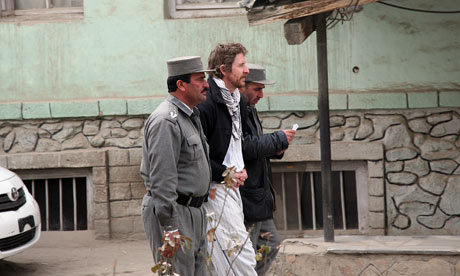
Former Australian soldier Robert Langdon escapes execution in Afghanistan

Robert Langdon (center) in Kabul
A former Australian soldier sentenced to 20 years in a notorious Afghan jail will be lucky to survive the term, his lawyer says.

But lawyer Stephen Kenny is hopeful his client Robert Langdon's punishment for murder will be reduced.

Langdon, 39, has been spared the death penalty after an appeal and a compensation payment and jailed for 20 years for shooting dead a colleague while protecting a supply convoy under attack from the Taliban in 2009.

Mr Kenny says 20 years in Pol-e-Charkhi jail is tantamount to a death penalty but he hopes further appeals may reduce Langdon's sentence.

"I am hopeful is all I can say," Mr Kenny told ABC News 24 on Thursday.

"The prison in Afghanistan is of course not as good as prisons in Australia - so 20 years in Pol-e-Charkhi in Kabul, you'd be very lucky to survive."

Mr Kenny said the death sentence was commuted after an agreement was settled with the victim's family to provide compensation, known as ibra, and for them to provide forgiveness to his client.

Langdon, from South Australia, was employed by US-based Four Horsemen International as a security contractor when he shot the Afghan security guard.

Mr Kenny said Langdon maintains he acted in self-defence and in fear of his life.

"It was a dispute about whether a convoy should remain in a particular area that Mr Langdon believed was quite dangerous, there were some further complicated reasons that I don't wish to comment on at this stage," he said.

The lawyer said Langdon regretted throwing a grenade into a truck afterwards, thus destroying evidence.

"He now regrets that he did not take the body with him but it was, in terms of destruction of trucks, a standard procedure used in insecure places in Afghanistan."

Mr Kenny has not seen Langdon since May when his client appeared worried and had lost a lot of weight.

Prime Minister Julia Gillard welcomed the fact that Langdon will not face the death penalty.

"We as a government, indeed as a nation, we are opposed to the death penalty," Ms Gillard told reporters in Perth.

"We intercede for Australians around the world who may face the death penalty and register our nation's strong opposition to it."

Consular officials visited Langdon in prison as late as December 28, one of 18 visits made by Australian embassy staff in Kabul as they facilitate visits and delivered supplies.

Langdon's family in South Australia declined to comment when contacted by AAP.

Source: AAP, January 6, 2011

Wednesday, January 5, 2011

Sacatides victim of drug ring, court told

Michael Sacatides (center)
An Australian man allegedly caught entering Bali with a large amount of the party drug ice concealed in his luggage has employed a defence similar to that used by convicted drug smuggler Schapelle Corby.

Michael Sacatides, 43, a kickboxing instructor who has been living in Thailand, was arrested at Bali's international airport on October 1 when customs officers found 1.7 kilograms of methamphetamine in a compartment in his suitcase.

Sacatides, who could face the death penalty if convicted, has denied that the drugs, worth an estimated $A390,000, belong to him.

The Sydney man's lawyer, Erwin Siregar, on Wednesday asked for the charges against Sacatides to be dropped, telling the court that he was the unwitting victim of a drug ring.

A similar defence was used by Corby, who is now serving 20 years for smuggling more than 4kg of marijuana into Bali in 2004. She was also represented by Siregar, who is being funded by Australian Legal Aid.

"The defendant's position is more ... victim of a drug syndicate, not as the real perpetrator, as been accused by the prosecutor," Siregar said on Wednesday.

Sacatides told investigators at the time of his arrest that he had borrowed the suitcase from an Indian associate, Akaleshi Tripathi, whom he knew from Bangkok where he had been living.

"The prosecutor's indictment has gone blurry and premature as the prosecutor was not careful enough in describing the events and mistakenly placed the defendant as someone who's suspected as perpetrator without further explanation on Akaleshi Tripathi's, alias Peter's, whereabouts or involvement," Siregar said.

He said authorities had been provided with an address for Tripathi in Bangkok but had failed to investigate the matter further.

Sacatides watched on intently during the proceedings before making a personal plea via a translator, asking for the court to dismiss the charges.

Three other Australians - Scott Rush, Andrew Chan and Myuran Sukumaran - are on death row in Bali's Kerobokan Prison over a 2005 attempt to smuggle more than 8kg of heroin from Bali to Australia.

Another six members of the so-called Bali Nine are serving sentences of between 20 years and life in prison over the plot.

The trial of Sacatides resumes on January 11.

Source: The Sydney Morning Herald, January 5, 2011