When I was the United States ambassador to the European Union (then the European Communities) in the late ’80s, as preparation for the advent of the euro was taking place, the crosscurrents were strong and visible. It couldn’t possibly succeed, as predicted by many, without a finance ministry for all of Europe, not possible then or foreseeable now.Spot on.
A real look at European debt, which is far greater than the narrowly reported official deficits, bodes badly. Bailouts are being affected by the imposition of rising and unsustainable interest rates. Just look at recent bond yields in Portugal, Ireland and Greece. And what will happen when more onerous austerity programs are initiated to meet new budgetary targets? Will the E.U. survive? Of course it will. It has succeeded in quelling thousands of years of internal warfare. But the euro and current E.U. structure — well, that’s another matter.
Showing posts with label austerity. Show all posts
Showing posts with label austerity. Show all posts
Friday, January 28, 2011
Eurotrashed
In a letter to today's International Herald Tribune, Former US ambassador Alfred Kingon summarises the situation facing the euro and the EU:

Monday, September 27, 2010
Taking their own advice?
 Finance Ministers meet today in Brussels to discuss proposals for strengthening the EU’s “economic governance”, spearheaded by European Council President Herman Van Rompuy and his “task force” on the subject (which so far has failed to convince member states). In parallel with whatever Van Rompuy and the Finance Ministers come up with, the Commission will on Wednesday table its proposals for various measures intended to pre-empt another sovereign debt crisis. These will include sanctions for countries which run unhealthy budget deficits .
According to German daily Die Welt, the Commission is also contemplating the introduction of a “warning system” to monitor wages in member states' public sectors. This is potentially hugely controversial stuff, depending on what the proposal looks like in the end. Marco Buti from the European Commission for Economic and Financial Affairs explains the rationale: "the wage development in the public sector does of course have a great influence on the economy".
Fair enough. However, although it's not entirely clear to us which EU institution will be in charge of deciding when public sector wages are posing a risk to the sustainability of the overall economy under the forthcoming proposal, if Mr. Buti sees the Commission in this role, he might be up against some resistance. Says Buti, "when wages in the public sector damage competitiveness and price stability then the country will be requested [by the Commission] to change this policy."
Problem is, the Commission isn’t exactly in the strongest moral position to give lectures to member states on public sector pay. EU officials’ salaries are already far higher than the majority of public servants in member states, and the Commission now wants to award its officials three pay rises by 2011, adding up to a pay hike of 5% – at a time when most member states are busy imposing pay freezes and deep cuts. The same reasoning can be applied to the Commission’s drive to make Europe’s various pensions systems more sustainable (including retiring later). Meanwhile, EU officials can retire at 63 with up to 70% final salary pensions, and many take early retirement.
It has been pointed out many times before – by Dan Hannan in the European Parliament last week for example – but it can never be repeated enough times: the mismatch between what the EU institutions preach on public finances and what they practice is mind-boggling.
If member states had the same pay and pension policies as the EU institutions, we fear that they would go bust in no time.
Monday, August 16, 2010
"Cutting" the budget - Brussels style
The media reported last week that EU member states have agreed to push for €3.6 billion worth of "cuts" to the EU budget for 2011, bringing the new total figure to €126.6 billion.
The BBC highlighted the news with the headline, "EU budget plans for 2011 cut by ministers". But just in case someone missed it, this is not really "cuts" in the sense that the EU's overall budget will be downsized. The "cuts" still represent a 2.9 percent increase from the budget for 2010, but a more modest increase than what the Commission's original proposal envisaged. Predictably, even this modest modification will be resisted by the Commission and the European Parliament, with a a spokesman for Budget Commissioner Janusz Lewandowski, saying: “It is not our intention to redo our numbers” (numbers which include a pay rise for the Commission and all other EU officials.)
We're eagerly awaiting the day when the word "austerity" enters the Brussels vocabulary.
The BBC highlighted the news with the headline, "EU budget plans for 2011 cut by ministers". But just in case someone missed it, this is not really "cuts" in the sense that the EU's overall budget will be downsized. The "cuts" still represent a 2.9 percent increase from the budget for 2010, but a more modest increase than what the Commission's original proposal envisaged. Predictably, even this modest modification will be resisted by the Commission and the European Parliament, with a a spokesman for Budget Commissioner Janusz Lewandowski, saying: “It is not our intention to redo our numbers” (numbers which include a pay rise for the Commission and all other EU officials.)
We're eagerly awaiting the day when the word "austerity" enters the Brussels vocabulary.
Monday, July 19, 2010
Home truths
A great report on EUobserver today features some very revealing comments by a, disappointingly, anonymous EU official about the "mushrooming" cost of the EU institutions, and their total disengagement from the debates going on across Europe about the need to cut government budgets, and improve value for money for EU taxpayers.
The official said:
"Austerity measures at the moment have yet to really set in, but in the autumn, this is going to be tangible, with salary and social benefit reductions, pension cuts. People will begin to feel it, and people will look at us and say: 'How is it that they are immune, they keep growing when we are having to cut back?' The number one issue should be to stop the mushrooming of the institutions. We don't need new institutions. There is a tendency to think every time there is a new problem, the EU can solve it with a new institution."
This sage official then goes on to promote another extremely sensible idea, one with which we have concurred before:
"We should also shut down the Economic and Social Committee and Committee of the Regions. These institutions were born when the parliament had no power, was not a factor. Now this is a duplication. There is no real need for these bodies."
He certainly gets our vote on that. It is a shame that the identity of this official is not shared, although he would certainly shoot any chance of career advancement in the foot with his outspoken comments which confirm many of the gripes people have with the EU institutions. Nonetheless, a few home truths such as these delivered to his colleagues might go a long way.
It also comes amid what is shaping up to be a fierce battle over the EU's 2011 budget. The Commission wants an increase of 6%, compared to the 2010 budget, while national ambassadors want to limit that to 2.8%, which one MEP branded 'offensive', and member states potentially want to push for actual cuts to the budget, i.e. the 2011 budget to be less than the 2010 budget.
A scandalous prospect to be sure, but regardless, let’s hope this wave of realism penetrates the mindset of a few more European politicians. After all, is it really so outrageous to suggest that there is more than a sliver of fat that could afford to be trimmed from the EU budget, or that employees of the European institutions cannot expect continuous rises to their salary and benefits while their compatriots working in member states hunker down for pay freezes and renegotiations of their benefits package?
The official said:
"Austerity measures at the moment have yet to really set in, but in the autumn, this is going to be tangible, with salary and social benefit reductions, pension cuts. People will begin to feel it, and people will look at us and say: 'How is it that they are immune, they keep growing when we are having to cut back?' The number one issue should be to stop the mushrooming of the institutions. We don't need new institutions. There is a tendency to think every time there is a new problem, the EU can solve it with a new institution."
This sage official then goes on to promote another extremely sensible idea, one with which we have concurred before:
"We should also shut down the Economic and Social Committee and Committee of the Regions. These institutions were born when the parliament had no power, was not a factor. Now this is a duplication. There is no real need for these bodies."
He certainly gets our vote on that. It is a shame that the identity of this official is not shared, although he would certainly shoot any chance of career advancement in the foot with his outspoken comments which confirm many of the gripes people have with the EU institutions. Nonetheless, a few home truths such as these delivered to his colleagues might go a long way.
It also comes amid what is shaping up to be a fierce battle over the EU's 2011 budget. The Commission wants an increase of 6%, compared to the 2010 budget, while national ambassadors want to limit that to 2.8%, which one MEP branded 'offensive', and member states potentially want to push for actual cuts to the budget, i.e. the 2011 budget to be less than the 2010 budget.
A scandalous prospect to be sure, but regardless, let’s hope this wave of realism penetrates the mindset of a few more European politicians. After all, is it really so outrageous to suggest that there is more than a sliver of fat that could afford to be trimmed from the EU budget, or that employees of the European institutions cannot expect continuous rises to their salary and benefits while their compatriots working in member states hunker down for pay freezes and renegotiations of their benefits package?
Tuesday, June 22, 2010
Austerity - but not for all
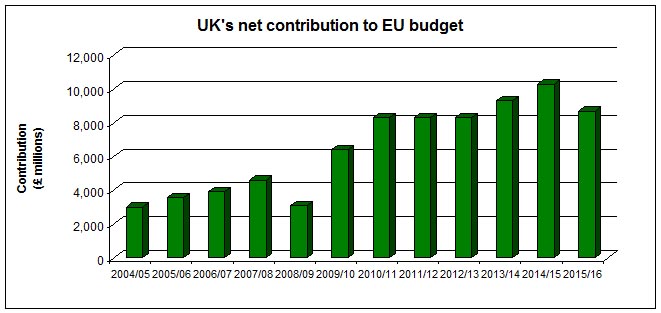 While today's emergency budget in the UK provided many talking points for the media at large – it also provided new information for those with an interest in the UK’s ever-increasing contribution to the European budget *(courtesy of one T.Blair).
Hopefully this graph should illustrate how sharply our contributions climbed last year, and will continue climbing until 2014/15 when the contribution will hit an estimated £10.3 billion – (no explanation as yet as to why it is then predicted to fall back in 2015/2016 as the contribution for that year is still to be negotiated - we suspect wishful thinking). In a decade, the UK's net contribution has therefore increased by around 230%.
While our exasperation at the poor hand Tony Blair negotiated in the 2005 budget deal has been well-documented – these figures are further evidence of that legacy.
As we move to contribute such increasingly vast sums to the EU budget, it should focus the Government, and the Commission, more than ever on obtaining real value for money.
The EU wastes a great deal of money – it’s budget is bloated and its financial management controls are not up to scratch. This much is undeniably true. But if examples of ridiculous EU spending were met with indignation amongst citizens before, they will jar all the more resolutely from now on. Spending cuts and austerity measures are now the order of the day, and the order of tomorrow. But this new order has escaped Brussels - as Bruno Waterfield points out on his EUobserver blog.
So the next time Jose Manuel Barroso, or any of the other EU elites, considers how best to win back public support for the European project, he might consider the public sector pay cuts in Ireland, or the VAT raises in the UK, or any of the other cuts around Europe, and think about how to reform the image that Brussels is bloated and isolated from the harsh realities in EU member states. And then he might actually do something about it.
(i.e. publicly backing reform to wasteful EU policies like the CAP, ending some of the outrageously generous perks for lifetime EU civil servants, a pay freeze for those same civil servants, backing calls for an end to the travelling circus - the list can be made very long - further suggestions are welcome in the comments).
(Source: 2010 June budget, p.102, 2009 Treasury Statement on EU public finances, p.21. Note: Figures for 2007/08 financial year, and all financial years previously, are based on calendar year outturns)
Subscribe to:
Posts (Atom)