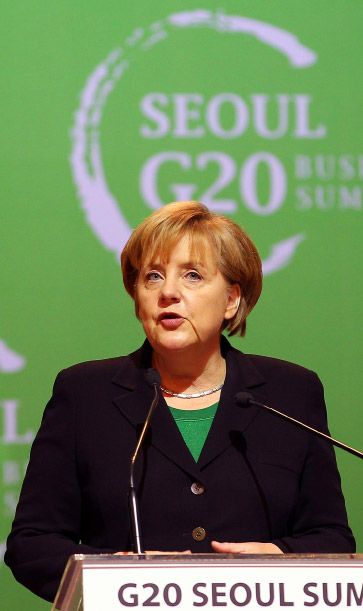
THE NEW YORK TIMES: SEOUL, South Korea — President Obama’s hopes of emerging from his Asia trip with the twin victories of a free trade agreement with South Korea and a unified approach to spurring economic growth around the world ran into resistance on all fronts on Thursday, putting Mr. Obama at odds with his key allies and largest trading partners.
The most concrete trophy expected to emerge from the trip eluded his grasp: a long-delayed free trade agreement with South Korea, first negotiated by the Bush administration and then reopened by Mr. Obama, to have greater protections for American workers.
And as officials frenetically tried to paper over differences among the Group of 20 members with a vaguely worded communiqué to be issued Friday, there was no way to avoid discussion of the fundamental differences of economic strategy. After five largely harmonious meetings in the past two years to deal with the most severe downturn since the Depression, major disputes broke out between Washington and China, Britain, Germany and Brazil.
Each rejected core elements of Mr. Obama’s strategy of stimulating growth before focusing on deficit reduction. Several major nations continued to accuse the Federal Reserve of deliberately devaluing the dollar last week in an effort to put the costs of America’s competitive troubles on trading partners, rather than taking politically tough measures to rein in spending at home.
The result was that Mr. Obama repeatedly found himself on the defensive. He and the South Korean president, Lee Myung-bak, had vowed to complete the trade pact by the time they met here; while Mr. Obama insisted that it would be resolved “in a matter of weeks,” without the pressure of a summit meeting it was unclear how the hurdles on nontariff barriers to American cars and beef would be resolved. >>> Sewell Chan, Sheryl Gay Stolberg and David E. Sanger | Thursday, November 11, 2010
THE NEW YORK TIMES: Obama Ends G-20 Summit With Criticism of China >>> Sewell Chan | Friday, November 12, 2010
THE TELEGRAPH: China believes its economic success reflects its superior culture.
The leaders of the G20 group of rich and developing nations met in Seoul this week for what might reasonably be described as their first post-crisis summit. But it also had the feeling of the first post-Western summit. China, the world’s second richest nation and its rising power, believes that the financial crisis was actually a “North Atlantic crisis”. Now that the worst of it is over, Beijing sees little reason to swallow the medicine for someone else’s sickness. The summit therefore broke up – none too amicably – without really addressing the trade imbalances that were one of the root causes of the crisis, or America’s worry that Beijing is gaining an unfair advantage by artificially keeping its currency weak. Instead, China flexed its muscles and got what it wanted: a watered-down statement that will not force it to change course. If President Obama hoped that the G20 would burnish his image as a world statesman after the disaster of the midterm elections, those hopes were disappointed.
It is inescapable that we are witnessing a historic shift of economic power from West to East. David Cameron has certainly taken this on board, judging by the caution with which he and his Cabinet members treated China during their visit earlier this week. The Prime Minister approached the subject of human rights far more obliquely than he did as leader of the Opposition. Whether this was wise judgment or a failure of nerve is difficult to say. Although China treats dissidents with gross inhumanity, the more it is lectured on the subject, the more intransigent it becomes. In a sense, that is convenient for Mr Cameron: if protesting about repression makes the situation worse, then Britain can concentrate on trade with a fairly clear conscience. Read on and comment >>> Telegraph View | Friday, November 12, 2010