Showing posts with label 1984. Show all posts

Wednesday, February 9, 2011

KAMAL NATH DENIED DIPLOMATIC IMMUNITY IN USA

This is really a step forward.  Kamal Nath does not have diplomatic immunity in the USA and Sikhs For Justice's (SFJ) case against him can go on as planned.  My understanding is that he is due for a pre-trial conference this Wednesday.


FROM:Tamil Daily News

February 6, 2011

Kamal Nath summoned by US court in 1984 Sikh riots case

By Arun Kumar

Washington,(IANS) Indian Urban Development Minister Kamal Nath has been summoned by a New York court for a pre-trial conference Feb 9 for his alleged role in the 1984 anti-Sikh riots.The trial will proceed as the US State Department has declined to intervene in the case due to the seriousness of allegations of human rights violation against Kamal Nath, according to Gurpatwant S. Pannun, legal advisor for Sikhs For Justice (SFJ), a US based human rights advocacy group.

After being summoned by the Southern district court of New York Dec 10, 2010, Kamal Nath had sought diplomatic immunity. His request for immunity has now been turned down by the State Department, Pannun said.

In April 2010, SFJ along with two individuals filed a law suit against Kamal Nath under Alien Tort Claims Act (ATCA) & Torture Victim Protection Act (TVPA) asking the court to order compensatory and punitive damages against the minister.

According to Pannun: “Alien Tort Claims Act of United State, the law under which trial against Kamal Nath will be held is specifically created to provide remedy and forum to victims of genocide to vindicate their complaints.”

The trial against Kamal Nath “is one such opportunity through which SFJ plans to put on the record of the court evidence related to genocide of Sikhs and Kamal Nath’s role in it,” he said.

Plaintiffs have asked for a “jury trial” and will have the right to call upon survivors and experts on genocide as witnesses to prove that systematic killing of Sikhs in November 1984 was genocide as defined in Article 2 of the UN Convention on Genocide.

Responding to Kamal Nath’s comment that “no case has been filed against him in India during past 26 years”, Pannun said Nath’s argument is absurd because if a case is not filed against a criminal, it does not mean that he has not committed the crimes.

SFJ and victims of November 1984 riots also plan to launch a campaign in India asking Prime Minister Manmohan Singh to sack Kamal Nath from his cabinet position for his alleged involvement in attack on Gurdawara Rakab Ganj Sahib in Delhi, Pannun said.

More than 3,000 people were killed in various clashes across north India during the riots that followed the assassination of then prime minister Indira Gandhi Oct 31, 1984.
(Arun Kumar can be contacted at arun.kumar@ians.in)

This YouTube video is from last year;  I include it because it contains a lot of useful information and it is always interesting to see actual tapes of accused.


Tuesday, June 1, 2010

Storming The Temple, a video

This video is primarily about the attach on Darbar Sahib and the events and conditions leading up to it.

I can't say I agree with everything in it, but it in more balanced than most.  I do wish that  SaintSoldiers would move their logo so we could read the subtitles.

From The History Channel.  In English.


Monday, May 31, 2010

Blue Star Massacre Widget.


I have made this widget - also in the sidebar to the right - to commemorate the shaheeds of the Bluestar Massacre.


Bluestar Massacre Widget
If you would like to add it to your blog/website, the code can be found at:

 http://sites.google.com/site/thanksandchardikala/0-bluestar-massacre-widget

Copy/paste that into your site's html. To put it in the sidebar, add it as a gadget using the Javascript/html.

While you're there, feel free to look through that website.  I set it up to thank the people in my life who need thanking.  That most certainly includes you, my faithful readers.   The pages are meant to be read in order and start at the home page:  Thanks, Gurufateh and Chardi Kala. 

Friday, May 21, 2010

CHARGES BROUGHT AGAINST SAJJAN KUMAR!

We have been trying for this for a long, long time.  Here is the release I received this morning.  A nice thing to see in my inbox.   Now, Step One is complete.  I will be keeping a close eye on this.  In the meantime, you might like to friend Sikhs For Justice in Facebook. 


Sikhs Justice May 20 at 9:45am

The sustained struggle for Justice by victims of November 1984 Sikh Genocide, Human Rights Advocacy group Sikhs For Justice and All India Sikh Student Federation (AISSF) bore fruit when a Delhi Court ordered framing of charges against Congress Leader Sajjan Kumar for his role in killing of Sikhs during the November 1984 Sikh Genocide. The charges will be framed under Murder; Looting, Dacoity and Robbery; Spreading enmity between communities; Violation of curfew orders, Arson, burning of Gurudwara and burning of Houses. Additional Sessions Judge Sunita Gupta allowed CBI's plea seeking prosecution of Sajjan Kumar under various sections of Indian Penal Code after finding prima facie evidence against him. Besides Sajjan Kumar, the other accused in the case are Balwan Khokhar, Mahender Yadav, Maha Singh, Capt Bhagmal, Santosh Rani, Girdhari Lal and Krishna Khokhar.
This case relates to killing of five Sikhs in Delhi Cantonment area by a mob led by Sajjan Kumar and other accused during the November 1984 Sikh Genocide. On the basis of recommendations of Justice Nanavati Commission, this case was entrusted to CBI in 2005 for further investigation/ reinvestigation against Sajjan Kumar and other accused. The investigation and the case against the accused would have closed for lack of evidence if it had not been for the efforts of the Human Rights Advocacy group Sikhs for Justice and AISSF who brought forward and (held the arm) of star witnesses like Jagdish Kaur, Nirpreet Kaur, Jagsher Singh, Sheila Kaur to testify against the powerful politicians. Sikhs For Justice and AISSF even arranged for the investigation agency to be taken to Amritsar where the statement of the witnesses were recorded. It was after testimonies of these important witnesses that the CBI filed chargesheet against the accused.
Sikhs for Justice and AISSF are pursuing a legal battle in Indian courts to get punished those guilty of killing Sikhs during the November 1984 Sikh Genocide in India. Sikhs for Justice has established a legal team which is headed by Advocate Kamna Vohra along with Advocate Navkiran Singh Advocates have also been appointed to represent the CBI including Senior Advocate Mr. RS Cheema, Mr. DP Singh and Mr. Y.P. Saxena.

Senior advocate Mr. HS Phoolka who is representing the victims of the Genocide since last 25 years said that the framing of the charges will pave for trial in the case. The Delhi High Court had earlier issued direction to complete the trial within six months of cases relating to November 1984 Sikh Genocide. The trial will be held on day today basis.
Advocate Kamna Vohra appearing for the victims stated this is a very important development and she is very hopeful that the perpetrators of the November 1984 Sikh Genocide will be punished.
Attorney Gurpatwant S Pannun, Legal Advisor of Sikhs for Justice stated that as a human rights advocacy group we have completed our task by locating and bringing the witnesses forward and now it is upto the Indian Judiciary to bring the cases to their logical conclusions and punish the perpetrators of the Genocide. He stated that the hopes of the victims and all others are now pinned on the Indian Judiciary.
AISSF President Karnail Singh Peermohammed stated that though delayed, he is hopeful that justice will be done. He stated that the wounds of the Sikh community will be healed only after the killers of the Sikhs are punished by law.
In January 2010, CBI filed two charge sheets against Sajjan Kumar for his role in the November 1984 massacre of Sikhs. The chargesheets pertained to killing of seven Sikhs in Sultanpuri, North-West Delhi and killing of five Sikhs in Delhi Cantonment in November 1984.
The charges in this case will be formally framed in the court on May 24, 2010.
The Sikhs for Justice legal time is currently pursuing 32 Appeals involving 98 accused in Delhi High Court and 3 Appeals against acquittal of accused at the Supreme Court of India.
Newspaper Coverage:
http://news.outlookindia.com/printitem.aspx?682688
http://www.dnaindia.com/india/report_cbi-alleges-sajjan-kumar-incited-mob-during-84-riots_1385521
http://www.ptinews.com/news/661453_CBI-alleges-Sajjan-incited-mob-during--84-riots
http://www.indianexpress.com/story-print/621108/

Photograph from The Hindu 16 February 2010

Tuesday, May 18, 2010

"I AM I, MANI SINGH!"

I am on hiatus, but this story just begs to be told.  So much tragedy on our last trip to India.  It wasn't all tragedy, though.  There were some funny moments that have tended to become lost amidst the blood and guts and glory.  This is one such moment. 
****************************************
Twenty-six years ago almost to the day, three very weary Sikhs landed in the Delhi International Airport.  The three, a man of 43, a woman of 34 and a boy of 13, really just wanted some quiet sleep after two days air journey from Montreal.  We three, of course.  I'm sure we looked less tired than we actually were.  Mani and Sandeep were both in bana, I was wearing a red silk Punjabi suit.  We looked very, very Sikh.  Mani was his usual 188cm (6 ft, 2 in) self, straight back, striding through the airport as if he owned it.  Sandeep - with a beginner's mustache, quite attractive and a few stray strands of hair on his chin, already taller than his 152 cm (5 ft.) mother - and I  trotted along beside him. Neither Mani nor I of us had been to India since the summer of 1969 and we didn't know what we would find.  It was Sandeep's first visit.  We knew, of course, about the tensions between us Sikhs and Indira's government and were very much aware of -  and supporters of - the Khalistan Movement.  We had even hoped that we might somehow be able to meet Sant Jarnail Singh Bhindranwale ji.   Still we were unprepared for the feeling of coldness, even slight hostility toward us.  Nothing we could quite put our fingers on, but definitely something unpleasant in the air.

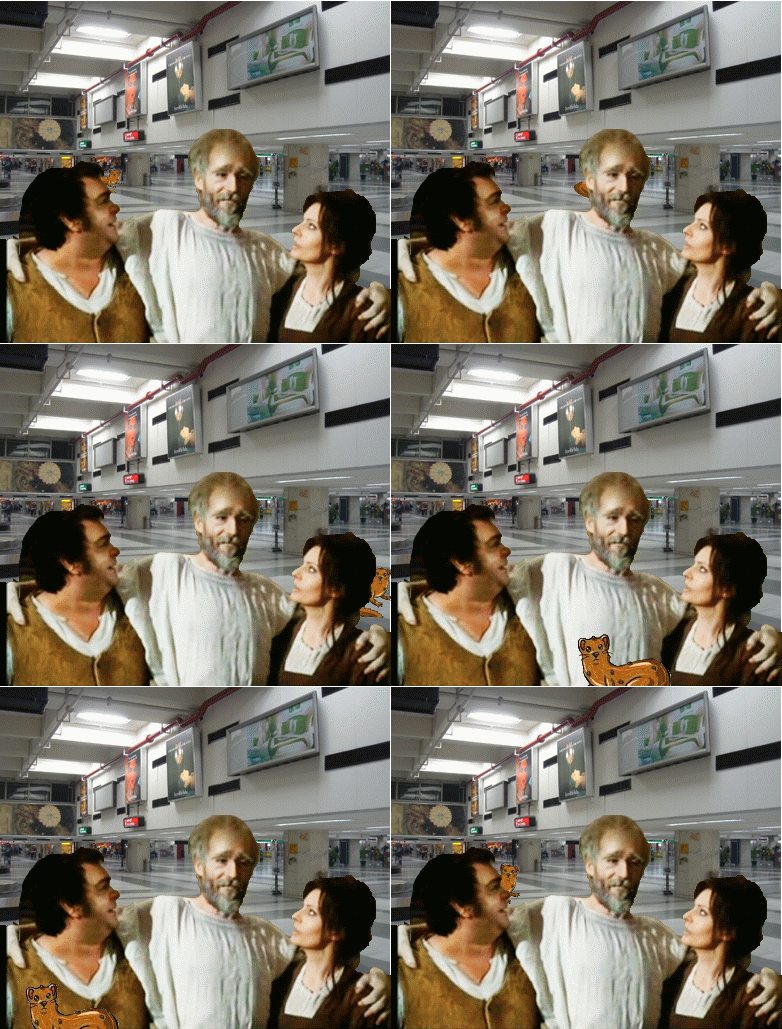
As we walked quickly through the airport, a weaselly little Hindu kept running alongside us barely able to keep up, jabbering on and on about, "It's 12 o'clock, Sardar."  No ji.


It was a bit annoying, but we ignored it and just kept going.  Finally, the gnarly weasel stepped directly in front of Mani.  I have to say this about the little creep, he had guts.  "He looked up at Mani, directly into his eyes, and said, "What do you think you're going to do?  Who do you think you are, anyway?"  Or something very close to that.  I gasped;  even Sandeep was taken aback.  I knew Mani was tired and might well lose his temper.  His left hand was on the hilt of kirpan and a scowl was on his face.  The weasel seemed to relise that he had made a mistake.  Others, too, noticed what was going on, and our immediate environment became very quiet.


This, of course, is not us.  Mani and Sandeep had turbans and I bear little resemblance to the luminous Sophia Loren


Mani was Mani.  He threw back his head and began singing, very loudly,


Oh the trumpets of glory
Now call me to ride,
Yes, the trumpets are calling to me,
And wherever I ride,
Ever staunch at my side
My squire (one arm around Sandeep's shoulders)
and
my lady(the other arm around my shoulders)
shall be!
I am I, Don Quixote
The Lord of la Mancha

We caught on and joined him in the song:

Our destiny calls and we go!
And the wild winds of fortune 
Shall carry us onward,
Oh, whithersoever they blow,
Whithersoever they blow,
Onward to glory we go!

By now, the weasel was groveling in front of us, shaking, obviously terrified.

But Mani wasn't finished.  He tossed back his head and bellowed:

BOLEEEEEEE SO NIHAAAAAAAL!!!!

For a split second, I was about as scared as the weasel , half expecting the cops to roughly arrest us or possibly herd us on the next plane back to Canada.  Nothing could have prepared me for what actually happened.

Loudly, from all sides, came the response,
SAT SHRI AKAAAAAAAAAAAL!!


Mani gave a last look of contempt at the little Hindu, by now just quivering jelly on the floor and tossed a coin at him.  

 Sandeep, very quietly, whispered at him, "Khalistan Zindabad."  I have often wonder how this whole incident sounded when told from his point of view.


We continued on through the airport, singing loudly that we were all Don Quixote, the Lord of La Mancha going onward to glory.

Even at the time, it felt like being in a very silly Bollywood movie.  Looking back, it seems even funnier than it was at the time.  I guess it could have gotten very serious if the officials had decided to make an incident out of it, but someone was watching over us, I guess, and there were no bad repercussions, just a lot of giggles.

So those of you who know me well and have heard me burst out with "I am I, Don Quixote..." for no apparent reason now know the rest of the story.

The section with that contains the "I Am I" song  that we sang starts 2:11 at in the following video, the song itself starts at 8:52 (fortunately, Mani did not drop dead while singing).  Please listen and imagine the three of us and the weasel at the airport.:


The video is from the 1972 movie, The Man of La Mancha, which I highly recommend.  The song, "The Impossible Dream" has been an important part of my life since I first heard it.  The woman who plays my part is the very lovely Sophia Loren at the height of her beauty.


"What is illness to the body of a Knight Errant?
What matter wounds?
He rises where he has fallen and 
WOE TO THE WICKED!!"

Thursday, November 12, 2009

Regain Our Chardi Kala!


We have been remembering our wounds and pain now for a long time. Twenty-five years is a long time in the life of an individual. It is right and proper and necessary that we remember. We will never forget. Those of us who lived through it, whose loved ones were brutally murdered carry a special pain. We will never get over it. We will - we have - however learned to live with it.

Life goes on.

I remember the song written after the terrorist attacks (?) of September 11,2001, "Where Were You When the World Stopped Turning"? A touching title, but the world didn't stop turning. It goes on and on, around and around.

Our search for justice continues. We will continue our demands, loudly and persistently, until those guilty of genocide against us face the rope or until we ourselves are dead. This does not need to be said. We cannot and will not forget.

Life goes on.

We want Khalistan. We need Khalistan. The way our neighbours, the very people we have been defending and protecting for hundreds of years, turned on us in 1984 underlines this fact. We have the right of every people to self-determination. We are not unreasonable. We demand only that India live up to the promises made to us when we agreed to support them at the time of Independence.

So...

Let's move a step further. What is this Khalistan we will build for ourselves? I see a land of rivers and streams, rolling hills of wheat, beautiful prosperous farms, crowned by clean, elegant cities. I see Amritsar a city worthy of our glorious Harimandir Sahib, with pristine blue skies and pure, clean air.

I see an end to the ecological disaster that has overtaken and threatens to destroy Punjab. I see ourselves reversing the desertification of the land of our Gurus, of our land. I see our groundwater restored, I see the water of our rivers restored to us.


I see a land of joy and happiness. I see a people strong and prosperous and healthy in body, mind and spirit. I see us treating each other with love and respect, all vestiges of castism thrown into oblivion where they belong. I see all of us living as sisters and brothers, both sexes treated - and valued - equally as our Gurus have taught us. I see a land where all people are welcomed in the old Punjabi tradition. I could go on.

Am I dreaming? Of course I am! We need our dreams. We need to remember who we are and what we are. We need to remember where we have been - the proud moments and the painful - and we need to move forward. Is this practical? Probably not. But everyone who knows me has heard me say things like "Practicality is overrated." All great dreams are impractical.. Great people move beyond that and accomplish what seems to be impossible. This will not be easy, but worthwhile projects are rarely easy.

Can we do this? Of course we can IF we become the people are Gurus taught us to be, if we become real Sikhs, real Khalsa. Think about it. Dream with me and let us move forward to claim what is rightfully ours, spiritually and materially.

Before I start sounding less like a Khalsa and more like a motivational speaker, let me leave you with a song that we can sing together as we move forward in chardi kala!


http://www.youtube.com/watch?v=oa7frloKmVQ&feature=PlayList&p=59B837E3E86872AD&index=1

Friday, October 16, 2009

A NOT COMPLETELY RANDOM MEMORY

This time of year, I tend to get a bit retrospective and remember those little things from a long time ago that give life its texture and meaning.

One night while we were planning what turned out to be our last trip to India, Mani and I got to talking about the places we wanted to visit someday. After we got past Saturn and the Andromeda Galaxy (we both thought that being realistic was overrated),


I was a bit surprised that one of his dreams was to see the Great Pyramid of Giza and the Sphinx. As he knew my interest in Japan, he was less surprised to hear of my yen to visit the deer garden in Nara, Kyoto. We both agreed that our Sikhling really should
see the Great Wall of China, so that was on the list, as well.


Our flight to and from India was already booked, with a few days spent in Paris on the way back. Mani and I had been there in 1982, where we surreptitiously slipped my Dad's ashes into the Seine, but Sandeep had been left in Montréal. The current difficulties we Sikhs are having notwithstanding, everyone ought to visit Paris once in their life.


I remember we were sitting on big beanbag chairs in our family room. I was sitting up and Mani was reclining, head in my lap. His magnificent hair was lose and I had been playing with it, wrapping it around a wrist, when he looked up at me and asked, "If you could be anywhere in the world right now, where would you be?"

I didn't even have to think about that one. "I'm perfectly happy right where I am."

I never saw him look happier. "You know, that's the sentence every man wants most to hear from his wife. More even than that she loves him. If his wife is perfectly happy, he is a success whatever else might be true."


That was in April, 1984.

Friday, October 2, 2009

1984 VIDEO


I think the less said about this video, the better. Especially note our brother and sister from about 3:10 to 4:20.

FORGET?! WHO ARE THEY KIDDING?


And then they cannot understand our desire for self-determination.


Tuesday, September 22, 2009

KIVEN BHULAAN - A VIDEO


THE DIRECTORS


I do not want to say too much about this entry made by Japman Kaur, age 12 and Triman Singh of Windsor, Ontario, Canada. I'll just say that their Gian Kaur is expressing openly the feelings that I keep unexpressed, close to my heart for 25 years.

Please go vote for this video at:

http://www.sikhnet.com/filmfestival/2009/kivein-bhullaan-how-do-we-forget/

It's worth the trip!


Saturday, September 12, 2009

Pres. Obama's 911 Address


My dear brothers and sisters,

I wrote this and hesitate to post it in the tribute to 911 - it's hardly a tribute - but having written it, I would like to share it with you. I had not intended to write a 9/11 post this year, but reading Pres. Obama's speech, I was struck by the similarities. Read on and you'll see what I mean. Pres. Obama's words are in regular print; my revisions are in italics.

**************************

I have said elsewhere that 31 October-4 November 1984 was my 9/11. I ask your forgiveness for my slight rewriting of the beginning of Pres. Obama's speech....

We start with President Obama's opening words.

Eight years ago, on an ordinary Tuesday morning, nearly 3,000 lives were lost in the deadliest attack on American soil in our history.


Twenty-five years ago, on an ordinary Wednesday morning, more than 3,000 lives were lost in the deadliest attack on the Sikh people in centuries.


It was an event that forever changed the life of this city. And it was a tragedy that will be forever seared in the consciousness of our nation.


It was an event that should forever change the life of Delhi. And it was a tragedy that should be forever seared in the consciousness of the Sikh nation.


Every year on this day, we are all New Yorkers.


Every year on these days, Indians should all imagine themselves Sikhs.


We pause to remember the victims, to grieve with the families and friends of those who died, and to honor the heroes of that day and each day since who have sacrificed to save lives and serve their country.


We pause to remember the victims, to grieve with the families and friends of those who died, and to honor the heroes of those days and each day since who have grieved their loved ones sacrificed at the alter of hatred and prejudice.


We will never forget the images of planes vanishing into buildings; of billowing smoke rolling down the streets of Manhattan; of photos hung by the families of the missing.


We will never forget the images of turbanned men running in circles with burning tyres around their necks as the mobs jeered; of billowing smoke rolling down the streets of Trilokpuri; of photos hung by the families of the missing.


We will never forget the rage and aching sadness we felt.


We will never forget the rage and aching sadness we felt.


And we will never forget the feeling that we had lost something else: a sense of safety as we went about our daily lives.


And we will never forget the feeling that we had lost something else: a sense of safety as we went about our daily lives.


The memory of those images and that vulnerability reminds us of the real and present danger posed by violent extremists who would use terrorism against Americans at home and around the world.


The memory of those images and that vulnerability reminds us of the real and present danger posed by violent extremists who would use terrorism against Sikhs at home and around the world.


Sunday, June 7, 2009

6 June 1984-2009 If Ye Break Faith...


Another sleepless night. I had not intended to write a special post for 6 June this year, as there are so many others. Last night, however, as I lay awake, some thoughts came to me that I feel the need to share.

Again I saw the billowing clouds of smoke rising from Akaal Takht, choked on the acrid air, gagged at the smell of blood and decomposing bodies.


After Sohila, as I was logging off, this very famous picture flashed for a moment on my monitor:


and a poem that I learned in elementary school came into my mind:


In Flanders Fields

In Flanders fields the poppies blow
Between the crosses [and Khandas!], row on row,
That mark our place; and in the sky
The larks, still bravely singing, fly
Scarce heard amid the guns below.

We are the dead. Short days ago
We lived, felt dawn, saw sunset glow,
Loved, and were loved, and now we lie
In Flanders fields.

Take up our quarrel with the foe:
To you from failing hands we throw
The torch; be yours to hold it high.
If ye break faith with us who die
We shall not sleep, though poppies grow
In Flanders fields.


— Lt.-Col. John McCrae (1872 - 1918)


[For the story of the poem and its historical context, click on the title]

I saw the saffron turbans of the shaheeds as those poppies growing "in Flanders fields" and thought about the meaning of those turbans and the kes they protected. I considered the meaning of our kes.


I know this is a topic that has been beaten to death, and you may well be sick and tired of it. Please indulge me and read on. My husband and son and other family members achieved their shaheedi protecting and honouring that kes; I am left alive to speak for them.

"If ye break faith with us who die
We shall not sleep."


Those are haunting words, aren't they?

Is not dishonouring your kes breaking faith with these brothers who lie dead a mere 25 years ago? Please think about this, think very deeply. Does their sacrifice not serve as an inspiration to honour them by keeping your hairs unshorn? Is it really such a big sacrifice for you to keep your hairs, for my brothers to refrain from cutting and shaving, to tie a turban and walk proudly in the shadow of our Gurus? Is it really such a big sacrifice for you to keep your hairs, for my sisters to refrain from plucking and threading your eyebrows, for refusing to shave the hairs of your legs and underarms and "bikini line." We are all familiar with the picture of the scalping of Bhai Taru Singh, blood pouring over his body from his bleeding head. (If you aren't, here it is:)


Our mothers and fathers, our sisters and brothers, our daughters and sons, have willingly become sacrifices for this part of our bodies we Sikhs hold sacred. If it really is a sacrifice, is it not a sacrifice worth making?

"If ye break faith with us who die..."

Please, if you have kept kes and are considering shearing it, on this Day of Remembrance, think of this great sacrifice of our beloved shaheeds and make your own much smaller sacrifice.

"If ye break faith with us who die..."

And, if you have kept kes in the past and have stopped, today is a good day to reconsider. Words such as mona and patit are easily thrown around, I know, and I have found few Sikhs who want these words applied to them. These words can be left behind. Our hairs are very forgiving. Cut them or shave them, they grow back. Pluck them - it takes a bit longer, and they still grow back. Shearing is a deed that can, to a great extent, be undone.

If ye break faith with us who die..."


If you have never kept kes, today would be a good day to start. Yes, I know your friends, colleagues, co-workers might think you eccentric, strange, even silly, you might face ridicule and lack of understanding, it won't be easy. What in life that is worth accomplishing is easy? And who ever said being a Sikh is easy?

So...please consider the meaning of kes and start today becoming a "visible Sikh" in the tradition and footsteps of our Gurus, our sants and our shaheeds. Tie a turban today. You do not have to wait until your hair are long to do so. If you don't know how, go to your nearest gurudwara; I guarantee that there are those who will be delighted, overjoyed to teach you. And, yes, this applies to girls/women as well as boys/men.

If you are still not inspired - or even if you are - take about ten minutes and watch this:


http://www.youtube.com/watch?v=rnWcEOYR3lE

From Raj Karega Khalsa

This Shabad is by Guru Nanak Dev Ji in Raag Raamkalee on Ang 941 of Dhan Dhan Sri Guru Granth Sahib Ji Maharaj:

The Gurmukh lives in Fear of the True Lord.
The Guru's Bani refines the unrefined of the Gurmukh.
The Gurmukh sings the Lord's Immaculate Praises.
The Gurmukh attains the pure, supreme status.
The Gurmukh meditates on the Lord with every hair of his body.
O Nanak, the Gurmukh merges in Truth. The Gurmukh is pleasing to the True Guru; this is contemplation on the Vedas.
Pleasing the True Guru, the Gurmukh is carried across.
Pleasing the True Guru, the Gurmukh receives the spiritual wisdom of the Shabad.
Pleasing the True Guru, the Gurmukh comes to know the path within.
The Gurmukh attains the unseen and infinite Lord.
O Nanak, the Gurmukh finds the door of liberation.


And while we are at it, think of the blood of our shaheeds that was spilled on this day, the blood that turned the water of our sacred sarovar red, the blood that the army soldiers told our sisters and daughters to drink to quench their thirst, think of their blood, then go to the gurudwara sahib and give some of yours so that others can live.

Saturday, May 16, 2009

BLUESTAR MASSACRE: Lest We Forget


This arrived in my inbox today and I thought to share it with all of you, my dear readers.

Tuesday, April 21, 2009

In Gratitude To jagdish tytler

Why is jagdish tytler apologising? What does he have to apologise about? After all, he - in his own words-


"actually abused the governor as he was enjoying his drink while the carnage was on."


Let us rather express our gratitude at all he and those of his ilk have done for us.


They gave our husbands, sons, fathers, brothers, and sometimes, our wives, mothers and, daughters, as well as our good friends, the opportunity to achieve shaheedi in righteous battle.


They gave our women - our mothers, sisters, daughters and friends - the opportunity to overcome the effects - emotional and physical - of being beaten and gang-raped. They even gave some of our women the opportunity to widen the gene pool by bearing children thus conceived.


They gave our widows the opportunity to show their chardi kala by raising their children with few or no possessions and no male breadwinner and without the love and comfort of a husband.


They gave our children the opportunity to show their strength and intelligence by growing up without a male role-model in the home, without stability or security. He gave our children the opportunity to learn to turn to drugs (including alcohol) in an attempt to handle these things missing in their lives.


(NO PICTURE HERE. I REFUSE TO SHOW A TURBANED SIKH SHOOTING DRUGS )

He gave our whole community the opportunity to show the world that Sikhs are strong and resilient and refuse to stop seeking justice no matter how many times we are slapped down, humiliated, laughed at and blamed.


In light of all this, perhaps he shouldn't be apologising to us; perhaps we should apologise to him for wanting to see him hanging from the business end of a rope.


APOLOGY NOT ACCEPTED


--
WHY TRY TO FIT IN? YOU WERE BORN TO STAND OUT!

Sunday, April 19, 2009

When A Big Tree Fell

A BIG TREE FALLS ON THE SIKHS 2

I first read this article in the blog Seriously Sandeep, after being referred to it by Amrit Hallon's Writing Cave. I thank Sandeep Ji for reprinting this article. However, I must take issue with one of his statements:


only 4000+ Sikhs died.


Only 4000+ Sikhs died. ONLY 4000+ Sikhs died. ONLY 4000+ SIKHS DIED. I will not here dispute the 4000+ figure - although I think the "+" is very pluss indeed. I dispute that "only." It is not "only" if the dead are your family, the people you love. I'm sure he didn't realise how cold that "only" is to those of us who survived.


He further writes, "Read it and weep." I write, Read it and remember.


Please read all of this article. It is difficult reading, grueling, and it is necessary for all of us - Sikhs or not - to know this informastion. For those of us who are Sikhs, it is vital.


Kanchan Gupta


Manmohan Singh and Congress suffer from selective amnesia as they rake up the 2002 Gujarat violence to malign the BJP. But even if they choose to forget the 1984 pogrom that left more than 4,000 Sikhs dead, the story remains fresh in the minds of many, among them survivors waiting for justice for 25 years


Caught on the wrong foot over the brazen manner in which it tried to absolve Jagdish Tytler and Sajjan Kumar of the serious charges that have been levelled against them by survivors of the 1984 pogrom that resulted in the slaughter of 4, 733 Sikhs, the Congress has struck back at its principal political adversary, the BJP, by once again raising the bogey of the 2002 post-Godhra violence in Gujarat.


Addressing a Press conference in Mumbai on Monday, Prime Minister Manmohan Singh, who would like people to believe that he was "not informed, not consulted, over the CBI's clean chit to Jagdish Tytler" although that is an impossibility, has said, "Nor will I be found wringing my hands in frustration while one of my Chief Ministers condones a pogrom targeted at minorities."


Ironically, even as the Prime Minister was seeking to resurrect the Gujarat 'pogrom' and remind people of the 'atrocities' committed against Muslims, the Special Investigation Team set up by the Supreme Court and headed by former CBI director RK Raghavan submitted its report, refuting the allegations that have sustained the myth-making aimed at demonising Mr Narendra Modi and tarring the BJP's image.


The SIT's report shows Mr Singh's description of the Gujarat violence as a "pogrom targeted at minorities" is as fanciful as his denial of any knowledge about the CBI exonerating those who are accused of leading murderous mobs during the 1984 violence, planned and executed by Congress 'leaders' to avenge the assassination of Mrs Indira Gandhi. Noted writer and veteran journalist Khushwant Singh, recalling those terrible days of 1984, told the Nanavati Commission of Inquiry, set up by the BJP-led NDA Government, that the hideous bloodletting left him "feeling like a Jew in Nazi Germany".


It is possible that Mr Manmohan Singh has no memories of that massacre; selective amnesia is a disease from which too-clever-by-half politicians tend to suffer. It is also possible that he and his patrons in the Congress believe that by pretending nothing of note happened in 1984, those born after Congress mobs ran amok on the streets of Delhi, garlanding Sikhs with burning tyres, can be persuaded to vote for a party which claims to stand against the BJP's 'divisive politics'.


Such sanctimonious self-righteousness is best avoided by the Congress, not least because its then president — and India's Prime Minister — Rajiv Gandhi had no qualms about justifying the carnage. "Some riots took place in the country following the murder of Indiraji," Rajiv Gandhi said on November 19, 1984, even as thousands of families grieved for their loved ones killed by Congress hoodlums, "We know the people were very angry and for a few days it seemed India had been shaken. But when a mighty tree falls, it is only natural that the earth around it does shake a little." Some riots? Only natural? Shake a little?


Of course, Mr Singh would claim no knowledge of any of this. Perhaps he would even insist that he was "not informed, not consulted" by Rajiv Gandhi, or, for that matter, the mobs that bayed for blood (and feasted on it) for four days before someone called the Army in.


Twenty-five years is a long time. Public memory is notoriously short and it is unlikely those who have attained the right to vote in these 25 years would know what the protest against the Congress deciding to give party tickets to Jagdish Tytler and Sajjan Kumar is all about. It would, therefore, be in order to recall the chain of events lest we be persuaded to believe that nothing of consequence happened by a Prime Minister who spends sleepless nights worrying about a terror suspect held in distant Australia but blithely disowns responsibility for the shocking attempt to whitewash the crimes of his party and its 'leaders' committed against thousands at home.


So, here is the story, briefly told, of how more than 4,000 Sikh men, women and children were slaughtered; in Delhi alone, 2,733 Sikhs were burned alive, butchered or beaten to death. Women were raped while their terrified families pleaded for mercy, little or none of which was shown by the Congress goons. In one of the numerous such incidents, a woman was gang-raped in front of her 17-year-old son; before leaving, the marauders torched the boy.


For three days and four nights the killing and pillaging continued without the police, the civil administration and the Union Government, which was then in direct charge of Delhi, lifting a finger in admonishment. The Congress was in power and could have prevented the violence, but the then Prime Minister, his Home Minister, indeed the entire Council of Ministers, twiddled their thumbs.


Even as stray dogs gorged on charred corpses and wailing women, clutching children too frightened to cry, fled mobs armed with iron rods, staves and gallons of kerosene, AIR and Doordarshan kept on broadcasting blood-curdling slogans like 'Khoon ka badla khoon se lenge' (We shall avenge blood with blood) raised by Congress workers grieving over their dear departed leader.


In mid-morning on October 31, 1984, Mrs Indira Gandhi was assassinated by two Sikh guards posted at her home. Her death was 'officially' confirmed at 6 pm, after due diligence had been exercised to ensure Rajiv Gandhi's succession. By then, reports of stray incidents of violence against Sikhs, including the stoning of President Zail Singh's car, had started trickling in at various police stations.


By the morning of November 1, hordes of men were on the rampage in south, east and west Delhi. They were armed with iron rods and carried old tyres and jerry cans filled with kerosene and petrol. Owners of petrol pumps and kerosene stores, beneficiaries of Congress largesse, provided petrol and kerosene free of cost. Some of the men went around on scooters and motorcycles, marking Sikh houses and business establishments with chalk for easy identification. They had been provided with electoral rolls to make their task easier.


By late afternoon that day, hundreds of taxis, trucks and shops owned by Sikhs had been set ablaze. By early evening, the murder, loot and rape began in right earnest. The worst butchery took place in Block 32 of Trilokpuri, a resettlement colony in east Delhi. The police either participated in the violence or merely watched from the sidelines.


Curfew was declared in south and central Delhi at 4 pm, and in east and west Delhi at 6 pm on November 1. But there was no attempt to enforce it. PV Narasimha Rao, the then Home Minister, remained unmoved by cries for help. In his affidavit to the Nanavati Commission of Inquiry, Lt-Gen Jagjit Singh Aurora, decorated hero of the 1971 India-Pakistan war, said, "The Home Minister was grossly negligent in his approach, which clearly reflected his connivance with perpetrators of the heinous crimes being committed against the Sikhs."


The first deployment of the Army took place around 6 pm on November 1 in south and central Delhi, which were comparatively unaffected, but in the absence of navigators, which should have been provided by the police and the civil authorities, the jawans found themselves lost in unfamiliar roads and avenues.


The Army was deployed in east and west Delhi in the afternoon of November 2, more than 24 hours after the killings began. But, here, too, the jawans were at a loss because there were no navigators to show them the way through byzantine lanes.


In any event, there was little the Army could have done: Magistrates were 'not available' to give permission to fire on the mobs. This mandatory requirement was kept pending till Mrs Indira Gandhi's funeral was over. By then, 1,026 Sikhs had been killed in east Delhi. Jagdish Tytler and Sajjan Kumar were among Congress 'leaders' who, witnesses said, incited and led mobs. Both deny the allegation, but the evidence is overwhelming.


A report on the pogrom, jointly prepared by the PUCL and PUDR and published under the title, Who Are the Guilty? names both of them along with others. The report quotes well-known journalist Sudip Mazumdar: "The Police Commissioner, SC Tandon was briefing the Press (about 10 Indian reporters and five foreign journalists) in his office on November 6, at 5 pm. A reporter asked him to comment on the large number of complaints about local Congress MPs and lightweights trying to pressure the police to get their men released. The Police Commissioner totally denied the allegation… Just as he finished uttering these words, Jagdish Tytler, Congress MP from Sadar constituency, barged into the Police Commissioner's office along with three other followers and on the top of his voice demanded, 'What is this Mr Tandon? You still have not done what I asked you to do?' The reporters were amused, the Police Commissioner embarrassed. Tytler kept on shouting and a reporter asked the Police Commissioner to ask that 'shouting man' to wait outside since a Press conference was on. Tytler shouted at the reporter, 'This is more important.' The reporter told the Police Commissioner that if Tytler wanted to sit in the office he would be welcome, but a lot of questions regarding his involvement would also be asked and he was welcome to hear them. Tytler was fuming…"


The slaughter was not limited to Delhi, though. Sikhs were killed in Gurgaon, Kanpur, Bokaro, Indore and many other towns and cities in States ruled by the Congress. In a replay of the mayhem in Delhi, 26 Sikh soldiers were pulled out of trains and killed.


After quenching their thirst for blood, the mobs retreated to savour their 'revenge'. The flames died and the winter air blew away the stench of death. Rajiv Gandhi's Government issued a statement placing the death toll at 425!


Demands for a judicial inquiry were stonewalled by Rajiv Gandhi. Human rights organisations petitioned the courts; the Government said courts were not empowered to order inquiries. Meanwhile, Rajiv Gandhi dissolved the Lok Sabha and went for an early election, which the Congress swept by using the 'sympathy card' and launching a vitriolic hate campaign.


Once in office, Rajiv Gandhi was desperate for a breakthrough in Punjab. He mollycoddled Akali leader Sant Harchand Singh Longowal into agreeing to sign a peace accord with him. Sant Longowal listed a set of pre-conditions; one of them was the setting up of a judicial commission to inquire into the pogrom.


Thus was born the Ranganath Misra Commission of Inquiry, which took on the job of crafting a report that would suggest extra-terrestrials were to be blamed for whatever had happened. Worse, submissions and affidavits were passed on to those accused of leading the mobs; some of these documents were later recovered from the house of Sajjan Kumar. Gag orders were issued, preventing the Press from reporting in-camera proceedings of the Commission.


For full six months, Rajiv Gandhi refused to make public the Ranganath Misra Commission's report. When it was tabled in Parliament, the report was found to be an amazing travesty of the truth; neither were the guilty men of 1984 named, now was responsibility fixed.


Subsequently, nine commissions and committees were set up to get to the truth, but they were either disbanded midway or not allowed access to documents and evidence. India had to wait for the report of the Nanavati Commission for an approximate version of the real story.


Justice Nanavati's report said, "The Commission considers it safe to record its finding that there is credible evidence against Jagdish Tytler to the effect that very probably he had a hand in organising attacks on Sikhs." This is not an indictment, Mr Manmohan Singh and his Government decided, so why bother about it? Four years later they remain unrepentant, their attitude remains unchanged.


Two thousand seven hundred and thirty-three men, women and children killed in Delhi, another 2,000 killed elsewhere, scores of women raped, property worth crores of rupees looted or sacked. Families devastated forever, survivors scarred for the rest of their lives.


But the Congress doesn't care!


The Picture: I read someone saying, "When that big tree fell, did it only fall on Sikhs?" The short answer is, "Yes." I saw a picture in that statement. I made it and here it is.


--
WHY TRY TO FIT IN? YOU WERE BORN TO STAND OUT!

Saturday, April 11, 2009

Warriors In The Temple - 9 April 1984

Twenty-Five Years Ago, Yesterday


I came across this story, quite by accident while looking for a picture for another project. This was published 2 months before the Bluestar Massacre. An interesting perspective, eh?
My comments are in (parentheses and italics).


By LAURA LÓPEZ and DEAN BRELIS


WARRIORS IN THE TEMPLE

Time, New Delhi, Apr. 9, 1984


Photo: Bhindranwale, with entourage at the Darbar Sahib complex (also known as the Golden Temple complex), Amritsar

Sikhs and Hindus engage in frenzied clashes

In normal circumstances, entering the Golden Temple at Amritsar, Punjab, the holiest of Sikh shrines, is a serene and majestic experience. Over the past few weeks, however, the temple has become a formidable fortress. Religious symbols mix with modern rifle muzzles, automatic weapons, swords and battle-axes. Even women are armed, and some children as young as five have daggers hanging from their belts.

The Sikhs, a sect (sic) of 12 million that broke with Hinduism at the end of the 15th century, are known equally for being charitable hosts and aggressive warriors. Today they seem solely the latter, as they are preparing for what may be the battle of their lives. (Not to mention the battle FOR our lives) Their increased demands for political and religious autonomy in the Punjab and their use of violence to enforce those demands have made them virtual enemies of the government and the Hindus who once lived peacefully in their midst. The Sikhs have become a grave concern for Prime Minister Indira Gandhi. Says a senior Indian official: 'It is the greatest, most volatile crisis this government has faced since the days of partition.'

Resistance to Sikh militancy from Hindus in the Punjab and the neighboring state of Haryana has raised the latest violence to alarming levels. Within the past two months, at least 88 people have died and almost 250 have been wounded in frenzied clashes. In one instance, Sikh extremists threw a grenade into a Hindu religious festival in Amritsar. Three people were killed, 51 injured. The Hindus quickly became an outraged mob, charging the police and accusing them of favoring the Sikhs. Unable to contain the crowd with their long bamboo poles, police opened fire with tear gas and finally, in desperation, with bullets. Before the riot was over, the crowd had burned and looted many Sikh shops and smashed to bits Sikh-owned scooters and bicycles. (Just a foreshadowing of things to come in November.)

Ever since India's independence in 1947, the Sikhs claim, they have faced discrimination. (And still do.) Before then they had enjoyed preferential treatment in the armed forces and civil services, and were given special representation in elected bodies. With independence, those privileges were lost, and the Sikhs became politically subservient to the Hindu majority. (It seems to me, the problem was that we refused to become subservient to anyone. We were insisting on the government keeping the promises made before independence, when the Hindu majority needed our help.) Soon they began agitating for their own state. In 1966 they were given Punjab by the federal government. (An outright lie! If we had been "given Punjab by the federal government," we would have raised out flag, formed our government and lived in peace with India.)Although that state has India's richest, most fertile land, the Sikhs still felt their portion was too small compared with that of neighboring Haryana, the state created at the same time for the Hindus. Therefore, the Akali Dal Party, the political arm of the Sikhs, began an insistent drumbeat of peaceful protest. In 1973 the Akalis passed a resolution setting out various religious and political demands, among them that Punjab's capital, Chandigarh, be made a Sikh capital exclusively, and Amritsar a holy city.

Two years ago, an extreme right-wing (Extreme right-wing? Fascist? I've been called many things in my life, some of them uncomplimentary, but never right-wing or fascist. In fact, I have most often been called things like "dirty pinko commie.) Sikh faction emerged, thus turning the protest aggressive and radical. Its fanatical leader, Sant Jarnail Bhindranwale, (It strikes me as strange that first they call him "Sant," then "fanatical.")36, (So young. So strong. So pure.) now commands at least 1,000 armed followers from the most sacred room of the Golden Temple. Hindus have begun to fear that the demands of the more heavily armed Sikhs will be met as Bhindranwale's movement gains momentum. Even when Gandhi assured them that they would not be let down, Hindus organized to combat the Sikh threat. (Had the Hindu leaders kept their promises, there would have been no "Sikh threat"! Do I detect a tone of prejudice or bias here?)

In mid-February Hindus in Haryana staged then-most violent assaults yet. A mob of 5,000 quickly grew to 8,000, attacking however many Sikhs they could find. In one instance half a dozen Sikh prisoners were held immobile and their beards and hair shorn as Hindus hooted and yelled. 'There goes your hair power,' cried out one Hindu demonstration leader, referring to the Sikh belief that spiritual power derives from long hair. (Not exactly. Notice how they try to make us sound silly and superstitious?)Their heads shaved to the scalp, faces no longer covered with luxuriant beards, Sikhs lay in the street, blasphemed, humiliated and scorned. Blasphemed and scorned, to be sure, but not humiliated. No one can be humiliated without their own consent. I'm sure these brothers never consented to be feel humiliated.)

Last week, in an atmosphere of anarchy, Gandhi's government imposed harsh measures of its own. In clashes between police and terrorists in New Delhi, the Punjab and Haryana, at least eight people were killed and 36 wounded. After five moderate Sikhs were assassinated by radical members of the sect, the government ordered the arrest of 1,225 young Sikh fanatics (read Amritdhari) across the country who were suspected of sabotage and planning insurrection. To quell further uprisings, the government increased military patrols on all railroad lines and highways, bringing the total number of security forces assembled in Punjab and Haryana to 50,000.

Gandhi first moved forces in to surround the Golden Temple in early March, in an attempt to isolate Bhindranwale and stop Sikh provocations. It is unlikely, however, that Gandhi would decide to move them inside. By doing so, she would risk committing a sacrilege that all Sikhs, moderate and radical, would find intolerable. (She did and we did and she ended up executed by our beloved shaheeds, Beant Singh Ji and Satwant Singh Ji.) Since Sikhs make up 25% of the armed forces and hold key command positions, Gandhi does not wish to provoke them any more than necessary. Last weekend, in a bold bid for reconciliation, she established a committee to draft an amendment to the constitution that would define the Sikhs as a separate religion. Sikhs immediately responded to the new development by calling off the burning of 100,000 copies of the Constitution, which they had scheduled for this week. At last a breakthrough seemed possible. (Possible? I guess it didn't turn out that way.)

(Until reading this story I really didn't realise how prejudiced against us the Western press, in this case, Time Magazine, a respected news magazine was.)

(And that's the way it was, Monday, 9 April 1984, as we were preparing our trip to India. It was, of course, the last time we were to celebrate my birthday and our anniversary.)