In conversations with several of these developers the conversation would inevitably lead to tablets and whether they planned on offering services for the iPad, which had just been announced by Apple. "Yes, of course" was always the answer, but since then few of these mobile app developers actually launched tablet apps for their media client.
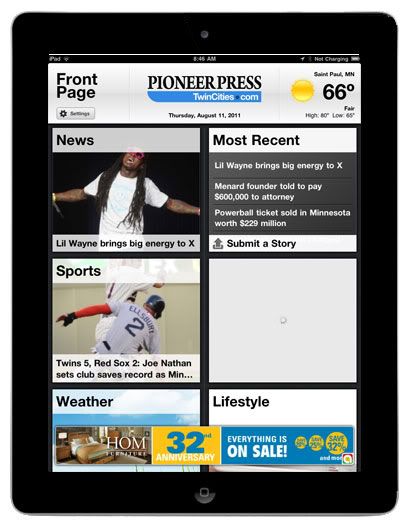
One that has just done that is DoApp, the Minneapolis-based developer that has over 200 iPhone apps currently in the App Store. Yesterday the company launched nearly a dozen universal apps for its media clients: Lowell Sun News, St. Paul Pioneer Press, The Gazette, NBC 4, WTMJ-TV, WCAX Mobile Local News, Vail Daily Mobile Local News, KTNV Mobile Local News, LancasterOnline, 8 News Now|KLAS-TV and WCCO Mobile Local News.
In its press release to announce the new apps, DoApp does not hold back on its opinion of these new apps.
"We started from scratch on the front and back end design of our iPad solution," Wade Beavers, DoApp’s CEO, said in the company's release announcement. "This is definitely not a refresh of our Mobile Local News design for smart phones, it’s a completely new experience. We focused on usability and user experience to create a great product, elegantly taking advantage of the metaphors and screen size offered by the iPad."
"Our new iPad product is a huge step forward in the consumption of news on a mobile device," said DoApp founder Joe Sriver. "The experience developed for our readers is nothing less than stunning. The initial reaction to our new iPad product has been tremendously positive. Our design and usability stands head and shoulders above anything else in the news industry."
The app released so far all free to download and offer the content free-of-charge, as well. The apps offer the easy navigation which includes attractive navigation animation that looks a lot like that being used in Lion.
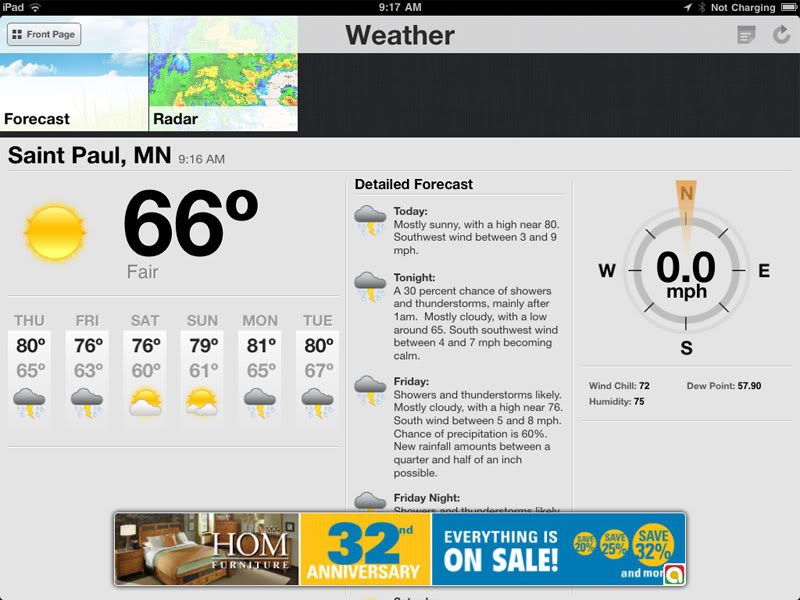
Each of the apps I looked at also have a banner ad along the bottom that floats over the content itself. In each case, it appears that the advertising is from a network which I assume to be DoApp's own Adagogo.
And it is at this point that you begin to sense the issues involved with these apps. Like the mobile apps from DoApp, they are all identical. There is absolutely zero variation in look that I could detect, each app using the same box design that is kind of a poor man's Flipboard. This kind of design could have been created using any number of out-of-the-box app design companies such as RedFoundry or any number of others.
The advantage of this approach, of course, would be that when you are finished with your app it would appear in the App Store under your name as you would have created your own Apple Developer account.
In the case of these apps, they are all appearing under the DoApp name – great branding for DoApp, but not for the publisher.
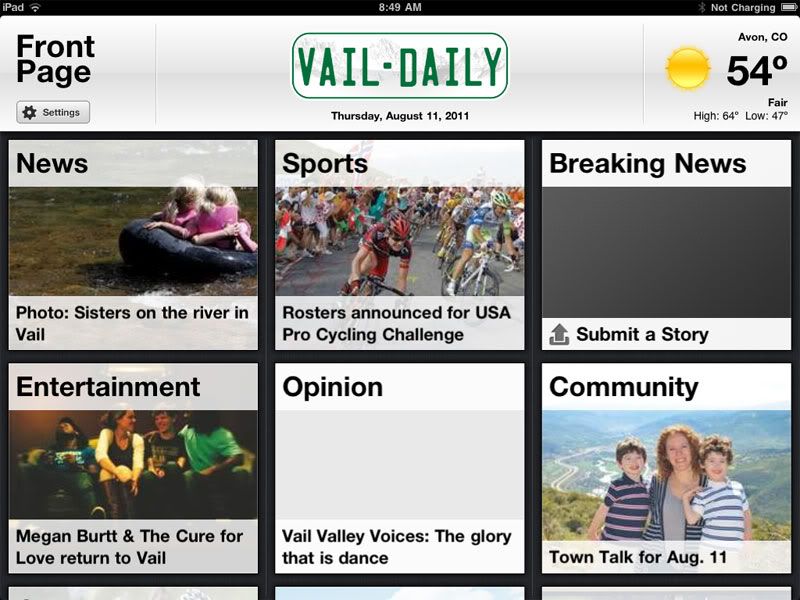 | 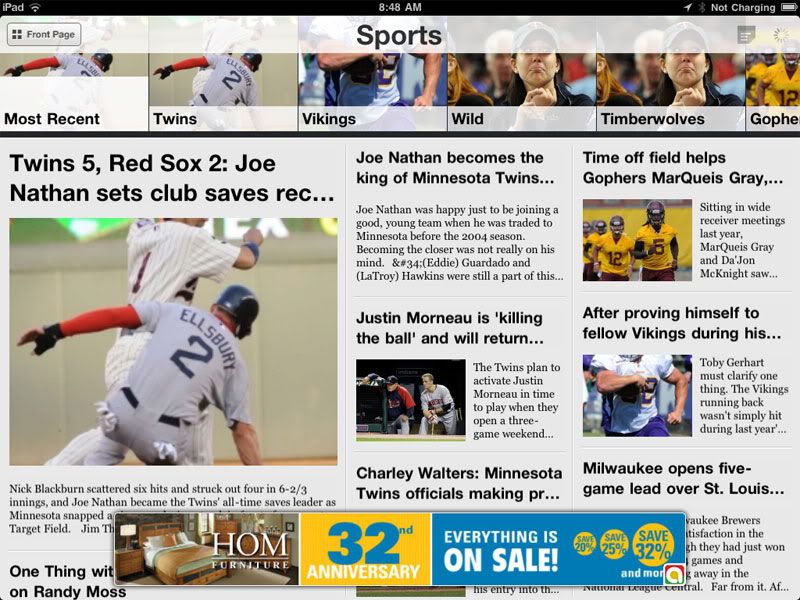 |
So if you look at the Pioneer Press app, for the MediaNews Group owned newspaper, and the WCCO app, for the CBS Local Media owned app, one gets confused as to which app you are looking at – especially true today because both news organizations are featuring the same AP story.
Most importantly, these kinds of apps really limit a publishers options. One can't, for instance, use Apple's in-app subscription services because you, as the publisher, are not the "seller". You can't charge for the app, again for the same reason. And you can't (apparently) sell local advertising.
The purpose of these apps seem to be to create an ad network for the developer, because of this I have to assume that these apps are free for the publisher. If not, well, I don't even want to speculate.
Back in the early part of last year good, solid mobile apps were the gold standard. But today the real need in media is to create sound business models. That means revenue streams that include income for circulation, national and local advertising, and classifieds (though few media apps are exploring this area). It also means branding and marketing. Lastly, I also think it means building in-house capabilities, even if the media company is working with outside firms.
I really think these kinds of apps are a step backwards, not forwards. Each of these media properties are locked in a box. Now whether you think that box is attractive, and worth the price of admission is up each decision maker.
 |  |


No comments:
Post a Comment