Now that the Lisbon Treaty is safely in force (as of yesterday) the Lib Dems have predictably abandoned their support for a referendum on Britain's EU membership.
The tactic to support such a referendum was nothing more than a pathetically transparent and feeble attempt to get them off the hook for abandoning their manifesto commitment to a referendum on the Constitutional Treaty. Pretending to favour giving people a referendum that was never on the cards, the Lib Dems shamefully teamed up with Labour to block calls for referendum on the Treaty as it went through Parliament last year.
Safely over that hurdle, Nick Clegg can now ditch the dishonesty and go back to what he really believes - which is that the British public should never be given a say on the EU of any kind.
Wednesday, December 2, 2009

Avoiding the issue
Within the next year, the UK Government (whoever it will be) will find itself in crucial negotiations over the next EU 'financial framework', which will decide who pays what into the EU budget over the period 2014 to 2020.
You will remember that Tony Blair sealed the deal on the current financial framework (2007 to 2013) back in December 2005, giving up £7 billion of our rebate in return for what turned out to be an empty promise about reform of the CAP. Cheers Tony.
In order that we don't make the same mistake again, politicians of all colours need to be thinking carefully about a new way of negotiating, and what exactly we want from the talks.
So it was good to see the Tories trying to raise the subject with the Government in Parliament yesterday. Unfortunately, Europe Minister Chris Bryant wasn't remotely interested in discussing the issue. This is despite the fact that the huge problems with the EU budget go right to the heart of many people's criticism of the EU. We desperately need to start talking sensibly about what it is the Government and also the Opposition intend to do about the budget.
But instead we get:
Philip Davies (Con): Given that the accounts of the EU have not been signed off by the auditors for 15 years running, why do the Government keep giving more and more money to the EU? Surely if the Government are serious about reform of the EU budget, they should say that the EU will not get a penny more from the British Government until it gets its accounts properly audited.
Chris Bryant: The hon. Gentleman knows perfectly well that if we were to follow his policy, which is to get out of the EU, it would significantly harm British interests. He knows perfectly well, too, that, as the director general of the British Chambers of Commerce, David Frost said only a few weeks ago: "Business", by which he meant British business, "wants a pragmatic approach to the EU, not an ideological one" such as the hon. Gentleman's.
Great - thanks for that.
This follows the Government's refusal to publish forecasts for how much the UK will pay into and get out of the EU budget beyond 2010-2011, following a request by David Heathcoat-Amory MP. How can we possibly formulate a strategy for negotiating a better deal for British (and indeed European) taxpayers if the Government won't acknowledge there's a problem, won't engage in the debate, and won't even let us know how the land will lie in a year's time?
You will remember that Tony Blair sealed the deal on the current financial framework (2007 to 2013) back in December 2005, giving up £7 billion of our rebate in return for what turned out to be an empty promise about reform of the CAP. Cheers Tony.
In order that we don't make the same mistake again, politicians of all colours need to be thinking carefully about a new way of negotiating, and what exactly we want from the talks.
So it was good to see the Tories trying to raise the subject with the Government in Parliament yesterday. Unfortunately, Europe Minister Chris Bryant wasn't remotely interested in discussing the issue. This is despite the fact that the huge problems with the EU budget go right to the heart of many people's criticism of the EU. We desperately need to start talking sensibly about what it is the Government and also the Opposition intend to do about the budget.
But instead we get:
Philip Davies (Con): Given that the accounts of the EU have not been signed off by the auditors for 15 years running, why do the Government keep giving more and more money to the EU? Surely if the Government are serious about reform of the EU budget, they should say that the EU will not get a penny more from the British Government until it gets its accounts properly audited.
Chris Bryant: The hon. Gentleman knows perfectly well that if we were to follow his policy, which is to get out of the EU, it would significantly harm British interests. He knows perfectly well, too, that, as the director general of the British Chambers of Commerce, David Frost said only a few weeks ago: "Business", by which he meant British business, "wants a pragmatic approach to the EU, not an ideological one" such as the hon. Gentleman's.
Great - thanks for that.
This follows the Government's refusal to publish forecasts for how much the UK will pay into and get out of the EU budget beyond 2010-2011, following a request by David Heathcoat-Amory MP. How can we possibly formulate a strategy for negotiating a better deal for British (and indeed European) taxpayers if the Government won't acknowledge there's a problem, won't engage in the debate, and won't even let us know how the land will lie in a year's time?
It's going to get a whole lot worse
In a speech yesterday David Cameron cited Open Europe's recent report which showed that the UK has spent more than £35 billion complying with EU employment, health and safety law in the last decade.
What he didn't mention, is the report's even more important findings that if the problem of EU regulation isn't tackled, EU social and employment laws will cost a further £71 billion over the next decade, even in the highly unlikely event that no more regulations are added to the rulebook in this time.
In our view, the Conservatives should negotiate a blanket opt-out from all the social and employment related articles in the EU treaties, and bring control over these laws back to the UK, where we can scrap, amend or fine tune them to the needs of our own economy.
What he didn't mention, is the report's even more important findings that if the problem of EU regulation isn't tackled, EU social and employment laws will cost a further £71 billion over the next decade, even in the highly unlikely event that no more regulations are added to the rulebook in this time.
In our view, the Conservatives should negotiate a blanket opt-out from all the social and employment related articles in the EU treaties, and bring control over these laws back to the UK, where we can scrap, amend or fine tune them to the needs of our own economy.
Millions of Cell Phones Shut Down in India
INDIA: India has blocked services to at least 20 million cell phones because of concerns about security.

The government took the action Tuesday, which was the deadline for owners of the inexpensive, mostly Chinese-made cell phones to purchase additional equipment or face the loss of phone services.
India says the targeted phones lack International Mobile Equipment Identification (IMEI) - a 15 digit number that allows calls to be traced. Indian intelligence agencies have warned that militants could use the untraceable phones to launch attacks.
Consumers flocked to stores Monday to purchase the equipment needed to install the IMEI number on their phones.
In late October, the government banned the use of pre-paid mobile phone connections in the volatile Indian-controlled part of Kashmir. The government also cited security concerns for the ban.
source: http://www1.voanews.com/
The government took the action Tuesday, which was the deadline for owners of the inexpensive, mostly Chinese-made cell phones to purchase additional equipment or face the loss of phone services.
India says the targeted phones lack International Mobile Equipment Identification (IMEI) - a 15 digit number that allows calls to be traced. Indian intelligence agencies have warned that militants could use the untraceable phones to launch attacks.
Consumers flocked to stores Monday to purchase the equipment needed to install the IMEI number on their phones.
In late October, the government banned the use of pre-paid mobile phone connections in the volatile Indian-controlled part of Kashmir. The government also cited security concerns for the ban.
source: http://www1.voanews.com/
Le origini delle religioni : Islam ( Parte 9 )

Come già detto , il sacro testo musulmano è il Corano , ed è stato scritto in nome di Allah ( Dio ) e rappresenta la sua parola divina e infallibile sulla terra . Il libro è diviso in centoquattordici capitoli , detti sure , che trattano di morale , di come comportarsi adeguatamente e di come servire Dio nel migliore dei modi.
Detto questo , ha proposito della credenza secondo la quale l'Islam non predica l'odio contro i non musulmani , leggiamo queste sure :
[2:193 ] Combatteteli finchè non ci sia più persecuzione e il culto sia ( reso solo ) ad Allah . Se desistono , non ci sia ostilità , a parte contro coloro che predicavano ( quelli che sbagliano politeisti , indù ) .
[3:118 ] Non sceglietevi confidenti al di fuori dei vostri , farebbero di tutto per farvi perdere .
[5:51 ] Non sceglietevi per alleati i giudei e i nazareni . In verità Allah non guida un popolo di ingiusti ( politeisti , indù ) .
[60:1 ] Non prendetevi per alleati il Mio nemico e il vostro , dimostrando loro amicizia , mentri essi non hanno creduto alla verità che vi è giunta .
[60:13 ] Non prendetevi per alleati gente contro la quale Allah è adirato ( gli ebrei , puniti per aver idolatrato il vitello d'oro ) .
Dopo questo piccolo assaggio del Corano in quanto libro "santo" , andiamo ad analizzare chi è l'uomo che c'è dietro .
Benchè Maometto fosse un uomo di poca cultura , egli dettò il Corano a una serie di segretarie personali che ricordarono le sue parole e le scrissero , in alcuni casi , anche generazioni dopo la morte .
Proprio il fatto che Maometto non fosse un uomo colto è uno dei principali motivi per cui i musulmani credono che egli sia stato un profeta divino : come avrebbe fatto a scrivere poesie così belle , se non fosse stato lo stesso Allah a parargli ? Ma se Dio avesse veramente voluto dare un messaggio di salvezza , perchè si sarebbe rivolto a un uomo che sapeva a malapena scrivere ? Perchè Dio non ha scelto una persona colta e istruita come suo rappresentante sulla terra , invece ?
I musulmani dimenticano che Maometto magari aveva scarsa cultura , ma non era certo uno stupito . Infatti quando il profeta dell'Islam venne apparentemente avvicinato da Dio nel 610 a.C. , egli era un mercante di successo e quindi sarebbe stato capace di comporre delle poesie da solo .

Al di là del linguaggio poetico il Corano riporta alcune interessanti , seppur semplici , nozioni scientifiche e cosmologiche e contiene anche alcune teorie evoluzionistiche : per esempio la teoria secondo la quale il mondo non è piatto , che l'universo in espansione è nato da una esplosione , che la vita umana è venuta dal mare , e anche che esiste una vita extraterrestre . Tuttavia la descrizione dei primi stadi della vita umana nel grembo materno ( l'essere umano sarebbe prima argilla , poi grumo di sangue , poi parassita e infine << una cosa masticata >> ) è piuttosto ingenua . Di sicuro Dio avrebbe potuto descrivere la propria creazione con termini medici più esatti .
La cosa triste è che , come ben sa chi ha letto anche un minimo dell'antica scienza filosofica greca , poco di quello che è scritto nel Corano non è stato già detto dai greci . Inoltre , considerando che gli arabi hanno a cuore gli insegnamenti di Aristotele , il loro amore per la filosofia greca e l'ovvia influenza che ha avuto su di loro sono cose risapute . é un peccato allora che i musulmani abbiano dimenticato queste parole di Aristotele << Platone mi è caro , ma ancora più cara mi è la veirtà >> .
Al di là del fatto che il Corano sia stato o meno influenzato dalle incredibili scoperte dei filosofi greci come Aristotele , sfortunatamente questo libro finisce per uniformarsi alla Bibbia per quanto riguarda il concetto di "ira di Dio" : anche qui è presente infatti un creatore onnipotente che distribuisce punizioni e ricompense a destra e a manca , e il cui comportamento non dovrebbe lasciare nessun dubbio ai lettori scettici riguardo il fatto che l'Islam è una religione creata dall'uomo , proprio come tutte le altre .
Fiji to challenge Games ban
FIJI: Fiji will appeal its exclusion from the 2010 Commonwealth Games to the Court of Arbitration for Sport in Switzerland.

Vidya Lakhan, head of the Fiji Association of Sports and National Olympic Committee, said on Tuesday the decision taken at the Commonwealth Heads of Government Meeting in Trinidad to ban Fiji from next year's Games in New Delhi was "disappointing".
"We reiterate our position and that is that we see CHOGM's stance in this matter as political interference in sports," Lakhan said. "We will now take our case to the Court of Arbitration for Sport and this is our last straw.
"The decision made there will stand and we will all have to abide by it."
Commonwealth leaders meeting in Trinidad on Monday confirmed a decision to suspend Fiji over the failure of the military-led government of Commodore Frank Bainimarama to meet timelines for the restoration of democracy.
A spokesman for Prime Minister Bainimarama said Fiji's exclusion from the 2010 games was an inappropriate way to achieve the Commonwealth's aims.
"We hope that the Commonwealth will reconsider this decision," Permanent Secretary to the Prime Minister's Office, Pio Tikoduadua said. "They should not mix politics with sports. This is not helping in finding solutions to our problems."
Lakhan said he had three legal opinions which suggested Fiji had a strong case for reinstatement to the Commonwealth Games and he would be filing papers with the Court of Arbitration for Sport within two weeks.
"I would suggest that they (CHOGM) get into communication with the IOC and learn how sports and politics are separate," he told Radio New Zealand.
"Politicians are playing their game and of course their intention is to deprive athletes of opportunities. I guess politicians are only good at depriving people of opportunities."
Bainimarama seized power in a December 2006 coup and Fiji was suspended from the Commonwealth on September 1 when his government backed down on pledges to hold elections by 2010.
A CHOGM communique said the decision to suspend Fiji from the Commonwealth Games was in line with principles under which "sporting ties are inseparable from the values of the association."
Australian foreign minister Stephen Smith said the ban was reversible if Fiji met Commonwealth demands.
"There's one very quick way for Fiji to get itself back into the Commonwealth and to go for example to the Commonwealth Games and that's to have an election and return democracy, respect for human rights and respect for the rule of law to Fiji," Smith said.
source: http://news.smh.com.au/breaking-news-sport/fiji-to-challenge-games-ban-20091201-k2df.html
Vidya Lakhan, head of the Fiji Association of Sports and National Olympic Committee, said on Tuesday the decision taken at the Commonwealth Heads of Government Meeting in Trinidad to ban Fiji from next year's Games in New Delhi was "disappointing".
"We reiterate our position and that is that we see CHOGM's stance in this matter as political interference in sports," Lakhan said. "We will now take our case to the Court of Arbitration for Sport and this is our last straw.
"The decision made there will stand and we will all have to abide by it."
Commonwealth leaders meeting in Trinidad on Monday confirmed a decision to suspend Fiji over the failure of the military-led government of Commodore Frank Bainimarama to meet timelines for the restoration of democracy.
A spokesman for Prime Minister Bainimarama said Fiji's exclusion from the 2010 games was an inappropriate way to achieve the Commonwealth's aims.
"We hope that the Commonwealth will reconsider this decision," Permanent Secretary to the Prime Minister's Office, Pio Tikoduadua said. "They should not mix politics with sports. This is not helping in finding solutions to our problems."
Lakhan said he had three legal opinions which suggested Fiji had a strong case for reinstatement to the Commonwealth Games and he would be filing papers with the Court of Arbitration for Sport within two weeks.
"I would suggest that they (CHOGM) get into communication with the IOC and learn how sports and politics are separate," he told Radio New Zealand.
"Politicians are playing their game and of course their intention is to deprive athletes of opportunities. I guess politicians are only good at depriving people of opportunities."
Bainimarama seized power in a December 2006 coup and Fiji was suspended from the Commonwealth on September 1 when his government backed down on pledges to hold elections by 2010.
A CHOGM communique said the decision to suspend Fiji from the Commonwealth Games was in line with principles under which "sporting ties are inseparable from the values of the association."
Australian foreign minister Stephen Smith said the ban was reversible if Fiji met Commonwealth demands.
"There's one very quick way for Fiji to get itself back into the Commonwealth and to go for example to the Commonwealth Games and that's to have an election and return democracy, respect for human rights and respect for the rule of law to Fiji," Smith said.
source: http://news.smh.com.au/breaking-news-sport/fiji-to-challenge-games-ban-20091201-k2df.html
Taiwan to fight for reasonable treatment at Climate Conference
TAIWAN: Taiwan will continue to strive for "reasonable treatment" at the upcoming Climate Conference in Copenhagen, Denmark, after the meeting's organizers ignored Taiwan's national sovereignty and treated the country as part of China, an environmental official said Monday.

"Although a similar situation has existed for years, Taiwan will continue to try (for a breakthrough)," said Envir-onmental Protection Administration (EPA) Minister Stephen Shu-hung Shen.
Taiwanese organizations taking part in the conference, slated for Dec. 7-18, have been classified as being part of China on the official United Nations Framework Convention on Climate Change (UNFCCC) Web site, prompting objections from Taipei.
Though it is not a member of the United Nations, Taiwan hopes to be treated as fairly as it was in May at the 62nd World Health Assembly, in which it took part as an observer under the name of "Chinese Taipei," Shen said.
It marked the first time in 38 years that the Republic of China (ROC) had participated in a meeting hosted by a U.N. agency.
Hsieh Ying-shih, chairman of the Taipei-based Environment Quality Protection Foundation, said the foundation applied to participate in the Copenhagen meeting under the national name of "Taiwan," but the designation was changed to "China" on the UNFCCC Web site.
"It is an international political reality," he acknowledged, but argued that despite such a reality, Taiwan could not refrain from attending because climate change issues extend beyond the boundaries of sovereign countries.
Aside from the foundation, the Taiwan Institute for Sustainable Energy and the Industrial Technology Research Institute (ITRI) will also represent Taiwan at the Copenhagen meeting. Notably, the ITRI delegation will be headed by the deputy minister of the EPA, Chiu Wen-yen.
source: http://www.etaiwannews.com/etn/news_content.php?id=1121944&lang=eng_news&cate_img=83.jpg&cate_rss=news_Politics_TAIWAN

"Although a similar situation has existed for years, Taiwan will continue to try (for a breakthrough)," said Envir-onmental Protection Administration (EPA) Minister Stephen Shu-hung Shen.
Taiwanese organizations taking part in the conference, slated for Dec. 7-18, have been classified as being part of China on the official United Nations Framework Convention on Climate Change (UNFCCC) Web site, prompting objections from Taipei.
Though it is not a member of the United Nations, Taiwan hopes to be treated as fairly as it was in May at the 62nd World Health Assembly, in which it took part as an observer under the name of "Chinese Taipei," Shen said.
It marked the first time in 38 years that the Republic of China (ROC) had participated in a meeting hosted by a U.N. agency.
Hsieh Ying-shih, chairman of the Taipei-based Environment Quality Protection Foundation, said the foundation applied to participate in the Copenhagen meeting under the national name of "Taiwan," but the designation was changed to "China" on the UNFCCC Web site.
"It is an international political reality," he acknowledged, but argued that despite such a reality, Taiwan could not refrain from attending because climate change issues extend beyond the boundaries of sovereign countries.
Aside from the foundation, the Taiwan Institute for Sustainable Energy and the Industrial Technology Research Institute (ITRI) will also represent Taiwan at the Copenhagen meeting. Notably, the ITRI delegation will be headed by the deputy minister of the EPA, Chiu Wen-yen.
source: http://www.etaiwannews.com/etn/news_content.php?id=1121944&lang=eng_news&cate_img=83.jpg&cate_rss=news_Politics_TAIWAN
Pink Diamond Nets Record $10.8 Million in Hong Kong
HONG KONG: A ring with a pink diamond the size of a chickpea sold last night for a record HK$83.5 million ($10.8 million) at a Hong Kong auction of art, gems and antiques that was fuelled by Chinese buying.

The 5-carat gem was set by London-based jeweler Graff Diamonds and given the second-highest rating of potentially flawless. The so-called fancy-vivid stone broke the per-carat record for a diamond established in May with Hong Kong property tycoon Joseph Lau’s purchase of a 7.03-carat blue diamond in Geneva for 10.5 million Swiss francs ($10.5 million). A carat is a fifth of a gram.
The Graff jewel went to a phone buyer who wrested it from the Chinese millionaire stock-investor tycoon Liu Yiqian and his wife Wang Wei. They were bidding in the room and stopped at around HK$70 million. Host Christie’s International wouldn’t confirm if the lot was bought by another mainland Chinese. The jewelry sale tallied HK$372 million, with 89 percent of the 255 lots sold.
“Some prices were crazy, way above what one would pay even at a jewelry store,” said Donald May, a Hong Kong-based ruby and sapphire dealer who attended the auction. “There’s a lot of mainland Chinese buying; either they didn’t know what the items are worth or they wanted them so badly that price didn’t matter.”
Sapphire Record
Several items sold for many times their presale estimate. A cushion-shaped, 16.65-carat sapphire set by Van Cleef & Arpels fetched HK$18.6 million, a per-carat record for that gem type. Asia buyers accounted for eight of the 10 most expensive lots.
“It’s clear that Hong Kong has become one of the, if not the, most important fine jewelry center for Christie’s,” Francois Curiel, chairman of Christie’s Europe and head of the company’s jewelry department, said in an interview. Geneva has traditionally been Christie’s gems hub.
Quality, not size, matters more in Asia than elsewhere, said Curiel. The finest gems, even small ones, will fetch good prices in Asia, while Western markets favor bigger baubles.
With one day left in Christie’s five-day auction, the pink diamond is the priciest item offered at the 2,000-lot sale that has so far tallied HK$1.56 billion, against the company’s estimate of HK$1 billion, according to Hong Kong spokeswoman Kate Malin. Estimates don’t include commission.
Ceramics, Antiques
In the first half of yesterday, Christie’s tallied HK$371 million from its sale of Chinese ceramics and other antiques.
Compared with the buzz at rival Sotheby’s ceramics auction in October, the mood at Christie’s was calmer. Mainland Chinese bidders were also less conspicuous at the Christie’s sale than at Sotheby’s, with many top lots going to bidders speaking Cantonese or Mandarin with a Taiwanese lilt, suggesting they are from Hong Kong or Taiwan.
One of the top lots was an early Ming Dynasty red-lacquer tray depicting men astride horses arriving at a Chinese garden with pavilions and pine trees. The 15 3/4-inch square tray, which resembles one in Beijing’s Palace Museum, sold for HK$25.3 million, against a presale estimate of HK$15 million.
“This is a good auction with very respectable results,” said Wu Qun, a Beijing-based buyer who paid HK$23 million in April for a Xuande era (1426-1435) blue-and-white stem bowl with Tibetan script at a Sotheby’s Hong Kong auction. Wu, who observed the Christie’s sale, said he didn’t buy anything.
Above Estimate
A robin’s egg glazed censer with two loop handles and bearing Qing Dynasty Emperor Qianlong’s sealmark sold for HK$2.4 million, against an estimate of HK$180,000.
The ceramics expert Chen Lianyong, advising and buying on behalf of stock-investor Liu, bid with the Chinese tycoon’s trademark persistence and won about five items from the back row of the auction hall, including a Qing Dynasty famille-rose jar painted with a scene of five boys playing in a garden that sold for HK$18.6 million, against the item’s top estimate of HK$5 million. In October, Liu paid a record $11 million for an imperial throne with carved dragons.
Other auction highlights included a Qianlong era white- jade water buffalo that once belonged to the late Dutch collector Hugo Tutein Nolthenius (1863-1944); it sold for HK$20.8 million.
The auction ends today with the watch sale.
source: http://www.bloomberg.com/apps/news?pid=20601088&sid=awCQTXePG1Os

The 5-carat gem was set by London-based jeweler Graff Diamonds and given the second-highest rating of potentially flawless. The so-called fancy-vivid stone broke the per-carat record for a diamond established in May with Hong Kong property tycoon Joseph Lau’s purchase of a 7.03-carat blue diamond in Geneva for 10.5 million Swiss francs ($10.5 million). A carat is a fifth of a gram.
The Graff jewel went to a phone buyer who wrested it from the Chinese millionaire stock-investor tycoon Liu Yiqian and his wife Wang Wei. They were bidding in the room and stopped at around HK$70 million. Host Christie’s International wouldn’t confirm if the lot was bought by another mainland Chinese. The jewelry sale tallied HK$372 million, with 89 percent of the 255 lots sold.
“Some prices were crazy, way above what one would pay even at a jewelry store,” said Donald May, a Hong Kong-based ruby and sapphire dealer who attended the auction. “There’s a lot of mainland Chinese buying; either they didn’t know what the items are worth or they wanted them so badly that price didn’t matter.”
Sapphire Record
Several items sold for many times their presale estimate. A cushion-shaped, 16.65-carat sapphire set by Van Cleef & Arpels fetched HK$18.6 million, a per-carat record for that gem type. Asia buyers accounted for eight of the 10 most expensive lots.
“It’s clear that Hong Kong has become one of the, if not the, most important fine jewelry center for Christie’s,” Francois Curiel, chairman of Christie’s Europe and head of the company’s jewelry department, said in an interview. Geneva has traditionally been Christie’s gems hub.
Quality, not size, matters more in Asia than elsewhere, said Curiel. The finest gems, even small ones, will fetch good prices in Asia, while Western markets favor bigger baubles.
With one day left in Christie’s five-day auction, the pink diamond is the priciest item offered at the 2,000-lot sale that has so far tallied HK$1.56 billion, against the company’s estimate of HK$1 billion, according to Hong Kong spokeswoman Kate Malin. Estimates don’t include commission.
Ceramics, Antiques
In the first half of yesterday, Christie’s tallied HK$371 million from its sale of Chinese ceramics and other antiques.
Compared with the buzz at rival Sotheby’s ceramics auction in October, the mood at Christie’s was calmer. Mainland Chinese bidders were also less conspicuous at the Christie’s sale than at Sotheby’s, with many top lots going to bidders speaking Cantonese or Mandarin with a Taiwanese lilt, suggesting they are from Hong Kong or Taiwan.
One of the top lots was an early Ming Dynasty red-lacquer tray depicting men astride horses arriving at a Chinese garden with pavilions and pine trees. The 15 3/4-inch square tray, which resembles one in Beijing’s Palace Museum, sold for HK$25.3 million, against a presale estimate of HK$15 million.
“This is a good auction with very respectable results,” said Wu Qun, a Beijing-based buyer who paid HK$23 million in April for a Xuande era (1426-1435) blue-and-white stem bowl with Tibetan script at a Sotheby’s Hong Kong auction. Wu, who observed the Christie’s sale, said he didn’t buy anything.
Above Estimate
A robin’s egg glazed censer with two loop handles and bearing Qing Dynasty Emperor Qianlong’s sealmark sold for HK$2.4 million, against an estimate of HK$180,000.
The ceramics expert Chen Lianyong, advising and buying on behalf of stock-investor Liu, bid with the Chinese tycoon’s trademark persistence and won about five items from the back row of the auction hall, including a Qing Dynasty famille-rose jar painted with a scene of five boys playing in a garden that sold for HK$18.6 million, against the item’s top estimate of HK$5 million. In October, Liu paid a record $11 million for an imperial throne with carved dragons.
Other auction highlights included a Qianlong era white- jade water buffalo that once belonged to the late Dutch collector Hugo Tutein Nolthenius (1863-1944); it sold for HK$20.8 million.
The auction ends today with the watch sale.
source: http://www.bloomberg.com/apps/news?pid=20601088&sid=awCQTXePG1Os
Protectionism, yuan pressure 'unfair': Wen
CHINA: Premier Wen Jiabao Monday rejected "unfair" calls from European countries for faster reform of China's currency policies, despite lobbying from EU financial chiefs at the weekend.
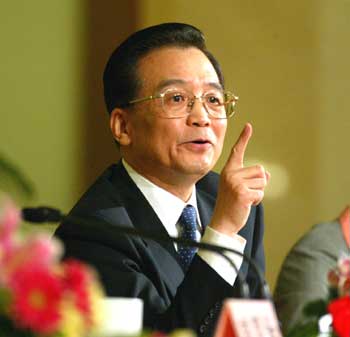
"Some countries demand the yuan's appreciation while practicing various trade protectionism against China. It's unfair and actually limits China's development," Wen told reporters in Nanjing, Jiangsu province.
European Commission President Jose Manuel Barroso and Swedish Prime Minister Fredrik Reinfeldt, whose country holds the rotating EU presidency, were also at the press conference.
Wen's unusually direct response followed a one-and -a-half hour summit between China and the EU, which has 27 member-nations. The summit ended with five agreements mainly on energy and environmental cooperation.
But it also ended without a breakthrough on issues that have brought stalemate between the sides, such as trade disputes and arms embargoes.
Wen said China will keep the yuan basically stable and carry out currency reform at its own, gradual pace.
A stable yuan is not only good for the Chinese economy but the world, Wen said.
The meeting took place against the backdrop of concern about the rising euro and the possibility it might derail the recovery in Europe, which imports heavily from China.
The yuan began gaining against major currencies after a set of exchange rate reforms were introduced in July 2005. After rising nearly 20 percent against the US dollar, it hovered around 6.83 to the US dollar for about a year. In the past month or so, the euro has risen to a 15-month high.
Euro Group President and Luxembourg Prime Minister Jean-Claude Juncker joined other European leaders in lobbying China's senior officials.
The Chinese officials explained that it was difficult to make a case for "immediate renminbi appreciation" in a country where 40 million people live on less than $1 a day.
The failure of the EU appeal was expected because Europe was only thinking about itself, claimed Wu Baiyi, a European studies expert at the Chinese Academy of Social Sciences.
Zhao Junjie, Wu's colleague, said that while China is not able to quickly change its currency policy, Beijing had made efforts in the past year to fill the EU trade gap.
"Actually, some of the goods bought by the dozen purchasing groups that China sent to the EU during the past year were bought only for the sake of the EU," he said. "But the EU still wants more."
Glenn Maguire, chief Asia-Pacific economist at Societe Generale SA in Hong Kong, told Bloomberg: "China will only adjust on its own terms and in its own time. It's decided that now is not the time to do that."
Despite lingering disputes, including trade protectionism and the EU's ban on the transfer of technology to China, Wen Monday raised expectations for improved relations with Beijing's largest trading partner.
"China and Europe walking together hand-in-hand will make the steps of humankind more steady, and that best illustrates the strategic significance of our ties," said Wen.
Barroso and other EU leaders Monday also applauded fresh Chinese commitments on countering climate change.
Stanley Crossick, founding chairman of the European Policy Centre, said Europe will need to commit to lifting its arms embargo against China.
"Beijing is right that listing China among a handful of embargoed pariah states is totally inconsistent with the treatment of a strategic partner," he said.
Crossick suggested that EU officials be trained in contemporary China and taught Mandarin.
Wen opened the door to better understanding Monday, announcing that 2011 will be the year for China-EU youth communication and the establishment of other youth and cultural exchange mechanisms.
source: http://www.chinadaily.com.cn/china/2009-12/01/content_9081886.htm
"Some countries demand the yuan's appreciation while practicing various trade protectionism against China. It's unfair and actually limits China's development," Wen told reporters in Nanjing, Jiangsu province.
European Commission President Jose Manuel Barroso and Swedish Prime Minister Fredrik Reinfeldt, whose country holds the rotating EU presidency, were also at the press conference.
Wen's unusually direct response followed a one-and -a-half hour summit between China and the EU, which has 27 member-nations. The summit ended with five agreements mainly on energy and environmental cooperation.
But it also ended without a breakthrough on issues that have brought stalemate between the sides, such as trade disputes and arms embargoes.
Wen said China will keep the yuan basically stable and carry out currency reform at its own, gradual pace.
A stable yuan is not only good for the Chinese economy but the world, Wen said.
The meeting took place against the backdrop of concern about the rising euro and the possibility it might derail the recovery in Europe, which imports heavily from China.
The yuan began gaining against major currencies after a set of exchange rate reforms were introduced in July 2005. After rising nearly 20 percent against the US dollar, it hovered around 6.83 to the US dollar for about a year. In the past month or so, the euro has risen to a 15-month high.
Euro Group President and Luxembourg Prime Minister Jean-Claude Juncker joined other European leaders in lobbying China's senior officials.
The Chinese officials explained that it was difficult to make a case for "immediate renminbi appreciation" in a country where 40 million people live on less than $1 a day.
The failure of the EU appeal was expected because Europe was only thinking about itself, claimed Wu Baiyi, a European studies expert at the Chinese Academy of Social Sciences.
Zhao Junjie, Wu's colleague, said that while China is not able to quickly change its currency policy, Beijing had made efforts in the past year to fill the EU trade gap.
"Actually, some of the goods bought by the dozen purchasing groups that China sent to the EU during the past year were bought only for the sake of the EU," he said. "But the EU still wants more."
Glenn Maguire, chief Asia-Pacific economist at Societe Generale SA in Hong Kong, told Bloomberg: "China will only adjust on its own terms and in its own time. It's decided that now is not the time to do that."
Despite lingering disputes, including trade protectionism and the EU's ban on the transfer of technology to China, Wen Monday raised expectations for improved relations with Beijing's largest trading partner.
"China and Europe walking together hand-in-hand will make the steps of humankind more steady, and that best illustrates the strategic significance of our ties," said Wen.
Barroso and other EU leaders Monday also applauded fresh Chinese commitments on countering climate change.
Stanley Crossick, founding chairman of the European Policy Centre, said Europe will need to commit to lifting its arms embargo against China.
"Beijing is right that listing China among a handful of embargoed pariah states is totally inconsistent with the treatment of a strategic partner," he said.
Crossick suggested that EU officials be trained in contemporary China and taught Mandarin.
Wen opened the door to better understanding Monday, announcing that 2011 will be the year for China-EU youth communication and the establishment of other youth and cultural exchange mechanisms.
source: http://www.chinadaily.com.cn/china/2009-12/01/content_9081886.htm
Tiger 'faces charge' over crash
Tiger Woods will be charged by police over an accident in which he drove his car into a tree after a rumoured spat with his wife, entertainment website TMZ reports today.
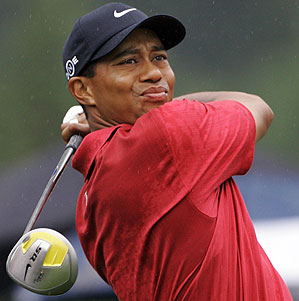
According to TMZ, law enforcement sources said the Florida Highway Patrol "will move to have charges filed against Tiger Woods in connection with the accident last Friday," which left Woods with facial cuts and bruising.
TMZ did not detail the charges but said "the case is against Tiger - not his wife."
"We know FHP was investigating whether Tiger was driving his SUV under the influence," the article said.
Further, the report claimed Woods was "drifting in an out of consciousness after the crash."
TMZ said Woods' wife, Elin Nordegren, gave ambulance officers two bottles of prescription medication she said Tiger had taken, but she was unable to say when he had taken it.
Woods has refused to speak to police about the crash, fuelling wild speculation in the media.
Florida police are expected to a press conference conference about 3pm local time (7am AEST).
On Tuesday, the alleged mistress dismissed the affair rumours, saying she had met Tiger twice in her life and only in her professional capacity as director of VIP services at a New York night club.
"It's the most ridiculous story. It's like they are asking me to comment if there are aliens on Earth," Ms Uchitel told the New York Post daily.
"Tiger and I are not friends," 33-year-old Uchitel said, adding that the fact she was in Australia at the same time as Woods in November was a mere coincidence.
"Like I could just walk up to the 35th floor and go to the Presidential Suite if Tiger Woods was staying there? Like they would hand a girl a key at the front desk and let her go to Tiger's room. I didn't see him at all in Australia. I was just there with friends."
Woods has called the rumours "unfounded and malicious".
source: http://www.theage.com.au/world/tiger-faces-charge-over-crash-20091202-k46r.html
According to TMZ, law enforcement sources said the Florida Highway Patrol "will move to have charges filed against Tiger Woods in connection with the accident last Friday," which left Woods with facial cuts and bruising.
TMZ did not detail the charges but said "the case is against Tiger - not his wife."
"We know FHP was investigating whether Tiger was driving his SUV under the influence," the article said.
Further, the report claimed Woods was "drifting in an out of consciousness after the crash."
TMZ said Woods' wife, Elin Nordegren, gave ambulance officers two bottles of prescription medication she said Tiger had taken, but she was unable to say when he had taken it.
Woods has refused to speak to police about the crash, fuelling wild speculation in the media.
Florida police are expected to a press conference conference about 3pm local time (7am AEST).
On Tuesday, the alleged mistress dismissed the affair rumours, saying she had met Tiger twice in her life and only in her professional capacity as director of VIP services at a New York night club.
"It's the most ridiculous story. It's like they are asking me to comment if there are aliens on Earth," Ms Uchitel told the New York Post daily.
"Tiger and I are not friends," 33-year-old Uchitel said, adding that the fact she was in Australia at the same time as Woods in November was a mere coincidence.
"Like I could just walk up to the 35th floor and go to the Presidential Suite if Tiger Woods was staying there? Like they would hand a girl a key at the front desk and let her go to Tiger's room. I didn't see him at all in Australia. I was just there with friends."
Woods has called the rumours "unfounded and malicious".
source: http://www.theage.com.au/world/tiger-faces-charge-over-crash-20091202-k46r.html
Subscribe to:
Posts (Atom)