Tuesday, May 22, 2007
Matt Got a Job
Well, Matt actually got a job. I know, it's a miracle. But in short, he had to change his blog to fit his new found glory. Therefore, you can now read of Matt's comings and goings at Kittens and Sunshine. Be sure to update your links and enjoy!

Saturday, May 12, 2007
Another Four Indianapolis Bloggers!
They're joining in bunches these days! First of all, thanks to everyone who has been spreading the word about this site. We are the largest ring of Indianapolis Bloggers on the internet. Congratulations to you all! Keep it up.
Next, if you'd like your photo to go next to your link on the sidebar, you must give me the url location of the photo you want, or else you just get the text link. Email me if you have any questions about this. Now, on to our newest members:
First up is the blog, Dangerous Articles. This blog covers everything, especially the not-to-mainstream type stories. More about the blog:
Everyone be sure to go check it out!
Next we have Stephen, who brings us the blog S.R. Coley. Stephen lives in Indy and blogs about his sweet web developing skills. More about the blog:
Go check it out!
Last but not least is our good friend The Russ. The Russ tells us the way it is in his blog, The Russ Says.... More about the blog:
Be sure to check out The Russ.
Thanks to everyone for joining! Be sure to spread the word and keep living the good life in Indy!
Next, if you'd like your photo to go next to your link on the sidebar, you must give me the url location of the photo you want, or else you just get the text link. Email me if you have any questions about this. Now, on to our newest members:
First up is the blog, Dangerous Articles. This blog covers everything, especially the not-to-mainstream type stories. More about the blog:
Dangerous Articles is everything important in the world: politics, media, art, entertainment and Anderson Cooper. I'm a journalist/writer with a lot of free time at the moment, so my energy is going into DA. The site should continue to grow so keep watching.
Everyone be sure to go check it out!
Next we have Stephen, who brings us the blog S.R. Coley. Stephen lives in Indy and blogs about his sweet web developing skills. More about the blog:
SRColey.com is a blog dedicated to my progressive learning in the field of Web Development and the Internet.
Go check it out!
Last but not least is our good friend The Russ. The Russ tells us the way it is in his blog, The Russ Says.... More about the blog:
I talk about me, my life, what's going on here in town, and all the geeky guilty pleasures I'm into.
Be sure to check out The Russ.
Thanks to everyone for joining! Be sure to spread the word and keep living the good life in Indy!
Friday, May 4, 2007
Three More Indianapolis Bloggers!
Three more Indy bloggers are finally joining us today. A few of them were newer blogs and had to wait to be approved, but we're proud to introduce three of our newest members.
First up is Matt. Matt Needs a Job. No, really. He needs one so badly that the name of Matt's infamous blog is, MATT NEEDS A JOB. More about the blog:
Thanks for joining us Matt! Keep up the blogging, spread the word, and good luck in your job hunt.
Lastly we have one of the worst blogs ever. Bryan gives us all we need to know about sports in his blog, The Worst Sports Blog Ever. More about the blog:
Thanks for joining Bryan. Everyone be sure to check these new blogs out. Keep spreading the word and thanks for growing our little community here!
First up is Matt. Matt Needs a Job. No, really. He needs one so badly that the name of Matt's infamous blog is, MATT NEEDS A JOB. More about the blog:
Take a walk through the everyday minutia of an unemployed malcontent
in central Indiana. After working as an editor in chief of a newspaper
and a deputy campaign manager, Matt can't even get temp agencies to
call him back -- and he's not happy!
Thanks for joining us Matt! Keep up the blogging, spread the word, and good luck in your job hunt.
Lastly we have one of the worst blogs ever. Bryan gives us all we need to know about sports in his blog, The Worst Sports Blog Ever. More about the blog:
Saving my wife endless hours of boredom by offering unique commentary about one of society's biggest obsessions. A sports blog about the Colts and other various sporting topics.
Thanks for joining Bryan. Everyone be sure to check these new blogs out. Keep spreading the word and thanks for growing our little community here!
Thursday, April 5, 2007
Monday, March 26, 2007
3 New Indianapolis Bloggers!
We've got three more bloggers joining our ranks today. First up is The Casual Friday, brought to us by Immixmarketer. More about the blog:
Thanks for joining the ring, everyone be sure to go check it out.
Our next blog is a one-stop visit for all upcoming events in Indianapolis. The name of this blog is AroundIndy.com. More about the blog:
Everyone be sure to check them out too.
Last up for today is another political blog called, Heartland Monitor. More about the blog:
Everyone be sure to check out these blogs. Don't forget to spread the word and everyone keep blogging!
"As a former "Blog of Note" The Casual Friday posts weekly Highlights of the Mundane."
Thanks for joining the ring, everyone be sure to go check it out.
Our next blog is a one-stop visit for all upcoming events in Indianapolis. The name of this blog is AroundIndy.com. More about the blog:
"A daily synopsis of upcoming events and things to do in Indianapolis and central Indiana, extracted from our main Web site, http://www.aroundindy.com. The RSS Feed is an excellent way to get a daily overview of some of today's events in Indy. A free Event Reminder Service is also available on the main site."
Everyone be sure to check them out too.
Last up for today is another political blog called, Heartland Monitor. More about the blog:
"Online ramblings of events that relate to Indiana politics and policy."
Everyone be sure to check out these blogs. Don't forget to spread the word and everyone keep blogging!
Friday, March 23, 2007
Site News
As you can see from Cervantes' posting below this site crashed badly after publication. It's not fixable I have rescued Cervantes' posting it can be found here
I phoned Cervantes today and explained the problem to him, we are closing this site permanently for new postings and reader commenting as of tonight.
The archives here will of course continue to be available.
As a temporary measure for tonight I have turned off the ability to make comments on the new site.
markfromireland
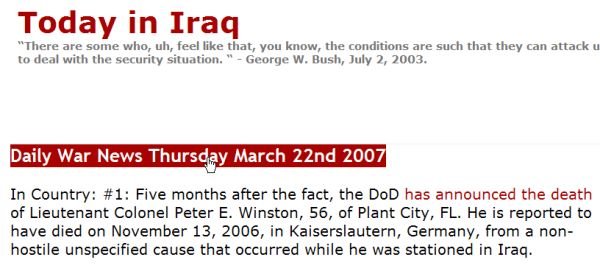
DAILY WAR NEWS FOR Thursday, March, 22, 2007
In Country:
#1: Five months after the fact, the DoD has announced the death of Lieutenant Colonel Peter E. Winston, 56, of Plant City, FL. He is reported to have died on November 13, 2006, in Kaiserslautern, Germany, from a non-hostile unspecified cause that occurred while he was stationed in Iraq.
Baghdad:
Thursday, March 22, 2007
 DAILY WAR NEWS FOR WEDNESDAY, March 21, 2007
Photo: Iraqi girls watch as a U.S. army soldier from the 1st Battalion, 23rd Infantry Regiment holds a hand gun that he found while searching their home in western Baghdad's Sunni neighborhood of Ghazaliyah, Iraq, Wednesday, March 21, 2007. U.S. troops conducted a major house to house search in parts of Ghazaliyah Wednesday. (AP Photo/Marko Drobnjakovic)
SECURITY INCIDENTS
Baghdad:
U.S. soldiers killed five suspected militants on Wednesday in a raid on a bomb-making factory north of Baghdad that was later destroyed in an air strike, the U.S. military said. The military said the operation near Taji, 20 km north of Baghdad, uncovered a number of 50-gallon barrels of explosive material.
"Two roadside bombs detonated near passing police patrols near the Beirut Square in eastern part of the capital, damaging a police vehicle and wounding two policemen aboard," the source told Xinhua on condition of anonymity. The blasts also damaged several nearby civilian cars and wounded three people, the source added.
Two people were killed when a roadside bomb targeting a passing police patrol in Palestine street exploded. Three policemen were wounded.
A bystander was killed and two guards of the finance ministry were wounded when US troops detonated a car bomb they discovered next to the ministry, a defence ministry official said. The controlled explosion rocked central Baghdad and shook windows in buildings as thick white smoke rose into the sky.
Police discovered a booby- trapped truck in downtown Baghdad. Police experts were called in to conduct an under-control explosion, wounding 12 civilians and security members, the source added.
Iraqi police detonated a huge truck bomb near the Finance Ministry in Baghdad on Wednesday in a controlled explosion that collapsed part of the main highway linking the north and south of the capital. Police said they discovered the truck bomb parked under the Mohammed al-Qassim highway just metres from the ministry building. The explosives were hidden under a pile of lettuces. They detonated the bomb in a controlled explosion but were apparently taken by surprise by the force of the blast, which reduced a section of the raised highway to rubble, punched holes in the ministry building and blew out its windows.
Three policemen were wounded when two roadside bombs detonated in quick succession near a passing police patrol in Zaiyounah neighborhood, the source said.
Gunmen killed police captain Hussein Abdullah on Tuesday in the western Baghdad district of Mansour, police said.
A member of parliament and senior member of radical Shi'ite cleric Moqtada al-Sadr's movement, said U.S. forces staged an overnight raid on his office in northern Baghdad's Kadhimiya district. Araji said they seized a pistol, rifle and a computer memory card.
Diyala Prv:
“A number of armed groups started to bring down satellite dishes in Muqdadiyah district,” eyewitnesses told the independent news agency Voices of Iraq (VOI). They also warned residents against using the dishes.
A group of tribal forces in the district engaged in clashes with al-Qaeda-linked armed groups in Diala province.
Al Madaen:
Eight people were killed and 18 wounded in twin mortar attacks in Al-Madaen, a small town south of Baghdad, police said. One mortar landed in a residential area wounding several people, prompting crowds to gather. A second mortar then smashed into the crowd, causing most of the casualties.
Iraqi police patrols found in the wee hours on Wednesday two unidentified bodies in al-Madaen district, southeast of Baghdad, said a police source.
Hilla:
Two Iraqi police officers escaped attempts on their lives when two explosive charges went off near their houses in central Hilla, 100 km south of Baghdad, said a police source. “The bombs were planted outside their houses,” media spokesman from the Babel police department, Captain Muthana Khaled Ali, told the independent news agency Voices of Iraq (VOI). “The first bomb was detonated at 7:30 am on Wednesday in al-Shawi region in central Hilla, while the second bomb went off ten minutes later in Nader region, also in central Hilla,” he added. The blasts caused material damage to the two houses.
Diwaniya:
Police said they found the body of a man, shot in the head and bound, on Tuesday in Diwaniya.
A policeman was killed and eight wounded, including four civilians, when clashes erupted between police and gunmen on Tuesday in several districts of Diwaniya, 180 km (110 miles) south of Baghdad, police said.
The bodies of two police commandos were found with gunshot wounds in the southern city of Diwaniya, 180 km (110 miles) south of Baghdad, police said
Basra:
British forces launched a crackdown operation in Hussein neighborhood, west of Basra, in the early hours of Wednesday that targeted two houses, believed to be involved in indirect shooting against the British Consulate in central Basra,” Captain Katie Brown told the independent news agency Voices of Iraq (VOI) by phone. “Three suspected gunmen fled from the place during the operation, while the forces managed to arrest a suspect in the second house,” she added. “The British patrol came under attack while leaving the area and a shootout started with a group of gunmen, during which one of the attackers was wounded,” she said.
Mosul:
Police said that they found the bodies of seven people shot dead on Tuesday in different districts of the northern city of Mosul, 390 km (240 miles) north of Baghdad.
Al Anbar Prv:
U.S.-Iraqi troops backed by American warplanes battled al-Qaida-linked insurgents for more than five hours in clashes near Fallujah that left eight killed and five Iraqi policemen wounded, the military said. Local police then killed two al-Qaida fighters and wounded five in a gunbattle, Hollenbeck said in an e-mailed statement, adding that five policemen also were wounded. Insurgents using a roadside bomb during the 10-hour operation killed one civilian and wounded five, it said.
Gunmen killed a former army brigadier and a friend in a drive-by shooting in the city of Falluja, 50 km (35 miles) west of Baghdad, police said.
>> NEWS
Iraq's vice president called for talks with the country's myriad insurgent groups as the only way to tame violence more than a month into a massive security plan to quell Baghdad.
Tareq al-Hashemi, a Sunni, made the remarks as it emerged that the US Army had released an aide of radical Shiite cleric Moqtada al-Sadr, one of America's sworn enemies in Iraq, apparently on the request of the prime minister. (…)
Hashemi told the BBC in an interview broadcast a day after the fourth anniversary of the US-led invasion that militants, terror network Al-Qaeda excluded, were "just part of the Iraqi communities."
"I do believe there is no way but to talk to everybody," said Hashemi, who was due in Tokyo later Wednesday.
All groups "should be invited, should be called to sit down around the table to discuss their fears, their reservations," he said, despite saying Al-Qaeda was "not very much willing, in fact, to talk to anybody."
Hundreds of chanting mourners buried Saddam Hussein's former vice president near the ousted dictator, his sons and two other executed deputies Tuesday in a spot that has become the graveyard of the ousted regime.
Taha Yassin Ramadan's body, which was covered with the Iraqi flag, was interred in a building courtyard in the Tigris River village of Ouja hours after he was hanged for his part in the killings of 148 Shiite Muslims following a 1982 assassination attempt on Saddam.
>> COMMENTARY AND ANALYSIS
Left I on the News: CONVENTIONAL "WISDOM" ON IRAQ
A lot of people, politicians and pundits and "regular" people, take the attitude that "we" just can't leave Iraq, because we'll be abandoning the Iraqi people to chaos, and the occupation is the only thing preventing that from happening. This is something you hear from people who supported the war but now say they realize it was a bad idea (but they still don't think we can actually leave) as well as from people who were opposed to the war from the start. This line is said with absolute authority - the speaker knows this is what will happen if U.S. forces leave Iraq.
Even if this conventional wisdom were true, it wouldn't justify an illegal occupation. But there's one more little problem though - by a 2-1 margin, the Iraqi people, who are in a lot better position to know than American politicians and pundits, don't think it's true! This is what I think is the key result of a new poll (pdf link) that the media are writing and talking about. The question was, "do you believe that the security situation in Iraq will get better or worse in the immediate weeks following a withdrawal of Multi National Forces?" 29% said it would get "a great deal better," 24% said "a little better," and 6% said "stay the same." Only 26% thought it would get a little or a lot worse. So that's three out of five Iraqis, a clear majority, who think that the security situation in Iraq will not get worse, and only one in four who think it will get worse.
With all the coverage of this poll I've read and heard, though, (e.g., Washington Post, New York Times), not a single one has highlighted the result of this particular question, which relates directly to the major rationale offered why U.S. troops have to stay in Iraq. Funny, that.
link
Firas Al-Atraqchi, The Daily Star Egypt: FOUR YEARS LATER, THE ANNIHILATION OF IRAQ IS STILL ON COURSE
Four years ago, US-led forces began a vicious aerial bombardment of the oil-rich country of Iraq. Referred to as Operation Iraqi Freedom, the opening salvo ushered the vital Arab nation into an era of darkness, dread and destruction.
The first signs that Iraqis were in for a bloody and inhumane occupation were felt in the "precision bombing" of Baghdad and other cities. Arab media clamored viciously to broadcast the freshest images of civilian dead which were coming in to news bureaus every hour.
In the 1,461 days that have since passed, Iraq as a nation is in decay; its people are displaced — refugees in neighboring countries. Nearly 700,000 Iraqis of all religions and sects have died. Public order is in disarray; gunshots and explosions in schools, marketplaces, and parks have replaced the chirp and chatter of everyday life.
Mosques and churches have been leveled. Towns and villages have been cleansed. Cities have been occupied and systematically destroyed. Sectarian hatred has become civil law as thousands of families escape persecution and death.
Nearly five million Iraqis have escaped the carnage that is their once-loved country and now rely on the kindness — and patience — of Egypt, Jordan, Syria and others.
I have met many of these refugees in said countries; all are worn out. A sadness … a heaviness is to be found in their countenances, their eyes are sleepless and empty. They tell tales of horror, describing Iraq as a country fallen to zealotry, terrorism, and religious fanaticism.
They used to grimace when hearing of a 10-year-old neighbor kidnapped, raped, and beheaded. They used to gasp when hearing of a young Christian woman garroted because she refused to don the veil. They used to cry out in anger upon hearing a 14-year-old girl was raped by four US soldiers.
They do these things no longer. Iraqis are the waking dead. Zombies, if Hollywood analogies are permitted here.
read in full…
Khalid Jarrar: THE FOURTH YEAR
The fourth year has arrived.
and counting.
my biggest fear is that i will be sitting on a chair every year, posting about the fifth year, seventh year, 20th year of occupation and it's harvest of blood, pain and disappointment.
The policy and decision makers of the United states of American has turned into the most arrogant idiots, drunk with power to the point that they can't drive their way home from Iraq anymore.
We have a saying: God supports a just nation even if it was an infidel nation, and destroys an unjust one even if it believed in him. And it's about the time to say it, USA have became the unjust nation that needs to be removed, not removed off the map with a nuclear bomb i mean, but removed from it's position as the leader of the world.
USA doesn't have the moral superiority propaganda on it's side anymore. It's a mere mission of greed and aggression that its leading in the world now: If we don't like you, we shoot you. If you don't give us your wealth, we shoot you, and if you don't like us for doing this to others, we gladly shoot you too.
This has to come to an end. (…)
I say again: if it wasn't that the American army is losing by all means, most of Americans wouldn't have moved a hand, or a tongue to demand the withdrawal of the army from Iraq.
So after all, resistance does work.
of course it does work. Haven't you read the history?
Any occupied people revolt immediately or eventually, and when people do, armies never stand a chance, says history.
Yes the resistance, the national patriot resistance, the one that is attacking the American army and the other occupying armies, and everyone that helps them and protects them. Not the terrorists that are killing Iraqis, weather Sunna or Shea, no not those. Those nobody knows who they are and where were they before the occupation, they somehow grew and flourished under the umbrella of the occupation, and i dare say as a direct reason of it; when Bramer created the concept of the sectarian based distribution of government, it all started, and that was over a year after the war, so for a whole year Iraqis were heavily loaded with weapons and under a completely safe environment, and they didn't jump on each other, no sectarian tension was registered that led to battles, no Iranian or Iranian based militias killing Sunna and definitely no Sunni militias killing Shea too, neither, and if you go to Jordan or Syria now, there are about a million Iraqi refuge in each of these countries alone, ran out for their lives from the hell-y situation in Iraq, and among those millions of people we never heard till this very moment of any fight or any sort of sectarian based problems, which means that as i said: this sectarian tension was created politically by the occupation: divide and conquer.
But back to what i was saying: The national patriot resistance, the simple everyday Iraqis that can't be self centred and say: let Iraq fight on it's own, we will hide in our houses. No sir, no madam, they didn't. They left their lives and Jobs, as any hero in any occupied country would do, held their weapons and started to fight. And they did indeed make the life of the strongest army in the world a living hell, no doubt,they taught them the lesson: if we bite each other's fingers, you will be the ones to scream first.
Iraqis are in Iraq, the proper place for Iraqi people!, and have no where else to go, and will stay there and will fight there till the end, because simply they are too proud to be occupied, and simply because they have no where else to go after most of the countries in the world decided they won't open their doors to Iraqis and won't hold their burden, countries including USA itself, that accepted a tiny number of Iraqi refuges since the war, a shameful three figures number.
what a shame. what a shame.
And even terrorism itself, which is the killing of innocent people for no crime they did [excluding that done by the occupation at this particular context], is not making the life of the US army any easier too, it's just another indicator of how bad they are running the battle ground and how much they lack the ability to control the security in Iraq. Hell, news here are nothing but the death toll of the day.
So as a conclusion i have to say: That it's shameful enough, and hurtful enough to say, and sad enough yet truthful enough, that for most Americans it actually requires terrorism that kills innocent people, and resistance that kills thousands of Americans and burns billions of American money, to make them demand an end to an occupation, but still basing on their own losses and not because of the feeling of responsibility or guilt over what they did to Iraq, now correct me if i am wrong here, but there is something seriously wrong with this moral equation here. (…)
Sad fourth birthday hateful spiteful occupation, Sad fourth birthday dear beloved Iraq, i miss you, and i promise you that there will be an end, soon.
read in full…
Joseph Cannon, Cannonfire: THE WAR OF WORDS
Just a thought on this distressing anniversary (at least to us, if not to King George, the sports fan)….
Let’s stop dignifying this messo’potamia in Iraq by calling it a war. What has happened in Iraq is NOT a "war," it was never a "war," and the only real "war" that could ever come of our presence there is a civil war that no one in this administration can admit, and that we should not be party to in any way, shape or form. Certainly not now, after all.
Instead, let’s loudly insist that this very undignified mess be called what it is, an invasion of a sovereign nation that has led to our occupation of that nation.
We invaded Iraq, and we now occupy Iraq. This is not a war, it is an invasion and occupation.
The only folks involved who have any right to refer to our presence in Iraq as a war are the Iraqis themselves. We forfeited that right when we determined to be the aggressors, raising our bomb-filled fists and screeching "THIS MEANS WAR!!" without any real provocation whatsoever articulated or proven in that "this."
The implications of such a shift in wording are enormous for not only how the public responds to the situation (as if the public could be much more outraged if we called it genocide of Americans), but for how the debate is actually undertaken, particularly in Congress.
read in full…
>> BEYOND IRAQ
Afghanistan:
A private security guard from Irmo was seriously injured when a suicide bomber exploded his car next to a U.S. embassy convoy in Afghanistan. Tommy Cullinan, 27, works for North Carolina-based Blackwater Security Service, which has a contract to provide security for the U.S. embassy in Kabul.
The decapitated body of an Afghan truck driver supplying NATO forces in southern Afghanistan was found dumped at the side of a highway.
Militants at the weekend cut off the noses and ears of three drivers supplying US military bases in the mountainous eastern province of Nuristan. Police blamed the Taliban.
A clash between U.S. troops and militants in western Afghanistan on Wednesday left one Afghan child dead and three others wounded, Afghan officials said.
QUOTE OF THE DAY: "We (…) need to stop talking about 'insurgents.' These people are, by definition, resistance fighters. Insurgents are, by definition, individuals who fight against an established government; there is no established government in Iraq, not one that the citizens fully recognize as independent of the US. On the other hand, a resistance is, by definition, a fight against an occupying force. This is no less trivial distinction, and it is also not unrelated to making the distinction between calling this a war or calling this what it truly is, an invasion and occupation." -- from"The War of Words" by Joseph Cannon (see above)
Wednesday, March 21, 2007
 DAILY WAR NEWS FOR TUESDAY, March 20, 2007
Photo: A man looks through a hole of a bulletproof Humvee window in the Baiyaa neighborhood in western Baghdad, Iraq, Tuesday, March 20, 2007. A U.S. military convoy was hit by a road side bomb, according to eyewitnesses and casualties were evacuated by a helicopter. (AP Photo/Asaad Mouhsin) (See below)
A roadside bomb detonated near a passing U.S. convoy on the Jadriyah bridge in southern Baghdad, damaging a U.S. Humvee, killing and wounding the soldiers aboard," a police source told Xinhua on condition of anonymity. A witness at the scene, Ghassan Ali, said he saw a U.S. Humvee caught fire while the U.S. troops blocked the roads and cordoned off the area. "Two U.S. helicopters landed at the scene to evacuate the casualty," he added.
Bring 'em on: The DoD has announced a new death, one that does not appear to have been previously reported by CENTCOM. According to them, Specialist Marieo Guerrero, 30, of Fort Worth, Texas, was killed by a roadside bomb in Baghdad on Saturday, March 17th. His unit, the 1st Battalion, 18th Infantry Regiment of the 1st Infantry Division is currently attached to the 2nd Brigade of the 1st Cavalry Division in Baghdad. They are believed to be based out of FOB Prosperity in central Baghdad. No currently known death would seem to match this one.
OTHER SECURITY INCIDENTS
Baghdad:
A parked car bomb exploded near a main bus station in central Baghdad, killing five civilians and wounding 18, police said.
A suicide car bomber drove his vehicle into an Iraq army checkpoint in a neighborhood in western Baghdad, killing one soldier and wounding another, police said.
A roadside bomb struck the area about five minutes later but caused no casualties.
A car bomb exploded in a tunnel in downtown Baghdad, killing three civilians and wounding seven others, police said.
Seven civilians were wounded in two separate attacks in southeastern Baghdad.
Mortars in southeastern Baghdad wounded another four.
A mortar round landed on a residential district and wounded a man in Zaafaraniya district, south of Baghdad, police said
Late Monday, U.S. and Iraqi troops engaged in a major operation as part of a security crackdown in the volatile Hurriyah neighborhood in northern Baghdad, state television said. Witnesses said many people were reported holed up in two Shiite mosques, surrounded by U.S. forces. The state-run Iraqiya network said six civilians had been killed. The U.S. military did not comment on the reports.
Mortar rounds wounded five people on Monday just north of Baghdad, police said.
A bomb in a mini bus wounded four people in eastern Baghdad, police said.
Police said they found bodies of 30 people shot on Monday in different districts of Baghdad.
Two Iraqis were killed and six others were wounded in a roadside car bomb in a commercial complex in the Karada district, an Iraqi police source said
Four mortar bombs killed at least seven and wounded 20 in Abu Dsheer, a Shi'ite majority area, south of Baghdad, police said
A car bomb near a mosque killed a man and wounded three others in al-Ubaidi district in eastern Baghdad, police said
Hilla:
A woman and her child were wounded in a mortar attack on a residential neighborhood north of Hilla, a source from the Babel police command said on Tuesday.
Al Zab:
Gunmen killed a man and wounded another in the town of al-Zab, 70 km (40 miles) south west of Kirkuk, police said.
Kirkuk:
Seven civilians were wounded in a car bomb late on Monday evening, a police source in Kirkuk said on Tuesday. "The explosion occurred in the area of Tisaeen near a complex of schools," the source, who is from the Kirkuk police command's joint operations room, told the independent news agency Voices of Iraq.
Police said they found the body of a policeman, stabbed with a knife and bore signs of torture, in Kirkuk.
Gunmen killed a policeman on a main road near the city of Kirkuk, police said.
Al Anbar Prv:
Police found the body of a man with gunshot wounds in the Sunni stronghold of Falluja, 50 km (35 miles) west of Baghdad, police said.
Police and tribal fighters killed 39 gunmen linked to al-Qaeda in the town of Amiriya, some 5 km (3 miles) south of Falluja, Ahmed al-Dulaimi, Ramadi governor's office director, said. He said nine tribal fighters and eight policemen were killed and 17 wounded in the clashes. Doctor Abdul Sattar al-Esawi said that Falluja hospital received 17 bodies, including eight policemen and 16 wounded, three in serious condition.
In Country:
Iraqi army soldiers killed three insurgents and arrested 101 others during the last 24 hours in different parts of Iraq, the Defence Ministry said.
>> REPORTS
Small Israeli pilotless planes are gathering intelligence for US-led forces in Iraq and Afghanistan, said the manufacturer in a statement on Monday. Elbit Systems, one of Israel's leading defence electronics companies, said the little "Skylark" can be carried and operated by a single soldier, covering an area within a range of 10km day or night, said the company.
>> COMMENTARY AND ANALYSIS
Felicity Arbuthnot: THE IDES OF MARCH
'Beware the ides of March', is said as a warning of impending and certain danger. Since it is from Plutarch, referring to a warning to Julius Caesar, it is unlikely to have influenced George W.Bush's 'shock and awe' decision to invade Iraq in March, since literature is not his forte. (Unless you count 'My Pet Goat'.)
For Iraq though, March brings not alone the fourth anniversary of the illegal US led invasion, monumental destruction of life, all societal structures, history, the National Museum, libraries of ancient manuscripts, all records from educational qualifications to medical reports, births, deaths and marriages and never ending death and trauma beyond imagination, but the memory of the 1991 'turkey shoot' on the Basra Road and the US encouraged uprisings in the south and north - then bloodily put down - with US assistance. March marked the beginning of the forty day period of mourning for the thousands of retreating conscripts and civilian families incinerated in their vehicles, when B52's bombed the front and back of the sixty mile convoy, then relentlessly bombed the rest 'like sitting ducks', as one pilot explained.
At least 'fifteen hundred tanks, armoured vehicles, jeeps, water and fuel tankers, ambulances, firetrucks, tractor trailors, buses and civilian vehicles and passenger cars ... some flying white flags' were 'pounded for hours' with anti-personel bombs 'and finally finished off with devastating B52 bombing runs'. It is thought that thousands were crushed, or incinerated in their vehicles. Windscreens and humanity melted. As the William Tell overture and the Lone Ranger theme, blasted out on the USS Ranger, 'planes reloaded and reloaded, returning to hit the convoy again and again, dropping everything from cluster bombs to five hundred pound bombs 'like sharks in a feeding frenzy'.
US Air Force planes from Saudia Arabia 'raced north to join in the fun'. There was so much air traffic involved in the 'frenzy' that the 'killing box' had to be divided up by air traffic controllers to prevent aircraft colliding. 'I think we're past the point of letting (Hussein) get in his tanks and drive them back to Iraq ....' a US pilot said, adding: 'I feel fairly punitive about it.' Saddam Hussein, in whose name the United Nations denied medicines, food, pencils and even blackboards since he would personally misuse them, was now apparently capable of driving sixty miles of vehicles, single handedly. (…)
The Iraqi pull out from Kuwait began on 26th February 1991, the ceasefire was signed on the 28th February. On 2nd March 1991, the US 24th Mechanised Division slaughtered thousands more Iraqi soldiers, an action approved by General Norman Schwatzkopf (who famously remarked: 'no one left to kill'. His autobiography is 'It doesn't take a Hero'. Indeed.) 'We really waxed them', said one Commander. Another American was recorded saying 'Say hello to Allah', as his Hellfire missile obliterated a vehicle. 'Yee-hah', said another voice. There was an attempt to cover up the carnage of another vehicle strewn road, since: '..it didn't look good coming after the ceasefire.' (Ramsey Clark, The Fire this Time, Thunder's Mouth Press.) The then US Ambassador to Iraq, April Glaspie, had told Saddam Hussein that America had 'no view on Arab-Arab conflicts.' Hussein had consulted her on the possible invasion. Iraq accused Kuwait of slant-drilling into their Rumaila oil field across Kuwait's border, destabilising Iraq's currency and moving Kuwaiti settlements well into Iraqi territory.
One conscript who survived the horrors of the Basra Road, with the remnants of his unit, told me how they had walked the five hundred and fifty kilometres, through the destruction, by the body parts, home, to carpet bombed Baghdad, none knowing whether family or house had survived: 'We wanted to cry, but we had no tears left.' Eighty eight thousand five hundred tonnes of bombs had fallen on ancient Mesapotamia, which brought the world all we call civlized.
As the wickedness of George W.Bush and his war criminal Administration are marked, four years on from the illegal invasion and destruction of the 'cradle of civilisation', another George Bush and other criminal acts should also be remembered. He may have taken to crying publicly over his son, he should also look in the mirror.
And on this March day another Minister in Iraq's legitimate government ('sovereignty and territorial integrity', guaranteed by the United Nations) is hanged at dawn, taking civilisation back five hundred years, under the blood-lust watch of America and Britain, in a further act of barbarism, we all should. The unspeakable sins of the son and his Whitehall lackey, are being perpetrated in our name.
read in full…
Malcom Lagauche: HUSAYN AL-KURDI ON THE BA’ATH PARTY, KURDS, AND THE CIA
Husayn al-Kurdi as an expert on Middle Eastern Affairs. He is the president of News International. Over the past two decades, Al-Kurdi has had hundreds of articles published on the Middle East.
ML: The current rewriting of history includes many "leftist" writers who opposed the Iraq invasion and criticize U.S. imperialism. However, they also condemn Saddam and say that he was put in power by the CIA. What’s your take on this?
HAK: I’ve read and read and can’t see where that’s true. What’s the source behind all these sources? There’s nothing at all.
The thing we heard is that the CIA gave Saddam a list of communists. Even I believed this at one time. But, that’s an absurdity because everybody in Iraq knew who the communists were. They were public figures as well. A lot of them were tormenting the people a long time ago. The Ba'ath Party did not need a goddamn list from the CIA to say who they were, where they were, or what had to be done about them. Go behind the sources and see what it’s actually based on. The source will fold before your very eyes, just like Curveball and all the stuff he was coming out with.
ML: Another fallacy the left mentions is that the U.S. supplied Iraq with much military equipment in the Iran-Iraq War, thus the CIA kept Saddam in power. In fact, Iraq only spent $200 million dollars with the U.S. for this time, mostly on helicopters. Its major suppliers were the Soviet Union and China, with whom Iraq spent billions. After 1990, the CIA/Saddam allegations took on a life of their own. How does this play into the myths now being written?
HAK: You are pointing out the general fact of the CIA’s activities toward Saddam and the Ba’ath. The version via the Kurds that no deal was ever good enough for them. Who put them up to it? Today, we know it was the CIA and Mossad working in tandem. (…)
ML: Contrary to be popularly-held belief that the U.S. inserted Saddam in power, could it really be that the CIA was trying to undermine Saddam and the Ba’ath Party from day one?
HAK: Between the CIA and the Mossad, we have to take that into account. There is an overlapping project that has been in effect since the 1950s.
I don’t remember the period of 1968 to 1973 as the CIA being supportive of the Ba’athists. They considered Iraq to be a frontline state against Israel and a part of the rejectionist front toward Israel and during that period the U.S. was not friendly toward Iraq. The U.S.’ biggest client at the time was Iran. Then, the U.S. signed off and had its own deal with Barzani to subvert Iraq. It was precisely in that time-frame they were carrying on their activities.
ML: In 1973, the Ba’athists committed an unpardonable act in the eyes of the U.S. They nationalized Iraqi oil. How does this affect the interplay?
HAK: You’re approaching an area where the bad guys have always had it in for Saddam and the Ba’ath. Pan-Arabism is something the Israelis and the U.S. will never play. Then, you have the matter of "threatening their (U.S.) intereests" as an excuse to commit aggression. Then you had an Arab country becoming too strong. Then you had Saddam refusing to knuckle under. He wanted to go his own way.
read in full…
Iraq forever: FOUR YEARS AGO…
On the fourth anniversary of the Occupation and the invasion of Iraq..
The Resistance will prevail and God's enemies are being and shall be defeated tomorrow! God's willing!
Today! after four years of the bloodthirsty US, pigs Brits, and pagan Iranian aggression against Iraq!
Four years ago.. we never thought that the aggression will end up into occupation!
And four years ago we never imagined that Baghdad will burn as it did .. Our beautiful Baghdad, will be plundered and looted as it did!
Four years ago we never ever though betrayal was so easy.. for some people!
And four years ago we never imagined that Nizar Qabbani's prophecy that Arabs have died has become true!
But..
Four years ago we never thought that in Iraq there was such a Resisting people and in such a volume and in such a strength!
And four years ago we fought only through orders from the government..
And four years ago, US weapons scared us ..
Four years ago the sacrifice for God and the homeland was not as much widespread and deepened and growing as is the case today!
Four years ago our leaders were known and distinguished through their ranks, their cars and their names..
While today our leaders are only distinguished through the level of their combat, sacrifice and martyrdom for God, honor and Iraqi immaculate soil!
Four years ago we never though that the US will be bled to this horrendous extend and that the bloodthirsty US invaders will get burnt in Baghdad' streets, gates and ramparts on the hands of the believers men .. Today we witness with our eyes proper.. how these US gangsters filthy corpses fly in the air like torn loo papers while they die and pee on themselves with fright and desperation in their hiding spiders' holes..
Four years ago we never thought that we will be able to defeat so fast the US with all its weapons ..Today we are witnessing the defeat and the collapse of the mightiest planetary force with all its alliances and all what it built such as technologies, weaponry and criminal gangsters trained to kill for more than fifty years.. Today, these US criminals in Iraq, hide behind their armors and armed vehicle when moving around.. They sleep behind their armors.. and all that has no meaning for the men of Iraq who combat them with simple weapons their beds being the sacred soil of Iraq and their cover and protection the Iraqi skies.. These men have nothing protecting them from the scorching summers' heat and the grinding winters' cold! These men carry in their hearts the armors of faith and they are protected by their perseverance and patience.. Their food is piety and faith in one single and unique God.. Nothing scares them but God's wrath and they only ask the protection from the mighty and most capable God! They ask Him mercy and grace through eyes filled with tears and prayerful hearts and wish to their souls to meet Him and be in amongst the martyrs and the good ones! They don't request from His worshipers nothing but to pray for them and this is the minimum of faith!
read in full…
Whatever It Is, I'm Against It: HAPPY 4TH BIRTHDAY, IRAQ WAR! THEY’RE SO CUTE AT THAT AGE
Bush gave a little speech for the 4th anniversary (8 Friedman Units) of the Old Iraq War, with a painting of Teddy Roosevelt, presumably in Cuba, behind him. He didn’t spend much time on the Old Iraq War, which was initiated “to eliminate the threat [Saddam Hussein’s] regime posed to the Middle East and to the world.” He moves right on before you can ask, “Without the WMDs you said he had, what threat was that, monkey boy?”
It’s another clean-slate moment for George, like quitting drinking and 9/11. He wants us to forget the boring Old Iraq War and focus on the New Iraq War, the “Baghdad security plan.” The New Iraq War is bright and fresh and, ya know, new, and isn’t bogged down after four long years, no, it’s “still in the early stages,” so what are you people being all impatient about? It will “take months, not days or weeks.” So, 4 or 30 times longer.
“It can be tempting,” he says, “to look at the challenges in Iraq and conclude our best option is to pack up and go home. That may be satisfying in the short run” but blah blah contagion of violence blah safe haven blah blah. Yes, opposition to the war is all about giving in and doing what’s “satisfying,” it’s just self-indulgence and you people make me sick.
link
Roads to Iraq: BA’ATH PARTY: WE PROVED TO THE WORLD THAT “THE US IS A PAPER TIGER”
The neocons and the Zionists plan is the colonization of Iraq and use it as a launching base for full and direct control over the the oil in Middle Eastern countries and nations, and to move from Iraq, and in order to impose a new colonial world through the use of oil to blackmail other nations, destruct their economies, and disrupt all aspects of modern life, thereby to achieve the most desirable dream, to make the present century an American century.
The Iraqi national resistance in all its factions successfully destroyed the base of this project is, making impossible to achieve the other two steps: The full control over all the oil countries, and the third, which is the colonization of the world.
The Iraqi resistance strategy raised a serious global revolution against American imperialism, through compulsion to stop and prevent America from achieving any progress, and dealing with their project belligerently by making their army a daily target, draining the American economy and destroying their reputation, and we proved to the world that (America is a paper tiger).
Khrushchev, former President of the Soviet Union, who put the earlier statement, failed with all the Soviet might and nuclear super power to put his words in practice, Mao Zedong, leader of China said (yes America is a paper tiger but it has nuclear fangs)! Iraq Resistance and the Baath Party proved that America is a paper tiger and we succeeded to remove its fangs making it a stray dog running, looking for a place to hide from the strikes of the resistance lions.
As a result of the defeat of America in Iraq, the world emerged from the fear of American blackmail and started to challenge the US, as in the case of Latin America, which was called (the American back yard).
The armed resistance of the American occupation in Afghanistan evolved rapidly as a result of the Iraqi Islamic revolution and learning sophisticated, creative and unique methods of guerrilla warfare to combat.
The Iraqi million Army fighters are tested, the world has witnessed for the first time in its history a guerrilla warfare based on a large regular army fighters, and thus America and NATO realized that they have fall in a quagmire and they will will not exit only to the tomb of inevitable defeat.
read in ful…
QUOTE OF THE DAY: "Today, as we enter the fifth year of the occupation the world has become convinced that armed Iraqi resistance has become the sole superpower." -- from the Ba’ath Party statement on Iraq entering the fifth year under occupation (See above)
Tuesday, March 20, 2007
 DAILY WAR NEWS FOR MONDAY, March 19, 2007
Photo: An Iraqi woman pleads with Iraqi National Police as they detain her son during a joint patrol with US soldiers in the Dora neighbourhood of southern Baghdad, 17 March. Iraqis are increasingly pessimistic about their future, according to a new opinion poll as the nation battles to curb relentless bloodshed four years on from the US-led invasion.(AFP/File/David Furst)
SECURITY INCIDENTS
Baghdad:
In Sharja district in central Baghdad, three people were killed and 10 others wounded when an explosive device went off near a Shiite mosque, an Iraqi police source said.
A bomb exploded during prayers at a Shiite mosque in the capital, killing at least eight worshippers and wounding nearly three dozen on the eve of the war's fourth anniversary, police said. The attack occurred about 12:30 p.m., shattering windows and damaging a wall of the small green-domed mosque that is situated among several shops in the central Shorja market area. Police initially blamed it on a suicide bomber trying to enter the building but later said the blast was caused by a bomb placed in the corner behind the preacher's podium, leaving a crater in the floor.
In Alwiya district also in central Baghdad, a number of Iraqis were killed and wounded in twin blasts, al-Iraqiya state TV reported. No further details were immediately available in either attacks
A roadside bomb wounded four people in southern Baghdad, police said.
Iraqi army soldiers killed eight insurgents and arrested 66 others during the last 24 hours in different parts of Iraq, the Defence Ministry said.
Diyala Prv:
In Diyala province north-east of Baghdad, unidentified gunmen shot one Iraqi dead and wounded another, local Voices of Iraqi news agency reported citing an Iraqi police source.
Four civilians were killed and five others were wounded when two katyusha rockets hit a residential area north of Hibhib town, 55 km north of Baghdad, said a police source.
Dijelah:
The mayor of a small Shiite village south of Baghdad was kidnapped and killed today.Police say the mayor (of Dijelah) was abducted on his way to work. Later, his bullet-riddled body was found dumped along a highway. The village is about 100 miles southeast of the Iraqi capital.
Iskandariya:
A mortar round landed on a house, killing a woman and her daughter on Sunday in Iskandariya, police said.
Gunmen killed a man and wounded four others on Sunday in two different incidents in drive-by shootings in the town of Iskandariya, police said.
Gunmen killed a policeman in the town of Iskandariya, 40 km (25 miles) south of Baghdad, police said.
Hilla:
Gunmen killed a man on Sunday in a town near Hilla, 100 km (60 miles) south of Baghdad, police said.
Three people were killed when gunmen opened fire on them in the city of Hilla, south of Baghdad, police said.
Diwaniya:
Police found the body of a police captain on Sunday in Diwaniya, police said.
Gunmen killed the head of the local passport office on Sunday in the city of Diwaniya, 180 km (110 miles) south of Baghdad, police said.
Mahaweel:
Police found the body of a man with gunshot wounds in the head in the town of Mahaweel, 75 km (50 miles) south of Baghdad, police said.
Dhuluiya:
Two police stations were badly damaged when suspected al Qaeda militants planted bombs in and around them in the town of Dhuluiya, 80 km (50 miles) north of Baghdad, police said.
Dour:
A roadside bomb targeting an Iraqi army patrol killed one soldier and wounded three others in the town of Dour, near Tikrit, the U.S.-Iraqi Joint Coordination Centre said.
Tikrit:
Police found the body of an Iraqi soldier in the city of Tikrit, 175 km (110 miles) north of Baghdad, the U.S.-Iraqi Joint Coordination Centre said.
Samarra:
Gunmen attacked a police checkpoint, killing a policeman and wounding three others in Samarra, 100 km (60 miles) north of Baghdad, police said.
Balad:
Insurgents attacked a police station near Balad with a car bomb and small-arms fire on Thursday, the U.S. military said on Monday. Six people were killed in subsequent clashes -- three insurgents, two policemen and a civilian -- and one civilian was wounded, a U.S. statement said.
Kirkuk:
Three car bombs and two roadside devices killed 18 people and wounded 37 in the northern Iraqi city of Kirkuk on Monday, police said. The blasts happened in different parts of the city but exploded within a few minutes. One car bomb targeted the local offices of the secular political party of former prime minister Iyad Allawi.
The first and the biggest attack, a car bomb near two mosques, killed 10 people and wounded eight, police Colonel Taha Salaheddin told AFP. The bomb went off in central Kirkuk's Sector 90 district which houses the two mosques, one Shiite and one Sunni, as well as the emergency police command, Salaheddin said. He said 10 cars were completely burnt and 20 shops damaged.
The second car bomb went off in south Kirkuk's Ras Domeez market near a branch of the Islamic Bank, killing five people and wounding 26, he said. Of the five killed, four were policemen whose patrol was passing by at the time of the blast.
and the third exploded in a commercial street, Brigadier Sarhat Qader said.
The three roadside bombs targeted Iraqi police and army patrols, Qader said.
The car bombs targeted an Iraqi police patrol, an education directorate building, and a mobile phone company, according to police.
The fourth car bomb targeted a senior officer from Saddam Hussein's former army and destroyed a communication tower but caused no casualties.
Mosul:
A man was killed and two wounded on Sunday when clashes erupted between U.S. forces and gunmen in the city of Mosul, 390 km (240 miles) north of Baghdad, police said.
The bodies of four people with gunshot wounds were found on Sunday in Mosul, police said.
A roadside bomb targeting a police patrol wounded two civilians in the northern city of Mosul, police said.
>> NEWS
Iraq will execute Saddam Hussein's aide and former vice president Taha Yassin Ramadan on Tuesday -- the day the war-ravaged nation marks the fourth anniversary of the US-led war to topple the former dictator, a lawyer from Saddam's defence team told AFP Monday.
>> REPORTS
> The optimism that helped sustain Iraqis during the first few years of the war has dissolved into widespread fear, anger and distress amid unrelenting violence, a survey found.
The poll — the third in Iraq since early 2004 by ABC News and media partners — draws a stark portrait of an increasingly pessimistic population under great emotional stress. Among the findings of this survey for ABC News, USA Today, the BBC and ARD German TV:
_The number of Iraqis who say their own life is going well has dipped from 71 percent in November 2005 to 39 percent now.
_About three-fourths of Iraqis report feelings of anger, depression and difficulty concentrating.
_More than half of Iraqis have curtailed activities like going out of their homes, going to markets or other crowded places and traveling through police checkpoints.
_Only 18 percent of Iraqis have confidence in U.S. and coalition troops, and 86 percent are concerned that someone in their household will be a victim of violence.
_Slightly more than half of Iraqis — 51 percent — now say that violence against U.S. forces is acceptable — up from 17 percent who felt that way in early 2004. More than nine in 10 Sunni Arabs in Iraq now feel this way.
_While 63 percent said they felt very safe in their neighborhoods in late 2005, only 26 percent feel that way now.
> The population of prisons in Iraq has soared in recent months with tens of thousands of Iraqis currently in U.S. custody without trial.
U.S. troops and Iraqi government are investing heavily in the construction of prisons in the country with more than 100,000 Iraqis currently behind bars.
A parliamentary investigation commission has found that U.S. troops alone now detain more than 61,000 Iraqis and the figure is expected to swell as the Americans press ahead with their military operations.
More than 50,000 Iraqis were reported to have been arrested in the past four weeks as part of the joint U.S.-Iraqi military campaign to subdue Baghdad.
U.S. troops detain Iraqis merely on suspicion. Once detained, Iraqis may stay indefinitely as they are denied access to lawyers and Iraqi courts and government have no right to question U.S. troops’ actions.
Even Iraqi troops operations and activities now fall beyond the Iraqi judicial system as the country has been placed under emergency rule under which the courts have no power to question what the security forces do.
Guardian: THE REGRETS OF THE MAN WHO BROUGHT DOWN SADDAM
His hands were bleeding and his eyes filled with tears as, four years ago, he slammed a sledgehammer into the tiled plinth that held a 20ft bronze statue of Saddam Hussein. Then Kadhim al-Jubouri spoke of his joy at being the leader of the crowd that toppled the statue in Baghdad's Firdous Square. Now, he is filled with nothing but regret.
The moment became symbolic across the world as it signalled the fall of the dictator. Wearing a black vest, Mr al-Jubouri, an Iraqi weightlifting champion, pounded through the concrete in an attempt to smash the statue and all it meant to him. Now, on the fourth anniversary of the US-led invasion of Iraq, he says: "I really regret bringing down the statue. The Americans are worse than the dictatorship. Every day is worse than the previous day."
The weightlifter had also been a mechanic and had felt the full weight of Saddam's regime when he was sent to Abu Ghraib prison by the Iraqi leader's son, Uday, after complaining that he had not been paid for fixing his motorcycle.
He explained: "There were lots of people from my tribe who were also put in prison or hanged. It became my dream ever since I saw them building that statue to one day topple it."
Yet he now says he would prefer to be living under Saddam than under US occupation. He said: "The devil you know [is] better than the devil you don't. We no longer know friend from foe. The situation is becoming more dangerous. It's not getting better at all. People are poor and the prices are going higher and higher."
Saddam, he says, "was like Stalin. But the occupation is proving to be worse".
According to an opinion poll of 5,000 Iraqis carried out over the past month, 49% say they are better off now than under Saddam, and 26% say life was better under Saddam. More than one in four said they had had a close relative murdered in the past three years.
· Regrets of the Statue Man, the first of three films by Guardian Films to mark the fourth anniversary of the invasion, will be broadcast on ITV news at 6.30pm and 10.30pm tonight
link
>> COMMENTARY AND ANALYSIS
Anthony Arnove, Asia Times Online: BILLBOARDING THE IRAQ DISASTER
As you read this, we're four years from the moment the administration of US President George W Bush launched its shock-and-awe assault on Iraq, beginning 48 months of remarkable, non-stop destruction of that country - and still counting. It's an important moment for taking stock of Operation Iraqi Freedom.
Here is a short rundown of some of what Bush's war and occupation has wrought. (…)
Given the disaster that Iraq is today, you could keep listing terrible numbers until your mind was numb. But here's another way of putting the past four years in context. In that same period, there have in fact been a large number of deaths in a distant land on the minds of many people in the United States: Darfur. Since 2003, according to UN estimates, some 200,000 have been killed in the Darfur region of Sudan in a brutal ethnic-cleansing campaign, and another 2 million have been turned into refugees.
How would you know this? Well, if you lived in New York City, at least, you could hardly take a subway ride without seeing an ad that reads: "400,000 dead. Millions uniting to save Darfur." The New York Times has also regularly featured full-page ads describing the "genocide" in Darfur and calling for intervention there under "a chain of command allowing necessary and timely military action without approval from distant political or civilian personnel".
In those same years, according to the best estimate available, the British medical journal The Lancet's door-to-door study of Iraqi deaths, about 655,000 Iraqis had died in war, occupation, and civil strife between March 2003 and June 2006. (The study offers a low-end possible figure on deaths of 392,000 and a high-end figure of 943,000.) But you could travel coast to coast in the United States without seeing billboards, subway placards, full-page newspaper ads, or the like for the Iraqi dead. And you certainly won't see, as in the case of Darfur, celebrities on the American Broadcasting Co's weekday television program Good Morning America talking about their commitment to stopping "genocide" in Iraq.
Why is it that we are counting and thinking about the Sudanese dead as part of a high-profile, celebrity-driven campaign to "Save Darfur", yet Iraqi deaths still in effect go uncounted, and rarely seem to provoke moral outrage, let alone public campaigns to end the killing? And why are the numbers of killed in Darfur cited without any question, while the numbers of Iraqi dead, unless pitifully low-ball figures, are instantly challenged - or dismissed?
In our world, it seems, there are the worthy victims and the unworthy ones. To get at the difference, consider the posture of the United States toward Sudan and Iraq. According to the Bush administration, Sudan is a "rogue state"; it is on the State Department's list of "state sponsors of terrorism". It stands accused of attacking the US through its role in the suicide-boat bombing of the destroyer USS Cole in 2000.
And then, of course - as Mahmood Mamdani pointed out in the London Review of Books recently - Darfur fits neatly into a narrative of "Muslim-on-Muslim violence", of a "genocide perpetrated by Arabs", a line of argument that appeals heavily to those who would like to change the subject from what the US has done - and is doing - in Iraq. Talking about US accountability for the deaths of the Iraqis the US supposedly liberated is a far less comfortable matter.
It's okay to discuss US "complicity" in human-rights abuses, but only as long as you remain focused on sins of omission, not commission. The US is failing the people of Darfur by not militarily intervening. If only the US had used its military more aggressively. When, however, the US does intervene, and wreak havoc in the process, it's another matter.
If anything, the focus on Darfur serves to legitimize the idea of US intervention, of being more of an empire, not less of one, at the very moment when the carnage that such intervention causes is all too visible and is being widely repudiated around the globe. This has also contributed to a situation in which the violence for which the United States is the most responsible, Iraq, is that for which it is held the least accountable at home.
read in full…
Lenin's Tomb: A TALE OF TWO SURVEYS
In one media outlet, the latest polling information from Iraq shows a hardy and resolute Iraqi populace bluffly denying civil war and stoically insisting that life is better than under Saddam Hussein, regardless of all prevailing conditions. In another, media outlet, carrying a different survey, the results says something completely different.
One account, headlined Resilient Iraqis ask what civil war?, speaks of "striking resilience and optimism", a sense that perceptions of security have improved since Bush escalated the war, that only 27% believe there is a civil war, and a feeling among 49% that things - however bad - are better than under Saddam. The other, headlined Pessimism 'growing among Iraqis', reports declining confidence in the government and a mere 18% of the population having confidence in the occupiers. The former, by The Times, links to related articles including "Iraqis: life is getting better"; "A turning point for Iraq"; and, "Violence slashed as troop surge hits Baghdad", some written by the same reporter. The BBC links to related articles such as "Australia PM returns from Iraq"; "US in second day of Iraq rallies"; "US general upbeat on Iraq 'surge'"; "UN pleads for Iraq support". (…)
And that's it: that is the sole basis for the Sunday Times' ejaculation. A study that shows that Iraqi people think that security is terrible, fear that civil war is either imminent or in progress, say that the occupation has affected them all in the most devastating ways, and believe that security would improve immediately upon withdrawal of occupiers.
read in full…
Missing Links: HERE'S HOW US POLITICAL SCIENTISTS ARE TALKING ABOUT IRAQI CIVILIANS
Colin Kahl is the political scientist who wrote in the November/December issue of Foreign Affairs that "US compliance with noncombatant immunity in Iraq has been relatively high by historical standards, and it has been improving since the beginning of the war". By "historical standards" he was alluding to the fact counterinsurgencies in Philippines at the turn of the 19th century, and in South Vietnam more recently killed somewhere around 3% of the entire civilian populations in those countries, while the civilian death-toll in Iraq has been much lower on a dead-persons-per-capita basis. To understand what he means by "improvement since the beginning of the war", you would have to steel yourself, put on your white lab-coat and the read the whole article.
Today, thanks to the public-spiritedness of one of Kahl's scientific colleagues, we are offered some hints about the latest thinking about this. First of all, it seems the military-academic community has actually borrowed from the medical community the concept of "best practices", only in this case they are called "COIN [which means counterinsurgency] best practices", and this "COIN best practices" is something that is being implemented under the new leadership of Petraeus. So not only have efforts to "spare the civilian population" been improving, they are actually now part of an ideal approach: They represent "COIN best practices". There appear to be two main components of this: First of all, naturally you try not to do too much shelling of civilian neighborhoods; you try to minimize atrocities, and so on. Secondly, this appears to involve "spreading American troops out into smaller bases from which they can work with Iraqi forces to provide local security".
The next thing we learn is that there has recently been a "briefing", but the details of the briefing are kept out of sight, behind the three dots. All we can glean is that it appears US military authorities were doing the talking, and academics including Kahl were doing the listening and the nodding of the heads. Here's what Kahl says about the briefing:
(…)
In other words, among the other successful approaches to counterintelligence is the "Roman strategy", or scorched-earth approach, where the occupying forces annihilate target civilian populations. Kahl doesn't say this (along with its "somewhat softer, but still highly coercive" variants) is recognized as a shameful crime by every decent human being, he merely says it is "incompatible with norms against targeting of civilians embraced by the US military and political leadership." That is the first point. We have his word for it that the "Roman strategy" was "taken off the table," but only because they are "incompatible with the norms..." of the Bush administration. Am I the only person who hears an echo of the verbiage that has been used in the discussions about torture?
read in full…
>> BEYOND IRAQ
Afghanistan:
A car bomb exploded near a three-vehicle U.S. Embassy convoy on a busy road in Kabul on Monday, wounding several people, one seriously, officials said. The blast, witnessed by an Associated Press reporter, badly damaged the front of one black SUV that was shunted to the other side of the road. First aid was administered to at least two people at the scene. The other two vehicles in convoy also were damaged, close to the burning wreckage of the car where the bomb was apparently planted. Joe Mellott, a spokesman for the U.S. Embassy, said several people in the convoy were wounded, one seriously. He did not identify them or say whether they were Americans. He said the U.S. ambassador, Ronald Neumann, was not in the convoy.
A suicide car bomber attacked a three-vehicle U.S. Embassy convoy on a notoriously dangerous road in the Afghan capital on Monday, killing an Afghan teenager and wounding five embassy security personnel, officials said. Five U.S. Embassy security personnel were injured, one seriously.
Anthony D'Amato, Jurist: True Confessions? The Amazing Tale of Khalid Shaikh Mohammed
Students of the Stalinist purges of the 1930s will recall the astounding confessions made in open court by the accused persons. They had been severely tortured over weeks and months. But they showed up in court without external marks of torture. With all apparent voluntariness, they admitted subverting the Five-Year Plans that would have provided the Soviet people with necessary food items. They sabotaged factories, making sure the production lines were inefficient. They managed to import inferior metals so that Soviet tanks and automobiles would fall apart after a few months’ use. They infiltrated the Soviet Army and through dint of their persuasiveness, convinced the foot soldier that it was absurd to risk his life defending a dictatorial government. In short these accused persons, briefly in court on their way to the firing squad, took responsibility for everything that had gone wrong for the past two decades in the Union of Soviet Socialist Republics.
So why is it today that no one draws the connection between the Soviet purge trials and the confession of Khalid Shaikh Mohammed? Mohammed said that he had been tortured by his American captors. No one contradicted his assertion. Then he went on, with a straight and sincere face, to take responsibility for a long list of crimes recently perpetrated.
read in full…
Subscribe to:
Posts (Atom)