Saturday, May 1, 2010
Two massive disasters Eco-disaster and Economic posted by Suzannah B. Troy
This newest terrible oil spill is an eco-diaster beyond what people maybe understanding and it is heartbreaking but also here in NY, the budgetary crisis is devastating as well and we maybe moving from a recession to a depression. The oil spill is worse because entire populations of sea life maybe obliterated but both are nightmares as far as I am concerned and should never have happened.
The economic crisis here and for the country is not being addressed effectively and I am sure it will have world wide tremors but here in NY Albany's politicos can't get it through their thick skull how actually devastating this economic crisis is and refuse to work together to close the budget crisis. President Obama did inherit a disaster but here in NY it has been more the making of Albany and City Hall and they are not doing anything effectively to address the problem. Most New Yorkers see politicians as corrupt fat cats...not all but many.
We also have an accidental governor who is not a strong leader or one with integrity who should have resigned quite a while ago and I am guessing he spends a lot of time on the phone with his defense attorney because of all the scandals, at least 3 significant ones that make him an even more ineffectual leader if that was possible.
Both the eco-diaster -- this massive oil spill and this economic disaster are hard to wrap one's mind around. The nature disaster is a travesty beyond words and comprehension but this economic disaster means even more people lay-offed and more pay-cuts, more closings, quality of life here in NYC continuing to spiral downward. I continue to ask is City Council unvoting themselves a raise.
Here is my YouTube from Oct. 13, 2008 Gloomy Bloomy News Sub-Zero Trickledown
How did I know this and the mayor seemed not to know this and he made promises and brokered deals to win or steal his third term which would further bankrupt NYC as he gave away or spent over a hundred million dollars with sub-zero trickle down. Mike Bloomberg is also in big trouble with his spending close to a million dollars that he can't account for to buy his third term and this is being investigated by an appointee of Cy Vance's as well as Mike Bloomberg's association and continue loyalty to Steve Rattner who has essentially been blamed for anything and all things corrupt with Quadrangle and the pension fund scandals. Of course Rattner says he is innocent although his own firm, Quadrangle disavowed him and of course Rattner will just pay some hefty fine by real peoples' standards but small change for him and no jail time or even a guilty plea. In the US if you are rich, a celebrity, a politico or well connected you get to plead no contest.
All this spells disasters that will be affecting people and the eco-diaster the planet for a long time.
Vibeke Hastrup Suzannah B. Troy Restoration NY Theatre Workshop post by Suzannah B. Troy
New York happenings....A wonderful friend and New Yorker suppose to accompany me to Restoration was not feeling well so I had an extra ticket. I approached the box office and in my shy and demure way -- kind of like Claudia Shear "Blown Sideways Through Life" -- I just shouted out would anyone like a free ticket?
Viebeke Hastrup said yes and I was so happy to impress upon her a New York magical moment like this. She impressed me too. She is here from Denmark and this beautiful actress is here hoping to put on a play here in NYC in 2011.
Good luck Vibeke!!!!!! I will be there. I was here tonight as part of a small package of tickets I bought to support The New York Theatre workshop. It was such a pleasure to enjoy this play with someone who really appreciates the theatre, acting and the arts!
Claudia Shear in Restoration NY Theatre Workshop rocks the house! post by Suzannah B. Troy
I love Claudia Shear. I loved her in "Blown Sideways through Life" which I saw with my friend David Kaufman. I love her as Mae West. I loved her tonight in Restoration. I am her mother. No we are the same age (well almost). Claudia represents very passionate outspoken women, brash, intense, New York....did I say passionate? Add brazen to brash and passionate!!!!!
Tonight was no exception. Restoration was excellent, smart, fun and worth seeing so support the arts, good actors and one of my favorites Claudia Shear.
The play is about restoring Michelangelo's David and beauty and perfection in contrast to how imperfect humans are and how lonely. There are the Bill Gates of beauty and in contrast the star of Restoration although she is "rich" metaphorically -- her interior life --- she is gifted with a good heart, a brilliant mind and a burning passion for her work. She spends a lot of time with a really handsome security guard played by Jonathan Cake who is almost a living breathing David and the supporting cast was very good with a special nod for the prof. and mentor played by Alan Mandell.
Well done and I have to say it one more time. I LOVE CLAUDIA SHEAR!!! She can play me anytime but she has to act a lot taller!!!!!
Karen and Peter Love Saves the Day Reunion post by Suzannah B. Troy
http://www.youtube.com/watch?v=DysLL5dC_bM
I have a YouTube documentary series on Love Saves the Day and Karen moving around the corner to St. Marks Place after the store closed. Here she is with Peter having a reunion of sorts...visiting memory lane....
Oil Slick Covered by 'Streaky Clouds'... i.e. Chemtrails
Satellite image of oil slick in Gulf of Mexico blocked by chemtrails.
April 28, 2010
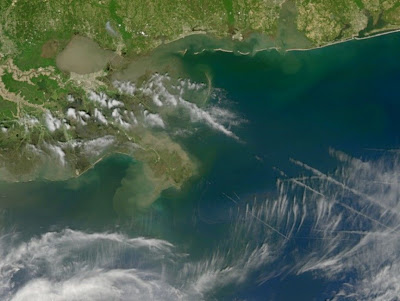
Above image: "In this image, the slick is partially covered by streaky clouds, but reddish streaks of oil can be seen in the close-up..." Click to enlarge image that was taken by the MODIS instrument on NASA’s Aqua satellite.
Source http://www.wired.com/wiredscience/2010/04/gulf_oil_spill-gallery/all/1
Yesterday's photo

A few days ago

--- end ---
RED FLAG: HALLIBUTON DEFENDANT IN LAWSUITS
Rig had history of spills, fires before big 1
By FRANK JORDANS and GARANCE BURKE
Associated Press
April 30, 2010
http://news.yahoo.com/s/ap/20100430/ap_on_bi_ge/us_gulf_oil_spill_the_rig
During its nine years at sea, the Deepwater Horizon oil rig operated by BP suffered a series of spills, fires — even a collision — because of equipment failure, human error and bad weather. It also drilled the world's deepest offshore well.
But Deepwater Horizon's lasting legacy will undoubtedly be the environmental damage it caused after it exploded and sank, killing 11 crew and releasing an estimated 210,000 gallons of oil a day into the Gulf of Mexico.
What likely destroyed the rig in a ball of fire last week was a failure -- or multiple failures -- 5,000 feet below. That's where drilling equipment met the sea bed in a complicated construction of pipes, concrete and valves that gave way in a manner that no one has yet been able to explain.
Oil services contractor Halliburton Inc. said in a statement Friday that workers had finished cementing the well's pipes 20 hours before the rig went up in flames. Halliburton is named as a defendant in most of the more than two dozen lawsuits filed by Gulf Coast people and businesses claiming the oil spill could ruin them financially. Without elaborating, one lawsuit filed by an injured technician on the rig claims that Halliburton improperly performed its job in cementing the well, "increasing the pressure at the well and contributing to the fire, explosion and resulting oil spill."
Remote-controlled blowout preventers designed to apply brute force to seal off a well should have kicked in. But they failed to activate after the explosion.
Scott Bickford, a lawyer for several Deepwater Horizon workers who survived the blast, said he believes a "burp" of natural gas rose to the rig floor and was sucked into machinery, leading to the explosion.
Halliburton's said "it is premature and irresponsible to speculate on any specific causal issues."
Before last week's catastrophe, Deepwater Horizon's most recent hiccup occurred in Nov. 2005, when the rig — under contract with BP — spilled 212 barrels of an oil-based lubricant due to equipment failure and human error. That spill was probably caused by not screwing the pipe tightly enough and not adequately sealing the well with cement, as well as a possible poor alignment of the rig, according to records maintained by the federal Minerals Management Service.
Following that spill, MMS inspectors recommended increasing the amount of cement used during this process and applying more torque when screwing in its pipes.
Experts say the number of safety incidents experienced by Deepwater Horizon isn't unusual for an industry operating in harsh conditions. And it is difficult to draw any connections between those problems and last week's deadly explosion, they say.
"These are big, floating cities," said Tyler Priest, a historian of offshore oil and gas exploration. "You're always going to have minor equipment failure and human error, and of course they're operating in a hurricane prone environment."
Because vessels like the Deepwater Horizon operate 24 hours a day, Coast Guard officials said minor equipment problems appear frequently. But if they go unfixed such incidents could mushroom into bigger concerns.
- In Feb. 2002, just months after the rig was launched from a South Korean shipyard, it spilled 267 barrels of oil into the Gulf after a hose failed, according to MMS records.
- In June 2003, the rig floated off course in high seas, resulting in the release of 944 barrels of oil. MMS blamed bad weather and poor judgment by the captain. A month later, equipment failure and high currents led to the loss of 74 barrels of oil.
- In January 2005, human error caused another accident. A crane operator forgot he was in the midst of refueling a crane, and 15 gallons of overflowing diesel fuel sparked a fire.
The rig was being used by BP during all of the above incidents.
The Coast Guard, which is supposed to ensure the vessels are seaworthy, keeps its own set of safety records on the Deepwater Horizon.
From 2000 to 2010, the Coast Guard issued six enforcement warnings and handed down one civil penalty and a notice of violation to Deepwater Horizon, agency records show.
On 18 different occasions during that period the Coast Guard cited the vessel for an "acknowledged pollution source." No further details about the type of pollution were immediately available.
The agency also conducted 16 investigations of incidents involving everything from fires to slip-and-fall accidents.
Steven Sutton, who oversees offshore drilling inspectors in the Coast Guard's New Orleans office, said the number of accidents and incidents reported on the Deepwater Horizon didn't strike him as unusual.
A collision with a towing vessel reported on June 26, 2003 could have created safety problems over the long term if the $95,000 damage to the rig's hull wasn't adequately repaired, Sutton said. The collision risked compromising the rig's watertight integrity or weakening the structure that supports the drilling operation, he said.
Guy Cantwell, a spokesman for the rig's owner Transocean Ltd., said Friday that the Swiss-based company planned to conduct its own investigation of what caused last week's explosion.
"Any prior incidents were investigated," he said. "Any speculation that they are related to the Deepwater Horizon incident is speculation."
Both Transocean and BP PLC cited comments made Monday by Lars Herbst, the regional director for the Minerals Management Service, who said the companies had a good history of compliance.
Last week's blowout was "an aberration in the history of the Gulf for the last 40 years" during which the industry has refined and automated much of the work on the estimated 3,500 rigs currently operating in the Gulf, said Priest, a professor and director of Global Studies at the Bauer College of Business at the University of Houston.
"The industry is going to learn a lot from this. That's what happens in these kinds of disaster," he said, citing the 1988 explosion of the Piper Alpha rig in the North Sea and the 1979 blowout of Mexico's IXTOC I in the eastern Gulf.
Britain overhauled its safety requirements after the North Sea incident, which killed 167 men, and companies have since spent billions upgrading emergency equipment and improving their operating procedures.
Norway, which has huge oil and gas reserves in the North Sea, requires rigs to have at least two independent systems to trigger the blowout preventer.
Deepwater Horizon was considered state-of-the-art when it was built in 2001 by Hyundai Heavy Industries, Cantwell said. It was designed to withstand 118-mile an hour winds and waves as high as 41 feet. Last year, it set a world record for the deepest oil and gas well when it drilled 35,055 feet into the Gulf of Mexico.
Cantwell said the $560 million semi-submersible model has been superseded by a new design capable of drilling 40,000 feet down in water as deep as 12,000 feet.
__
Jordans reported from Geneva, Burke from San Francisco. Associated Press Writers Mike Kunzelman in New Orleans and Chris Kahn in New York contributed to this report.
--- end ---
Gulf Oil Spill Fight Turns to Chemicals Team Hopes Oil Dispersants Will Limit Damage on LandMain Content
Ker Than
National Geographic News
Published April 30, 2010
http://news.nationalgeographic.com/news/2010/04/100430-energy-gulf-oil-spill-chemical-dispersants/

A dispersant plane passed over an oil skimmer in the Gulf of Mexico on Tuesday. Chemicals are a key tool in the fight against the spreading oil spill. Photograph by Patrick Semansky, AP
To combat the massive oil spill from BP’s wrecked drilling site, cleanup crews are dropping huge quantities of chemical dispersant into the Gulf of Mexico in an urgent effort to stop as much of the slick as possible from reaching land.
(See Related, “Oil Spill Hits Gulf Coast Habitats”)
This could well be the single largest deployment of dispersants against an oil spill in U.S. history, said Richard Gaudiosi, president of the Delaware Bay and River Cooperative in Linwood, Pennsylvania.
The joint federal-industry response team responsible for the cleanup effort reports that nearly 140,000 gallons (529,928 liters) of dispersants have been used so far, with an additional 51,000 gallons (193,056 liters) available. Responders also have been trying controlled burns and have deployed long lines of inflatable booms, but they have said the chemicals have proven the most effective method of attacking the spill so far.
"Even on the Exxon Valdez spill, dispersants weren't used all that readily," Gaudiosi said. The notorious 1989 tanker disaster, up until now the worst oil spill in U.S. history, dumped 11 million gallons (41.6 million liters) on the remote Prince William Sound in Alaska.
But the spill now spreading from the site of the April 20 explosion that destroyed the Deepwater Horizon oil rig, which could reach the size of the Valdez spill in 52 days at its current rate, threatens not only wildlife refuges, ecologically sensitive areas, and fisheries but also densely populated and developed waterfronts and resort areas.
(See Pictures: Gulf Oil Spill Hits Land—And Wildlife)
The oil slick touched land Thursday night in Louisiana and was expected to reach shore in Mississippi and Alabama this weekend and in Pensacola and the Florida panhandle by Monday.
Breaking oil into droplets
Oil dispersants have been available to combat spills since the mid-1980s. They are detergent-like chemicals that break up oil slicks on the surface of the water into smaller droplets, which can then be broken down by bacteria in the water and by other natural processes. Dispersants also help prevent the oil droplets from coalescing to form other slicks.
According to the U.S. National Research Council, oil spill dispersants do not actually reduce the total amount of oil entering the environment. Rather, they change the chemical and physical properties of the oil, making it more likely to mix into the water column than to contaminate the shoreline.
The NRC report says that evaluating the environmental trade-offs associated with
dispersant use is “one of the most difficult decisions that oil spill responders and natural resources managers face during a spill.” The reason is the increased oil exposure for fish, as well as for corals and creatures that live in the lowest level of the water, such as oysters, the report said.
"Dispersant only alters the destination of the toxic compounds in the oil," redirecting its impact from feathered and fur-bearing animals on shore to organisms in the water column itself and on the seafloor, Richard Charter, senior policy adviser for marine programs at the conservation group Defenders of Wildlife, said in an email.
"No good answers to a mess this big, only degrees of damage to various life-forms," Charter said.
(See Gulf Oil Spill Pictures: Aerial Views Show Leak's Size)
Dispersants are specially designed to have low toxicity to marine organisms, so any environmental impact they do have has more to do with the breakup of the oil into droplets than with the dispersants themselves, said Robin Rorick, director of marine and security at the American Petroleum Institute.
When the oil at the surface is treated with the chemicals, it initially disperses within the upper 30 feet (9 meters) of the water column, according to a briefing paper distributed by the Deepwater Horizon response team.
An underwater chemical experiment
The dispersants are being applied by aircraft over the Gulf of Mexico. Helicopters and ships also can be used, and the joint federal-industry response team, led by the U.S. Coast Guard, said yesterday it is planning also to apply dispersants underwater, directly to the source of the leak.
This technique is considered experimental and has never been attempted at a depth of 5,000 feet (1,524 meters). If BP and the Coast Guard go through with the plan, the undersea dispersants would probably be applied by robotic submarines, also known as remotely operated vehicles, or ROVs.
It would be yet another job for the submarines at a site that is far too deep, and where pressures are far too great, for human divers to venture.
(See "Rig Explosion Shows Risks in Key Oil Frontier.")
The subs also are monitoring the well site and have been deployed—unsuccessfully so far—to try to stop the leak. With BP saying it may take weeks or months to stop the flow, the need for more effective ways to disperse the oil and protect the shore has become urgent.
Rorick said undersea application probably is being considered because dispersants are most effective when they are applied to freshly leaked oil.
"If the oil is out there for a long period of time and it gets really mixed with the water ... the dispersants are less effective," he explained.
(Related blog: "Who's Still Spilling Oil in the Seas?")
April 28, 2010

Above image: "In this image, the slick is partially covered by streaky clouds, but reddish streaks of oil can be seen in the close-up..." Click to enlarge image that was taken by the MODIS instrument on NASA’s Aqua satellite.
Source http://www.wired.com/wiredscience/2010/04/gulf_oil_spill-gallery/all/1
Yesterday's photo

A few days ago
--- end ---
RED FLAG: HALLIBUTON DEFENDANT IN LAWSUITS
Rig had history of spills, fires before big 1
By FRANK JORDANS and GARANCE BURKE
Associated Press
April 30, 2010
http://news.yahoo.com/s/ap/20100430/ap_on_bi_ge/us_gulf_oil_spill_the_rig
During its nine years at sea, the Deepwater Horizon oil rig operated by BP suffered a series of spills, fires — even a collision — because of equipment failure, human error and bad weather. It also drilled the world's deepest offshore well.
But Deepwater Horizon's lasting legacy will undoubtedly be the environmental damage it caused after it exploded and sank, killing 11 crew and releasing an estimated 210,000 gallons of oil a day into the Gulf of Mexico.
What likely destroyed the rig in a ball of fire last week was a failure -- or multiple failures -- 5,000 feet below. That's where drilling equipment met the sea bed in a complicated construction of pipes, concrete and valves that gave way in a manner that no one has yet been able to explain.
Oil services contractor Halliburton Inc. said in a statement Friday that workers had finished cementing the well's pipes 20 hours before the rig went up in flames. Halliburton is named as a defendant in most of the more than two dozen lawsuits filed by Gulf Coast people and businesses claiming the oil spill could ruin them financially. Without elaborating, one lawsuit filed by an injured technician on the rig claims that Halliburton improperly performed its job in cementing the well, "increasing the pressure at the well and contributing to the fire, explosion and resulting oil spill."
Remote-controlled blowout preventers designed to apply brute force to seal off a well should have kicked in. But they failed to activate after the explosion.
Scott Bickford, a lawyer for several Deepwater Horizon workers who survived the blast, said he believes a "burp" of natural gas rose to the rig floor and was sucked into machinery, leading to the explosion.
Halliburton's said "it is premature and irresponsible to speculate on any specific causal issues."
Before last week's catastrophe, Deepwater Horizon's most recent hiccup occurred in Nov. 2005, when the rig — under contract with BP — spilled 212 barrels of an oil-based lubricant due to equipment failure and human error. That spill was probably caused by not screwing the pipe tightly enough and not adequately sealing the well with cement, as well as a possible poor alignment of the rig, according to records maintained by the federal Minerals Management Service.
Following that spill, MMS inspectors recommended increasing the amount of cement used during this process and applying more torque when screwing in its pipes.
Experts say the number of safety incidents experienced by Deepwater Horizon isn't unusual for an industry operating in harsh conditions. And it is difficult to draw any connections between those problems and last week's deadly explosion, they say.
"These are big, floating cities," said Tyler Priest, a historian of offshore oil and gas exploration. "You're always going to have minor equipment failure and human error, and of course they're operating in a hurricane prone environment."
Because vessels like the Deepwater Horizon operate 24 hours a day, Coast Guard officials said minor equipment problems appear frequently. But if they go unfixed such incidents could mushroom into bigger concerns.
- In Feb. 2002, just months after the rig was launched from a South Korean shipyard, it spilled 267 barrels of oil into the Gulf after a hose failed, according to MMS records.
- In June 2003, the rig floated off course in high seas, resulting in the release of 944 barrels of oil. MMS blamed bad weather and poor judgment by the captain. A month later, equipment failure and high currents led to the loss of 74 barrels of oil.
- In January 2005, human error caused another accident. A crane operator forgot he was in the midst of refueling a crane, and 15 gallons of overflowing diesel fuel sparked a fire.
The rig was being used by BP during all of the above incidents.
The Coast Guard, which is supposed to ensure the vessels are seaworthy, keeps its own set of safety records on the Deepwater Horizon.
From 2000 to 2010, the Coast Guard issued six enforcement warnings and handed down one civil penalty and a notice of violation to Deepwater Horizon, agency records show.
On 18 different occasions during that period the Coast Guard cited the vessel for an "acknowledged pollution source." No further details about the type of pollution were immediately available.
The agency also conducted 16 investigations of incidents involving everything from fires to slip-and-fall accidents.
Steven Sutton, who oversees offshore drilling inspectors in the Coast Guard's New Orleans office, said the number of accidents and incidents reported on the Deepwater Horizon didn't strike him as unusual.
A collision with a towing vessel reported on June 26, 2003 could have created safety problems over the long term if the $95,000 damage to the rig's hull wasn't adequately repaired, Sutton said. The collision risked compromising the rig's watertight integrity or weakening the structure that supports the drilling operation, he said.
Guy Cantwell, a spokesman for the rig's owner Transocean Ltd., said Friday that the Swiss-based company planned to conduct its own investigation of what caused last week's explosion.
"Any prior incidents were investigated," he said. "Any speculation that they are related to the Deepwater Horizon incident is speculation."
Both Transocean and BP PLC cited comments made Monday by Lars Herbst, the regional director for the Minerals Management Service, who said the companies had a good history of compliance.
Last week's blowout was "an aberration in the history of the Gulf for the last 40 years" during which the industry has refined and automated much of the work on the estimated 3,500 rigs currently operating in the Gulf, said Priest, a professor and director of Global Studies at the Bauer College of Business at the University of Houston.
"The industry is going to learn a lot from this. That's what happens in these kinds of disaster," he said, citing the 1988 explosion of the Piper Alpha rig in the North Sea and the 1979 blowout of Mexico's IXTOC I in the eastern Gulf.
Britain overhauled its safety requirements after the North Sea incident, which killed 167 men, and companies have since spent billions upgrading emergency equipment and improving their operating procedures.
Norway, which has huge oil and gas reserves in the North Sea, requires rigs to have at least two independent systems to trigger the blowout preventer.
Deepwater Horizon was considered state-of-the-art when it was built in 2001 by Hyundai Heavy Industries, Cantwell said. It was designed to withstand 118-mile an hour winds and waves as high as 41 feet. Last year, it set a world record for the deepest oil and gas well when it drilled 35,055 feet into the Gulf of Mexico.
Cantwell said the $560 million semi-submersible model has been superseded by a new design capable of drilling 40,000 feet down in water as deep as 12,000 feet.
__
Jordans reported from Geneva, Burke from San Francisco. Associated Press Writers Mike Kunzelman in New Orleans and Chris Kahn in New York contributed to this report.
--- end ---
Gulf Oil Spill Fight Turns to Chemicals Team Hopes Oil Dispersants Will Limit Damage on LandMain Content
Ker Than
National Geographic News
Published April 30, 2010
http://news.nationalgeographic.com/news/2010/04/100430-energy-gulf-oil-spill-chemical-dispersants/

A dispersant plane passed over an oil skimmer in the Gulf of Mexico on Tuesday. Chemicals are a key tool in the fight against the spreading oil spill. Photograph by Patrick Semansky, AP
To combat the massive oil spill from BP’s wrecked drilling site, cleanup crews are dropping huge quantities of chemical dispersant into the Gulf of Mexico in an urgent effort to stop as much of the slick as possible from reaching land.
(See Related, “Oil Spill Hits Gulf Coast Habitats”)
This could well be the single largest deployment of dispersants against an oil spill in U.S. history, said Richard Gaudiosi, president of the Delaware Bay and River Cooperative in Linwood, Pennsylvania.
The joint federal-industry response team responsible for the cleanup effort reports that nearly 140,000 gallons (529,928 liters) of dispersants have been used so far, with an additional 51,000 gallons (193,056 liters) available. Responders also have been trying controlled burns and have deployed long lines of inflatable booms, but they have said the chemicals have proven the most effective method of attacking the spill so far.
"Even on the Exxon Valdez spill, dispersants weren't used all that readily," Gaudiosi said. The notorious 1989 tanker disaster, up until now the worst oil spill in U.S. history, dumped 11 million gallons (41.6 million liters) on the remote Prince William Sound in Alaska.
But the spill now spreading from the site of the April 20 explosion that destroyed the Deepwater Horizon oil rig, which could reach the size of the Valdez spill in 52 days at its current rate, threatens not only wildlife refuges, ecologically sensitive areas, and fisheries but also densely populated and developed waterfronts and resort areas.
(See Pictures: Gulf Oil Spill Hits Land—And Wildlife)
The oil slick touched land Thursday night in Louisiana and was expected to reach shore in Mississippi and Alabama this weekend and in Pensacola and the Florida panhandle by Monday.
Breaking oil into droplets
Oil dispersants have been available to combat spills since the mid-1980s. They are detergent-like chemicals that break up oil slicks on the surface of the water into smaller droplets, which can then be broken down by bacteria in the water and by other natural processes. Dispersants also help prevent the oil droplets from coalescing to form other slicks.
According to the U.S. National Research Council, oil spill dispersants do not actually reduce the total amount of oil entering the environment. Rather, they change the chemical and physical properties of the oil, making it more likely to mix into the water column than to contaminate the shoreline.
The NRC report says that evaluating the environmental trade-offs associated with
dispersant use is “one of the most difficult decisions that oil spill responders and natural resources managers face during a spill.” The reason is the increased oil exposure for fish, as well as for corals and creatures that live in the lowest level of the water, such as oysters, the report said.
"Dispersant only alters the destination of the toxic compounds in the oil," redirecting its impact from feathered and fur-bearing animals on shore to organisms in the water column itself and on the seafloor, Richard Charter, senior policy adviser for marine programs at the conservation group Defenders of Wildlife, said in an email.
"No good answers to a mess this big, only degrees of damage to various life-forms," Charter said.
(See Gulf Oil Spill Pictures: Aerial Views Show Leak's Size)
Dispersants are specially designed to have low toxicity to marine organisms, so any environmental impact they do have has more to do with the breakup of the oil into droplets than with the dispersants themselves, said Robin Rorick, director of marine and security at the American Petroleum Institute.
When the oil at the surface is treated with the chemicals, it initially disperses within the upper 30 feet (9 meters) of the water column, according to a briefing paper distributed by the Deepwater Horizon response team.
An underwater chemical experiment
The dispersants are being applied by aircraft over the Gulf of Mexico. Helicopters and ships also can be used, and the joint federal-industry response team, led by the U.S. Coast Guard, said yesterday it is planning also to apply dispersants underwater, directly to the source of the leak.
This technique is considered experimental and has never been attempted at a depth of 5,000 feet (1,524 meters). If BP and the Coast Guard go through with the plan, the undersea dispersants would probably be applied by robotic submarines, also known as remotely operated vehicles, or ROVs.
It would be yet another job for the submarines at a site that is far too deep, and where pressures are far too great, for human divers to venture.
(See "Rig Explosion Shows Risks in Key Oil Frontier.")
The subs also are monitoring the well site and have been deployed—unsuccessfully so far—to try to stop the leak. With BP saying it may take weeks or months to stop the flow, the need for more effective ways to disperse the oil and protect the shore has become urgent.
Rorick said undersea application probably is being considered because dispersants are most effective when they are applied to freshly leaked oil.
"If the oil is out there for a long period of time and it gets really mixed with the water ... the dispersants are less effective," he explained.
(Related blog: "Who's Still Spilling Oil in the Seas?")
Giuseppi Logan new composition unnamed & gigs coming up by Suzannah B. Troy
http://www.youtube.com/watch?v=xXsoWEnYCEw
Support Giuseppi Logan's comeback!!!!!
See my YouTube series. This is number 22 in my YouTube documentary on Giuseppi Logan.
Subscribe to:
Posts (Atom)


